(BlackDoctor.org) — Two things we all have in common: we’re all human and we
all need sleep. However, depending on our ethnicity, certain bedtime routines
and our overall sleep health can vary significantly. For the first time, the
National Sleep Foundation (NSF) polled Asians, African Americans, Hispanics, and
Whites for its 2010 Sleep in America survey to uncover the similarities and
differences among the four ethnic groups’ attitudes, habits, and problems
related to sleep.
Over the years, researchers have conducted a few smaller studies that
suggested key differences in sleep differences among different ethnic groups.
“But we thought it would be important to learn more about whether these
differences really exist,” says Sonia Ancoli-Israel, PhD, professor of
psychiatry at the University of California at San Diego (UCSD) School of
Medicine and chair of the study.
How Well Does America Sleep?
All Americans spend about a third of their lives in bed. But the NSF study
uncovered significant differences among the four ethnic groups surveyed.
Blacks reported having the busiest bedtime routines of all the groups. In the
hour before going to bed, almost three-fourths of this group either watch TV
(75%) and/or pray or perform another religious practice (71%). By comparison,
only half of Asians polled (52%) report watching TV, and only 18% of Asians, 32%
of Whites, and 45% of Hispanics report praying in the hour before bed. Asians,
however, are twice as likely (51%) to be found online or on the computer every
night or almost every night in the hour before bed than the other ethnic groups
(20%-22%).
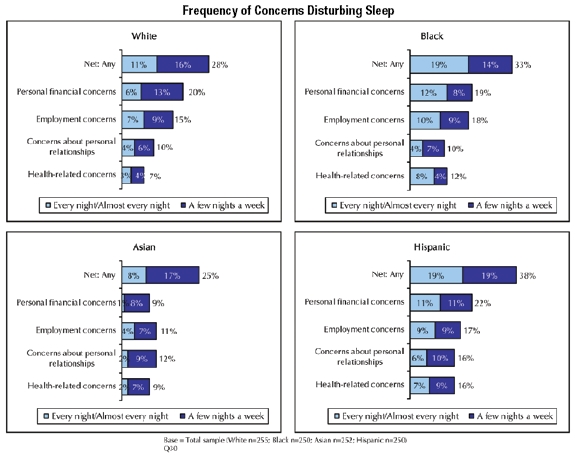
Once in bed, falling or staying asleep can be a struggle as the economy and
personal concerns keep Americans of all ethnic groups lying awake. Overall, at
least one-third of Hispanics (38%) and Blacks (33%) report that financial,
employment, personal relationship, and/or health concerns disturb their sleep at
least a few nights a week. By comparison, about one-fourth of Whites (28%) and
Asians (25%) find themselves kept awake by those same concerns.
What Are The
Effects of This Lack of Sleep?
Although all this activity and worry cut into everyone’s sleep, the poll
found that one group is getting significantly less sleep than all the others.
Whether on weekdays/workdays or weekends/non-workdays, Blacks spend more time in
bed without sleeping than the other ethnic groups—54 minutes on
weekdays/workdays and 71 minutes on non-workdays/weekends.
Additionally, the poll found that, of all the groups, Blacks are getting the
least amount of sleep on workdays/weekdays (6 hours and 14 minutes)—34 minutes
less sleep on a work night/weeknight than Asians and 38 minutes less than
Whites. Disturbingly, Blacks also reported that they only needed 7 hours and 5
minutes of sleep each night to perform at their best during the day,
significantly less sleep than the 7 hours and 29 minutes both Asians and
Hispanics said they needed
Overall, when comparing the hours of sleep each group says it needs to the
hours of sleep it is actually getting on workdays or weekdays, roughly one-third
reported not getting enough sleep.
“We know from different polls that the NSF has done, and from different
studies, that in general people are sleeping less than they should. And often
they realize that it affects them,” says Ancoli-Israel. “The fact that
Blacks/African Americans sleep less, but feel that’s enough, to me that’s the
most surprising finding.”
This lack of sleep is impacting the four ethnic groups similarly. All the
respondents reported disturbingly similar experiences missing work or family
functions because they were too sleepy (19%-24%). And among married people or
couples living together, one in five respondents reported that their intimate or
sexual relationship was affected because they were too sleepy (17%-23%). More
than one-half of those surveyed among each ethnic group agreed that lack of
sufficient sleep can impact or affect their job performance; their relationships
with family or friends; and their ability to carry out household duties, to care
for their family, and to do everyday activities.
So, how many hours of sleep should everyone be getting? According to Jose
Loredo, MD, MS, MPH, FCCP, professor of medicine and medical director at UCSD’s
Sleep Medicine Center, Americans should be getting between 7 and 8 hours of
sleep per night every night, otherwise they risk their health. “Sleep duration
is turning out to be a very strong and important health risk factor, and it
appears that we need just the right amount of sleep to maintain health,” says
Loredo. And although respondents may not be getting those precious 7 to 8 hours
every night, three-fourths agree with Loredo and health care professionals that
poor sleep is associated with health problems (76%-83%).
“If you sleep less than 6 [hours] on a chronic basis or more than 9 [hours]
on a chronic basis, that factor is associated with having worse health, whether
it’s cancer, heart disease, obesity, [or] psychiatric disorders,” says Loredo.
He adds that Blacks/African Americans’ total sleep time and attitudes regarding
sleep may be associated with the increased prevalence of sleep apnea,
hypertension, and diabetes in that population.


By subscribing, you consent to receive emails from BlackDoctor.com. You may unsubscribe at any time. Privacy Policy & Terms of Service.