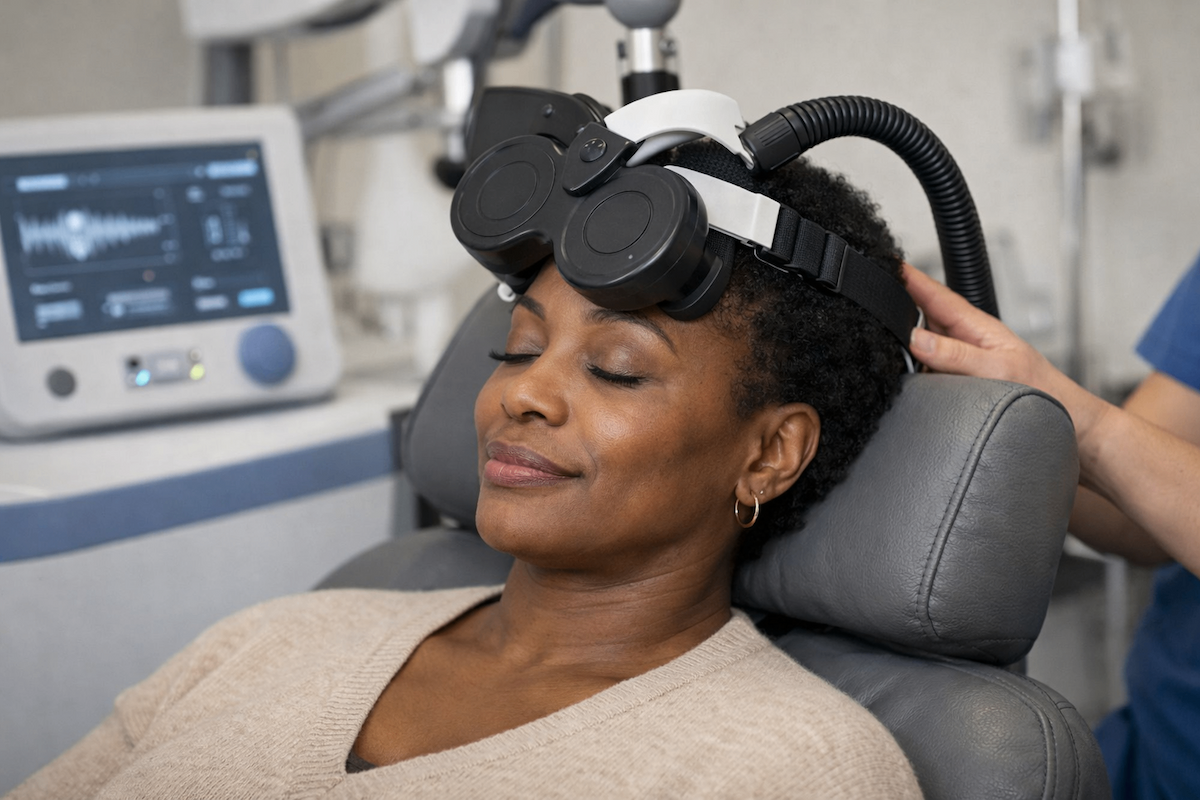
New research shows that crash courses of transcranial magnetic stimulation (TMS) can effectively ease symptoms of depression. Depression affects more than 8 percent of U.S. adults. While the mental health condition typically responds well to a combination of psychotherapy and antidepressants, some people may require more intensive treatment—especially if their symptoms are treatment-resistant.
Treatment-resistant depression (TRD) disproportionately affects Black people. They often experience more severe, chronic episodes, which are sometimes underdiagnosed or misdiagnosed. Access to high-quality, effective mental healthcare is also limited by systemic barriers and higher socioeconomic stress.
TMS is a non-invasive treatment that can help patients who haven’t responded well to first-line treatments. Advances in TMS could help Black patients with depression find more effective treatments to manage their symptoms.
A brain stimulation therapy for depression can show results in as little as a workweek, a new study says.
Transcranial magnetic stimulation (TMS) typically requires daily clinic visits over six to eight weeks, a rather rigorous schedule for people grappling with depression.
But patients can see benefits in as little as five days if they undergo five sessions per day, researchers will report in the June issue of the Journal of Affective Disorders.
This “five-by-five” treatment eased depression scores on par with conventional TMS among a small group of patients, researchers found.
“For patients with treatment-resistant depression, getting to the clinic every weekday for at least six weeks can be a real obstacle,” said lead researcher Michael Apostol, a doctoral student at the UCLA Semel Institute for Neuroscience and Human Behavior.
“What this study suggests is that we may be able to offer those same patients a path to meaningful relief in less than one week by condensing 25 TMS treatments over just five days,” he said in a news release.
TMS applies magnetic pulses to stimulate specific areas of the brain through electrodes placed on a patient’s scalp.
Large studies have shown that TMS can significantly reduce depression symptoms in 60 percent to 70 percent of patients, with 25 percent to 35 percent becoming completely symptom-free, researchers said in background notes.
In fact, most insurance plans cover TMS treatment for depression, researchers said.
To see if TMS could be applied more efficiently, researchers had 40 patients receive an accelerated protocol of five sessions per day for five days in a row. Each session took nine to 15 minutes.
Their progress was compared to another group of 135 patients who received conventional TMS therapy of one session a day, five days a week, for six weeks.
All of the patients suffered from depression that had not been eased using antidepressant medications.
Both groups showed meaningful reductions in depression symptoms, with no statistically significant difference in outcomes, researchers said.
Interestingly, half of the five-by-five patients did not show an immediate improvement in their depression, but showed a 36 percent decrease in symptoms after two to four weeks.
“All patients in this study had not benefited from multiple trials of antidepressant medication, yet they obtained great benefit from five-by-five treatment,” senior researcher Dr. Andrew Leuchter, director of the TMS Service at UCLA, said in a news release.
“Some patients need to wait a few days or weeks to see benefit, and we encourage them not to give up too quickly if they don’t feel better right away,” Leuchter said. “We are finding that the benefits of five-by-five can be even greater” if additional days of treatment occur after two weeks.
However, researchers noted that this was not a formal clinical trial and that larger trials will be needed to confirm their findings.
TMS is an FDA-approved, non-invasive procedure that uses magnetic pulses to stimulate nerve cells in the brain and treat symptoms of depression. It doesn’t require sedation or surgery.
A provider places a small coil on your head that sends magnetic pulses, creating tiny electrical signals in nerve cells, into your brain. These signals can activate underactive areas of the brain or calm overactive areas that are contributing to the worsening of depressive symptoms.
There are four types of TMS:
Transcranial magnetic stimulation may help anyone who hasn’t found relief from therapy or medication. Providers screen patients to ensure TMS is safe and will discuss any potential risks.
TMS is generally not recommended for people who:
Side effects are usually mild and temporary, and may include:

While treatments like TMS are proven to be effective for severe forms of depression, not everyone can access them.
Common barriers include:
For some patients, accelerated TMS may make treatment more feasible and reduce these barriers.
Accelerated transcranial magnetic stimulation treatments may offer a faster path to relief for people with treatment-resistant depression. While larger studies are needed, the study findings suggest that compressing treatments into a single week could make the therapy more convenient and accessible for some patients.


By subscribing, you consent to receive emails from BlackDoctor.com. You may unsubscribe at any time. Privacy Policy & Terms of Service.