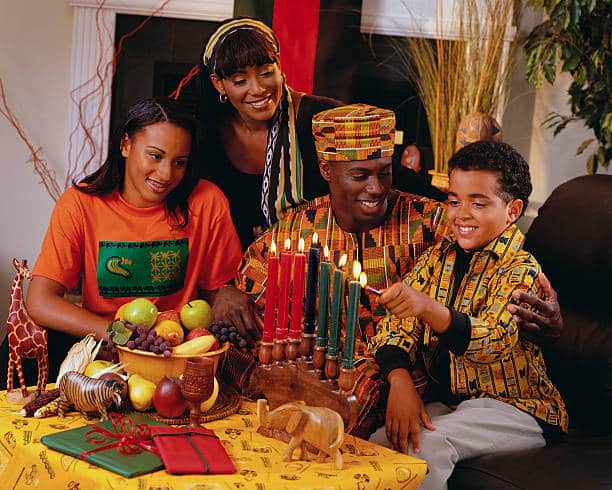
Kwanzaa, a traditional African holiday, has gained prominence in public life over the past ten years. Newspapers often cover local Kwanzaa celebrations, and television stations include Kwanzaa in their holiday greetings alongside Christmas and Hanukkah.
Kwanzaa means “first fruits” in Swahili, Africa’s most commonly spoken language. According to this description, Kwanzaa is a harvest holiday in part. It is, however, mostly a celebration of African culture.
Some people believe that Kwanzaa was created to replace Christmas. The festivity, however, has nothing to do with Christmas. Its goal is to foster African-American solidarity and awareness of cultural traditions.
The celebration is based on Yoruba, Ibo, Ashanti, Zulu, and other African tribes’ customs.
From December 26 to January 1. The celebration lasts seven days and focuses on a different concept each day: togetherness, self-determination, collaborative labor, cooperative economy, purpose, creativity, and faith.
Supporters of Kwanzaa argue that the celebration is cultural rather than religious and compatible with any faith, including Christianity.
The festival is portrayed as a time of adoration for the Creator and his creation. Kwanzaa is supposed to offer “a global message for all people of goodwill”—language similar to what the angels told the shepherds (see Luke 2:10; KJV).
Kwanzaa encourages seven virtues, or core life principles—one for each of the festival’s seven days. These qualities are based on ancient African life philosophies. They are unity (Umoja), self-determination (Kujichagulia), cooperative economy (Ujamaa), purpose (Nia), creativity (Kuumba), and faith (Imani).
These qualities, except for self-determination, recall essential characteristics of biblical Christianity. The Bible emphasizes the value of teamwork, responsibility, purpose, creativity, and faith. It is, therefore, not unexpected that Kwanzaa and Christianity intersect in some places.
RELATED: 10 Kwanzaa Food Traditions & Why They Are Good For The Body & Soul
Whereas Kwanzaa teaches us about ideas, Christmas teaches us about a person—the incarnate Son of God.
Every year on December 25, people gather to exchange gifts, sing carols, and eat turkey or ham for supper. Christmas preparations include tree decoration, secret Santa, and cookie making.
According to a recent poll, Christmas is now celebrated by more than 90% of Americans, despite its origins as a Christian festival. This includes more than 80% of Americans who do not identify as Christian.
Today, Christmas is a popular and commercial holiday, with Christmas-specific shopping starting as early as Thanksgiving each year.
However, Christmas wasn’t always about pine trees or Rudolph the Red-Nosed Reindeer, and it still isn’t entirely because 62% of Americans attend a religious service on Christmas Eve or Christmas Day.
The Christmas plot begins with the Holy Bible.
An angel appeared to a young Mary and informed her that she had been selected to be Jesus’ mother. She married Joseph, who was first perplexed and worried by Mary’s pregnancy; he, too, was visited by an angel (in a dream) who told him that all would be OK.
RELATED: Kwanzaa: What It Really Is And How & Why It’s Celebrated
Christmas is, therefore, a celebration of the birth of Jesus, who was born in a manger in Bethlehem to the Virgin Mary. Shepherds came to see him, as did wise men carrying gifts of gold, frankincense, and myrrh. He was cared for by Mary and Joseph.
Jesus, who God sent to cleanse humanity of their sins and grant them entry into paradise, died on a crucifixion and was raised (at which point Christians celebrate Easter).
In contrast, Kwanzaa begins on December 26th and concludes on January 1st.
Unlike Christmas and Hanukkah, Kwanzaa is a cultural celebration rather than a religious one.
Established formally in 1966 by Maulana Karenga, Kwanzaa in the United States was first affiliated with the Black Power movement.
The festival promotes African heritage celebrations, reunions of family and friends, and contemplation on seven African principles (called the Seven Principles, or the Nguza Saba). Seven candles symbolize the Seven Principles in a kinara or candelabra.
The kinara is filled with three red candles on the left side (representing the people’s battle for self-determination, cooperative economy, and innovation), a black candle in the center (representing the people’s unity), and three green candles on the right side (to represent the future, or collective work and responsibility, purpose, and faith).
Each of the seven days of Kwanzaa is devoted to one of the principles, and one of the candles is lit each day, beginning with the black candle and proceeding from left to right.
On the last day of Kwanzaa, people are urged to think about who they are, who they aspire to be, and what it means to be African.
Enjoy the vacation from school or work, whichever holiday you choose to celebrate this year. Take some time to complete your applications, read a book for leisure, and eat as much home-cooked food as you can. Happy holidays!


By subscribing, you consent to receive emails from BlackDoctor.com. You may unsubscribe at any time. Privacy Policy & Terms of Service.