Edwards Lifesciences


There are several kinds of clinical trials so doing your research beforehand will come in handy. Some clinical trials need healthy volunteers while other clinical trials seek volunteers needing treatment.
Essentially, whether or not a clinical trial is right for you will be based on the following protocol:
What types of volunteers may enter the study
The schedules of tests and procedures, study medications and dosages
Length of the study
Number of study visits
In some cases, if you don’t fit the above protocol, you may not qualify for the clinical trial.
After you qualify for a clinical trial, you will be asked to agree to the above protocol. This process is called informed consent. How Are You Protected if You Participate? Given past scenarios such as the Tuskegee Experiment, this is a valid question for many Blacks. You may be wondering if you will fall victim to the same treatment if you participate. What happens if similar problems arise? Who is making sure that participants are safe? These are some other questions that may be running through your mind.
The good news is, that there are several guidelines to protect you and prevent this from happening. Federal guidelines and codes of ethics are in place to protect clinical research volunteers from harm. In addition, an Institutional Review Board – a panel of professionals and community members – is responsible for monitoring study safety and protecting volunteer rights in every clinical trial.
Before you officially participate in a clinical trial, it is important to weigh the benefits and risks.
Benefits
Risks
If you want to further weigh the risks and benefits of a clinical trial you are interested in, these questions may help:
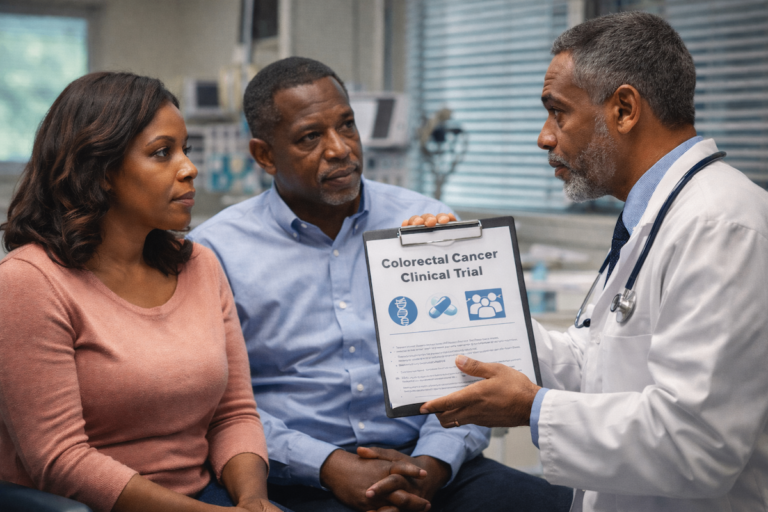
A clinical trial (also called clinical research) is a research study in human volunteers to answer specific health questions. Clinical trials are the fastest and safest way to find treatments that work and ways to improve health. Interventional trials determine whether experimental treatments or new ways of using known therapies are safe and effective under controlled environments. Observational trials address health issues in large groups of people or populations in natural settings.
Participating in a clinical trial allows you to play a more active role in your health care, gain access to new research treatments before they become widely available and contribute to medical research.
Before joining a clinical trial, you must qualify for the study. All clinical trials use an inclusion/exclusion criteria, which helps produce reliable results. These criteria are based on your age, gender, the type and age of your disease, your previous treatment history and other medical conditions. These criteria aren't used to exclude anyone. They are used to make sure a clinical trial is appropriate for you and keep you safe. The criteria also help ensure that researchers are able to answer the questions they plan to study. Some research studies are looking for participants with illnesses or conditions, while others require healthy participants.
Informed consent is the best way to get the key facts and information you need about the clinical trial before you decide whether or not to participate. This process will continue to be used throughout the study to provide you with important information. To help you decide, the doctors and nurses that are involved in the trial will explain the details of the study. If your native language isn't English, you can request translation assistance. Next, the research team will provide you with an informed consent document that includes details about the study, such as its purpose, duration, required procedures, and key contacts. This is also where you can learn more about the potential risks and benefits of the clinical trial. After reading over the informed consent document, you will then decide whether or not to sign the document. This is not a contract, you can still withdraw from the trial at any time.
Benefits:
Risks:
It is required that experimental treatments are evaluated for both immediate and long-term side effects. These side effects include headache, nausea, hair loss, skin irritation, or other physical problems. Experimental treatments must be evaluated for both immediate and long-term side effects.
The ethical and legal codes that govern medical practice also apply to clinical trials. In addition, most clinical research is federally regulated with built-in safeguards to protect the participants. Clinical trials are done under a carefully controlled protocol, which is a study plan that details what researchers will do in the study. These researchers will report the results of the trial at scientific meetings, to medical journals, and to various government agencies as the clinical trial progresses. The names of individual participants will remain secret and will not be mentioned in these reports.
Before participating in a clinical trial, it is important that you know as much information as you can. The following questions may be helpful to discuss with your health care team:
As you prepare to meet with the research coordinator or doctor, it will help to do the following:
Every clinical trial in the U.S. must be approved and monitored by an Institutional Review Board (IRB) to make sure the risks are as low as possible and are worth any potential benefits. An IRB is an independent committee of physicians, statisticians, community advocates, and others that ensures that a clinical trial is ethical and the rights of study participants are protected. All institutions that conduct or support biomedical research involving people must, by federal regulation, have an IRB that initially approves and periodically reviews the research.
Yes. It is within your right to leave a clinical trial, at any time. When withdrawing from the trial, you should let the research team know about it, and the reasons why you are leaving the study.
Ideas for clinical trials usually come from researchers. After testing new therapies or procedures in the laboratory and in animal studies, researchers choose the treatments with the most promising laboratory results to be moved into clinical trials. During a trial, researchers are able to gain more information about a new treatment, its risks and how well it may or may not work.
Clinical trials are sponsored or funded by a variety of organizations or individuals such as physicians, medical institutions, foundations, voluntary groups, and pharmaceutical companies, in addition to federal agencies such as the National Institutes of Health (NIH), the Department of Defense (DOD), and the Department of Veteran's Affairs (VA). These trials can also take place in a variety of locations, such as hospitals, universities, doctors' offices, or community clinics.
A protocol is a study plan that is carefully designed to safeguard the health of the participants as well as answer specific research questions. A protocol describes what types of people may participate in the trial; the schedule of tests, procedures, medications, and dosages; and the length of the study. While in a clinical trial, participants following a protocol are seen regularly by the research staff who will monitor their health and determine the safety and effectiveness of their treatment.
A placebo is an inactive pill, liquid, or powder that has no treatment value. These are often used in clinical trials to be compared with experimental treatments and assess the treatment's effectiveness. In some studies, the participants in the control group will receive a placebo instead of an active drug or treatment.
A control is the standard by which experimental observations are evaluated. In many clinical trials, one group of patients will be given an experimental drug or treatment, while the control group is given either a standard treatment for the illness or a placebo.
Clinical trials are conducted in phases. Each phase of a clinical trial has a different purpose and helps scientists answer different questions:
Most human use of investigational new drugs takes place in controlled clinical trials conducted to assess safety and efficacy of new drugs. Data from the trials can serve as the basis for the drug marketing application. In some cases, you may not qualify for these carefully-controlled trials because of other health problems, age, or other factors. However, if you may benefit from the drug use but don't qualify for the trials, you may qualify for a treatment IND (Investigational New Drug application) or treatment protocol.
The primary intent of a treatment IND/protocol is to provide people with a life-threatening or serious disease for which there is no good alternative treatment access to the new drug. A treatment IND/protocol is also used to generate additional information about the drug, especially its safety. Expanded access protocols are managed by the manufacturer, with the investigational treatment administered by researchers or doctors in office-based practice and can only be done if clinical investigators are actively studying the new treatment in well-controlled studies, or all studies have been completed. There must also be evidence that the drug may be an effective treatment in patients who will be treated under the protocol and the drug cannot expose patients to unreasonable risks given the severity of the disease to be treated.