Play Video
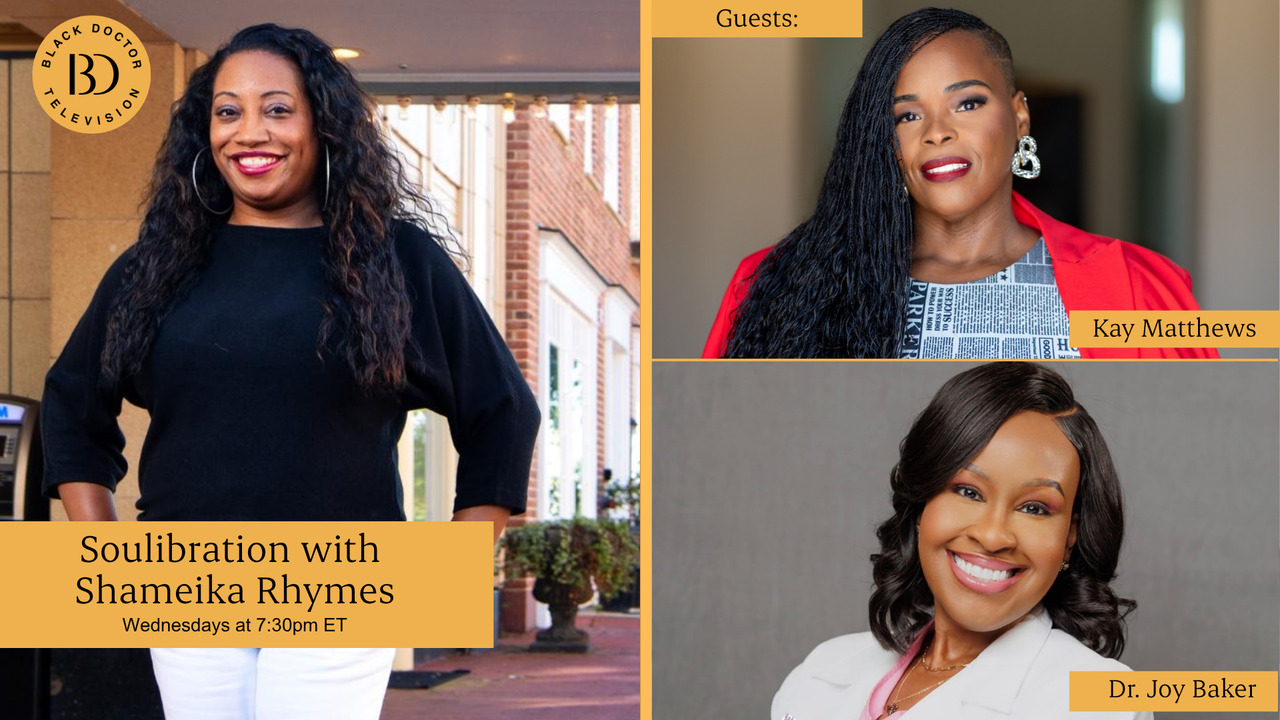
Black Maternal Health: The Reality of Postpartum and Mental Health
Shemeika Rhymes hosts Dr. Joi Baker and Kay Matthews for a deep dive into Black maternal mental health, postpartum depression, and the power of lived experience.




Good evening. I'm your host, Shemeika Rhymes, and welcome to Soulbration here on Black Doctor. Before we get started, let me know where you are watching from and how you're doing this evening, and don't forget to share this with your network because you never know who may need to hear it. And as always, if you have any questions tonight, drop it in the chat. I'm trying to pay attention tonight to Facebook. I know I've been neglecting y'all. But if you have any questions, drop it in the chat because you guys are the co-host. So I am super excited tonight because we're talking about what it really means to break up with the foods that no longer serve you.
Just like you're gonna break up with that girl or that man, same thing. Dr. Denise Ferrell, she's a doctor of educational psychology, she is joining us tonight to unpack why it's just not all about willpower. You know, we're gonna talk about everything from emotional eating to learned habits and everyday triggers, you know, 'cause our relationship with food runs deeper than we think. Let me know in the chat if there are any foods that you feel like you need to break up with, because I don't know about y'all, I had to break up with some foods and it And I still need to break up with some, and it's hurting my feelings.
So let's see. Let me see who is checking in before we bring Dr. Denise out. Let's see here. Let's see. Asheville, Charlotte, I see you. I see you. Welcome, welcome, welcome. Good to see you guys. All right, I'm gonna bring Dr.
Denise on so we can get started. Hi, Dr. Denise. Hello, everybody. Good to see you. Great to see you as well, and thank you for having me on tonight. Absolutely. Absolutely. Okay, let me just double-check these comments because yeah. I don't want people to feel neglected like they did before. let's see. Okay, here we go. All right, so now doing 50 things at once. So Dr. Denise, let's talk about this. When we say it's time to break up with the foods that don't love you back, what does that actually look like in real life? Because in my head, I'm supposed to go through my kitchen and throw out all the things that shouldn't be there.
Right. Right. Yeah, and that's what some people do. And then of course, if it was just about food, we wouldn't have to keep going through that same loop and those habits, right? Yeah. So let me dial it back just a little bit to help it make sense to those, the, to your listeners, right? I've been in the health game for quite some time, and when it comes to helping people with their health problems or their, you know, dieting, if they wanna call it that, it can definitely be a challenge because of so much misinformation out there. And then of course, there are foods that we know we need to break up with, and then they're like, "Well, I don't wanna talk to them and I don't wanna see that because they're gonna take my coffee away," as we were talking before- Mm-hmm or my Mexican food and all these kind of things.
So I like to look for things to help it make sense, you know, just kinda keep things basic because, And what I've come up with is the parallels between the relationship with food and how it's very similar to the relationship with humans, right?
Mm-hmm. So when we first meet somebody, everything looks great. Like, you know, they're tall or they got the right height, you know. they've got the right size, you know, big, small, whatever that, your choice is, the way they talk. The money. Don't forget the money. The money. Yes. All these things that are blinging is like, "Come to me, come to me," and you're like, "Where have you been all of my life?" Right? a lot of things in common, places that you like to go, all those kind of things. And then you're around each other a little bit more, and then the human side starts to come out.
Mm-hmm. And you're kinda like, "Well, they're not as great as I thought," you know? And then you get, become comfortable. you may not be dressing up as much. you may be, you know, the things that you s- you used to conceal before, like the hair and the makeup or even the gas- Mm-hmm whether it comes from here or there. You just kinda get, you know, you just get relaxed with people. So you end up showing that you're human. And it's very similar to Little Debbie or Miss Fields- or Sarah Lee or Wendy or Marie Callender. All these women. Let's think of women who are- Famous Amys.
Famous Amys. Shout out to Famous Amys. Exactly, right? So, you know, we just, we just get We just get comfortable with these things. So when it comes to relationship with food, things can just look so great because it's in this nice little wrapper and it's looking all juicy or chocolatey or whatever, again, whatever your flavor is.
But- we tend to ignore the warning signs because they've just been in our lives for a really long time, right? Wow. Yeah. they've always been consistent when other people weren't. they don't respond back with a negative attitude. They don't, have their own needs. So whenever we just, like, don't wanna think about anybody else, you just want the focus to be on you, it's just like, "All right, this is just what I'm gonna do. I'm just gonna have this cake and eat it too." So when it comes to the red flags of foods, we ignore them because the backlash is just not there immediately, right?
So- That's true that's why I often hear or The, what I often hear a lot of times is like, "Okay, I just woke up with all these pounds and I don't know how I got there," right? Even if it's You know, I've had clients that come to me who was like, "I don't remember how I gained all this weight." Mm-hmm. So to fast-forward back to your question and what it looks like breaking up with food- is that, we know what we need to, that is not good for us. Yeah. But we go back because it's familiar. We go back because it's been comforting. Mm-hmm. And it's just, you know, no one else is around, and you get that late night text.
It's like, "Oh, well, nobody else is around, so why not?" You know? and then, you know, to wrap that kinda up, it's like it's also addictive as well. Tell me. that person could be addictive because you've been in a relationship with them for so long. That food is also chemically addictive, and that's why they put sugar in everything, because that's what keeps us going back.
And it's nutritionally, deficient, but And we keep on taking one more bite, just one more bite, because it's not to fill us up. That's not what it's created for. So that's why it's really, really hard to stop. I swear every song I could think of has popped up in my head in the past couple minutes about, like, you know I can't think, I can't I'm gonna mess the lyrics up, so I'm not even gonna try. But if you guys know any type of songs that would go with this, what we're talking about, drop it in the chat. I'm curious. And y'all are lying if you're saying there's no foods that you need to break up with, 'cause I don't see any of you telling us the truth here, so Yes.
We all do. Yes. And I, I hope no one looks at me like I'm perfect. Listen, I've, I'm a human as well, so- Yeah. So was there a moment in your own life where you realized your relationship with food needed to change? Oh my goodness. There were multiple moments that I just kept sweeping under the rug and was like, "No, it can't be this little piece of chocolate here or this little hamburger and whatnot," because my mother, who loves me dearly, fed me these foods. So surely that can't be the issue. Until it was just smacking me in the face that it was the issue. So, yeah. some of my, you know, listeners, they know, my fibroid story.
And, I found out that I had two fibroids, both the size of tennis balls, and I just couldn't figure out why I was excessively bleeding. And, I was just like, "Well," I'm talking to a few other friends and whatnot, and they have the same story.
So I'm like, "Oh, okay. I guess this is the way it's supposed to be. That's just normal." And I'm like, no, I had to learn and l- and understand that just because it's common does not mean it's normal. So my cycles started at, you know, seven days, like most people, then it went to 14, then three weeks, and then 14 You know, four weeks. And at one point, it just didn't stop. And I was like, "Okay, this definitely, I need to get this checked out. Like, what's happening?" Yeah. So fast-forward later on, I figured out that's what it was. And then I traced it back to foods, and I was like, "No, there's no way.
There's absolutely no way that it's, it's foods that's causing this issue." And once I really just saw the science in black and white, I still couldn't stop eating it. So that's when I was like, "Okay, what's going on with me? Why am I like this?" And that's what inspired me to go back to school and, and understand the psychology of eating, so. So what foods 'Cause I, I mean, people here, on here are used to me talking about, I had fibroids as well. I think this last time was, I had 20 plus. And, it was insane, because I had cravings. I can remember standing in the middle of the grocery store crying because my friend, Miss Debbie, was out of stock.
And I was so upset. Like- Yes what do you mean? Call the other stores. Right. Absolutely. Yes, ma'am. It will, it will I mean, it's, it's a true addiction. I mean, you can look at the research, and sugar is now more addictive than cocaine.
And so growing up, we already knew how dangerous that drug was, you know? And so now that we have this substance that they put in literally almost everything- Mm-hmm on purpose, it's to keep us coming back. So it's totally understandable when you have your cravings the way that you do, because that's what they want to do. Yeah. Oh, I see, Lynette McCallum says she needs to break up with fast food. Ooh. Tough. Yeah. That- That's hard multi-layered. You know, it's, the reason why we pick certain foods these days is because of the time and the convenience and, of course, the taste as well, and a couple other things.
But once I started breaking up my relationship with certain foods- Mm-hmm I started just really truly paying attention. They wanna keep us distracted with the TVs or the scrolling and that kinda thing, so you're really not paying attention to what you're eating. Mm-hmm. But once you take those things away and really chew and think about what you're eating, you're gonna wake up and be like, "This ain't even that good anymore." And that's how I was able to break up with Little Debbie, 'cause I was like, "This thing tastes like a, a big bunch of lard." Like, it's just not the It's not hitting the same like it did when I was a kid, so something's up.
I don't know. I don't know, Dr. Denise. Well, I, I take it back. Once I got my fibroids removed, then I was like, "You're right." It, it did not taste like it used to, and I have not eaten one since, so. Yeah. Well, kudos to you.
Good job. Yes. Good job. But that's not to say I don't eat other stuff I should break up with. Yeah. But why do you think What I mean, I think you kind of explained it, but why we keep going back to these foods, like things that contain sugar, things like fast food or, salty things that we know are gonna drive up our other, like cholesterol or blood pressure or, you know, maybe push us into, depending on what's going on with, insulin and all the things.... diabetes, pre-diabetes, all of that. Why do we keep still ignoring like, "Leave this alone so you can be healthy," but we keep going back?
I guess it's the same thing like you were saying, it's like a relationship you can't let go of. Absolutely. Yeah, 'cause it's, it's just not about the food. And then again, if it was, we would've stopped a long time ago. Mm-hmm. So what's really happening is that it's a mix of brain chemistry, emotional wiring, and also habit loops mixed in with our identity as well. So the same reasons that we go back to relationships that we said we were done with is the same thing with food. So outside of the chemical addiction, it's the moment or in the moment that we feel like we want something, whether it's crunchy, salty, sweet, whatever, our brain doesn't just say, "Hey, is this gonna be good for us?" Like, it's not wired, it's not created to, you know, do things that are healthy for us.
It does It's wired in a way that is familiar. Mm-hmm. Again, going back to that whole familiar and comfortability.
Mm-hmm. it doesn't stop us in our tracks and be like, "Well, you know what, you know, Grandma said," and all that kind of stuff. No. Mm-hmm. It's saying like, "What's gonna make me feel better right now?" And that's why instant gratification and things of that nature is so dangerous, you know? Yeah. So the sugar, the fat, the processed foods, all of those things, deliver a quick dopamine hit. Mm-hmm. So our brains are like, "Hey, we like this. Let's do it again." Right? Ooh, okay. So it's not a weakness. It's just, again, a lot of things going on at once. I see in the chat, Shelley says, "I need to quit sugar.
It just ain't working for me anymore now in my 50s." And she's probably mad I read it just like she wrote it . Nice. And, let's see. Lorita Lee, welcome from Michigan. She's tuning in. She says, "Sugar and carbs. I'm an emotional eater." Well, let's talk about that. I'm, I'm gonna jump ahead to one of my questions about that, but how much of our eating is driven by emotions versus just the habit? 'Cause, you know, I, I, I don't know that I'm an emotional eater, but I know it's a habit. Like, if I'm gonna be sitting here watching TV, then I'm gonna need something salty with a little bit of sweet after .
See, you just said it. You just said it. So it's like, it's so many things going on, but food marketing just kinds of, plays on our emotions as well, right? Mm-hmm. have you ever seen a commercial and you were like, "What was that even advertising? I don't even know what that was." You know?
You might see kids playing in the park, and they're just jumping and screaming and, you know, they're just happy. And then the commercial goes off. Mm-hmm. But you may not have noticed that logo that came in at the end and was like, boom. Right? Yeah. So that's a strategic marketing trade where they just make you feel good, and they take you high and then boom, you don't even realize that you just saw the branding that just happened in, in the background. So, with the emotions, I mean, think, you can think about some of the brand names that are out there. Southern Comfort, you know?
Mm-hmm. there's so many that I can't even think of right now. I'm kinda drawing a blank. But it's, it's so much of the, the wiring that's happening. 90% of the commercials that we see are about food. We make over 200 decisions about food every single day because of those food marketing- Yeah tricks that are being played. It's just so much going on. So that's why I just try to tell people, "Don't be so hard on yourself." Mm-hmm. Because it's a psychological warfare that's, you know, being played on us. And honestly, when I'm first seeing a client and helping them with their rewiring, I don't even talk about food the first couple of weeks.
I actually help them with what's going on around in their lives. Because of the stress that's going on, that actually influences our food choices. Okay. So when we're stressed out, we want something crunchy and salty. Mm-hmm. But yeah. Go ahead. Ooh. And it's also, it brought up a memory cause, you know And I don't know.
Y'all let me know in the chat if you, if you remember this. You know, as growing up as a kid, you see all the commercials of the new cereal coming out. So I, I had to have all the new cereals. It doesn't matter, just had to have it, 'cause why not? But I mean And then as you get older, you're like, "Oh, I guess now I need to be eating like Raisin Bran or something , something bran with lots of fiber." But - Yeah. Yeah but, but I do wonder how, when you say, like, you know, stress or whatever could be going on- Mm-hmm how does that, how do you scale that down to calm that food noise?
Like, what, what do you tell your clients to, to balance that out? Because, yeah, like, you know, if I'm in a rush- Mm-hmm you know, sometimes it's like, okay, I don't have time to sit down and eat. Let me just grab what's right here, bag of chips, bag of whatever. Run out the door. Right. Right. Because I'm stressed and I gotta get to where I gotta get . Right. Yes. So lots going on. So yeah. That's actually the number one reason why part of my program, outside of the methodology and the strategic rewiring that I'm doing- Mm-hmm I also have a certified life coach who is talking to you about everything else that's going on in your life.
So that's part of my step-by-step program. But, one of the first things that I teach is actually, in I got it from Kabbalah wisdom, and it says, you know, just take a pause and then say out loud, "What a pleasure." And you're kinda like, "What? Pause? What a pleasure?" Like, "No, this is stressing me out.
How is this pleasurable?" Mm-hmm. Or if you wanna think about it in a way that is, okay, if you say you want more, you're asking the creator that you wanna be stretched.You want more money, you want more love, you want more whatever that it is. You're asking to be equipped to handle more. Mm-hmm. And so when the creator gives you a challenge, what is your response gonna be? Is it gonna be the same thing? Grab this, grab that. And then you're showing that you're not really ready to handle what you're asking for. So in, in pausing and saying, "What a pleasure," it's like, "Okay, thank you for this opportunity for me to be able to grow." And when you're growing, that's actually uncomfortable, right?
It's not really It's What's comfortable is sitting on the couch, grabbing your chips, popcorn, whatever that it is. That's comfortable until it becomes so uncomfortable, you're like, "No, I, I don't wanna do this anymore." Right? so that's the first step. Pause, what a pleasure, and literally say it out loud. And then you want to do some type of meditation. Now, I know some people are like, "Ugh, I've heard that before. That's not what we do." And I've, I've waved that off myself for many, many, many years. Mm-hmm. And I really think one of the biggest issues is that we feel like it's not necessarily for us is because a lot of the meditators don't look like us.
So I've gone through literally hundreds of meditations, and I just couldn't connect with a lot of them just because the voice behind it was like, who is this corny dude?
Like, I, I just can't. And so, I actually started recording my own. So I did the research behind, like, what is proper to say, what's appropriate at this time, and what should be heard and, you know, with the mind and everything. So I started recording my own, and I give that as part of my program. And then, the third one is, I actually have some videos on my YouTube about this, which is alkalizing breaths. And this is also, again, when I was told about it 10 years ago, I was like, "That's silly." But what you're doing, you're actually literally cooling off your nervous system.
So when we're stressed- Mm-hmm our brain is, like, so heated. It's, it's on fire, and we're, again, just trying to reach for something to relieve us immediately. But when you stop and you take in deep alkalizing breaths through your nose, you hold your breath for three seconds, and then you exhale through your mouth for six to eight seconds, that calms your whole entire body. And then some people, they're able to be like, "What was I about to Was I about to eat? I don't even want that anymore." Oh. And so that works for some people. But you have to keep practicing it. Mm-hmm.
It's not gonna just magically happen one time. You have to do those intentional breaths over and over and over again because the Michael Jordans of the world, they had coaches. They went to practice. Even though they were in the NBA, they still went to practice. Mm-hmm. So we have to do the same thing and do intentional practice with these breaths as well.
So. Wow, 'cause, when you said that, I was like, "Oh, that a- actually sets it up perfectly," 'cause next week we're talking, on celebration, we're talking about breathwork. So y'all wanna make sure you come back for that 'cause we're gonna actually do a demonstration on breathwork. because I've seen- I'll be here. Yeah. So I've seen so many people talking about it, so I'm like, he- and this is Stress Awareness Month, so we gonna get into it. We gonna break up with this food as well, y'all. Shelly had a question. She says, "I feel like foods, especially processed ones, taste so different now versus how good they tasted back in the day.
So should we be cutting out all processed foods?" Short answer, yes. But is that possible? for most people, no. it's less than 1% of people that can, you know, hear something, believe it, and then just cut it out cold turkey. you know, I believe that it's better to get all the things that we know that are good for us and then worry about taking away the bad later on. So once you fill your body up with more of the, the actual nutrients, the minerals, the vitamins that the body is truly, truly asking for, then that cuts out less space for the processed things. So just start there.
Okay. Well, how does trauma show up in the way that we eat or the way that our bodies hold on to weight? 'Cause I've seen, I've see- feel like I've read a lot of articles or seen a lot of videos where it's talking about, you know, sometimes the, the weight that you may put on.
Yes, o- great, yes, hormones and all the things like that, but it could also be related to a trauma. Definitely. Oh, that's a great question. trauma teaches the body find relief fast. So as we talked about earlier, the brain is not gonna stop you and say, "Hey, is this good for us?" So food becomes comfort when you're overwhelmed. Food becomes a distraction when you don't wanna feel any kind of pain. Food also becomes a reward when life just kind of feels unfair, right? Mm-hmm. So again, it's not a lack of discipline. It's not you need to get more willpower and motivation, all these kind of things.
Your nervous system is really asking for help and regulation. So those alkalizing breaths is what helps with that regulation. And when you practice it I have a, I have an alert that goes off on my phone three to f- or five times a day to do those alkalizing breaths, and I just stop whatever I'm doing. Because trauma and stress, that equals a higher demand in the body. Mm-hmm. And so your body is like, again, "Relieve me right now." So that's why we reach towards sugar and salty things and chocolatey things, all those kind of things because we've just been conditioned from way back to whomever raised us.
It's like, "Oh, you scraped your knee? Here's some cookies." You know? Mm-hmm. "Oh, you went through a breakup?" What do we always see in TV shows when a woman wants to get through a breakup? Ice cream. And I'm like, "Wait, you got cookies when you scraped your knee?" Yeah. I didn't.
Where are my cookies? It's like, oh, suck it up and just, you know, you'll be all right, right? Mm-hmm. Just so But yeah. It's, I mean, it's a combination of things that we've been conditioned to see and feel, and all those kind of things. So you said the number one word, ice cream. She's just got the whole tub in her lap, and she's just going at it while she's crying. "Oh my God, I can't believe he da, da, da." Yeah. You know what I mean? So that, that dopamine hit with the conditioning, this is what we're supposed to do. All those things going on at once is just, like, yeah, this is what we're reaching for every single time until we're taught different.
Yeah. So how do we find out Maybe it's a trauma that needs to be uncovered, 'cause it could be something, let's say, that you, you just kinda buried. It's a memory that maybe happened during your childhood or, you know, one of those things you just shoved to the back of your mind. Like, I don't wanna think about it, I'm just gonna keep pushing on and keep moving on. How do you uncover specifically maybe what that trauma is so that you can get your eating habits on track? Or, is that something that you deal with? Yeah. I don't specifically. That's why I have- Yeah like my partner, which is the, the therapist and whatnot.
Mm-hmm. But, we just go through so many different things in life. Everybody's dynamic is totally different. again, that's why I'm glad to have her, 'cause she is She's just dope. She really, really gets it. She understands.
She's my therapist as well. So, if you have a therapist that doesn't see a therapist, you might wanna keep searching. I don't know. But But yeah. But psychology 101 is all about think, feel, behave. Think, feel, behave. So whatever your thoughts are, you're gonna feel it. And then whatever you feel, you're gonna actually act out on that. Mm-hmm. And so that's why the meditation is so important. Because if you're doing the right ones, you're able to kinda remove yourself from your actual body and just kinda have, like, an out-of-body experience, but a positive one. And then focus on the things that Whatever your goals are in life.
Like, if you have goals that, of, you know, bettering your life, that's what you wanna focus on. So focus more on the good than the bad. Same thing as food. You know, bring in more of the good foods than worrying about taking away the bads. And so most people, they go through life just thinking about the negative stuff all the time. Then what are you gonna attract? More negativity. So we wanna just get your mindset into a space of where it's gonna be more beneficial than not. But yeah. Mm-hmm. So how would you I mean, I know meditation helps and breathwork helps, but the reframing your, your thoughts and, and trying to say, "Okay, my pleasure," or trying to just What am I trying to say here?
Yeah, just really trying to reframe your thoughts. Mm-hmm. How can you start doing that? Say you, you get frustrated with, all the things. You get frustrated with whether it's meditation, because you just don't You feel like you don't have enough time even though you can do it in one a couple minutes.
But you're like, "I don't have time." You get irritated with breathwork 'cause people are coming at you from all directions. Yeah. Like, what else can you do to reframe your thoughts? honestly, with all the research that I've done, it just keeps coming back to this. Okay. So the same way that we put, work on our schedule or kids on our schedule, you have to put this on your schedule because you don't have time not to do it. You know what I mean? Mm-hmm. And so we keep searching for things that are going to, you know, supposedly help us. And that end- that ends up not working because it actually does more damage.
Just kinda what popped in my mind was, when they come out with research saying, "Well, a glass of wine is good for you." Who probably sponsored that research? Like, let's just be honest. No. Sorry to be the bad bear. No. But yeah. Don't take away all of our good things. Are they good, though? Are they really, really good? You're right. Reframe. But Yeah. Yes. But, no. Okay. So you reminded me of, of a client that, you know, today's Wednesday, right? So it's wine o'clock. And so that was her mindset as well. She just did not think that she could break away from her wine.
And so I asked ab- her about her setup and her environment. And so she was like, "Well, what do you mean?" I was like, "Okay. Describe to me what your home setup looks like." And she's like, "Oh, yeah. I've got this cute little cellar, and I've got these, my wine glasses on the, on the counter, and I got my wine just chilling," da, da, da, da.
And I was like, "Okay. So let's kinda dial back a little bit. Let's get the wine glasses off of the counter." Because soon as you walk in, that, you're telling yourself it's wine o'clock, you know? Mm-hmm. So you may not think about it all the time as much if you put the wine glasses behind the cupboard. So that's why I don't believe in throwing everything away. Mm-hmm. Because I've had clients that told me, it's like, "I went digging in the trash for some food that I threw away." So that- No it's just not gonna help, right? Yeah. But we just wanna get it out our line of sight so we can think about it less and less and less.
And so it got to a point to where she was like, you know, she only thought about it maybe once a week, and then once a month. And then she just stopped drinking altogether. And as someone that is like, "Well, I don't want to, but I like it, it's so good," that's, that's a, a thought that you wanna really truly think about, because everybody knows that it's a toxic chemical that we're putting in our body. Everybody knows that how dangerous it could be. Mm-hmm. That's why you gotta be a certain age to drink it. You know what I mean? Right. And all these kinds of stuff that you really wanna truly think about, you know, how beneficial is it for you?
Mm-hmm. I remember I was teaching an undergrad class at, a university, and I was talking to my students.And, we were talking about beer, and all of them, they were like, "Oh my God, beer is the best thing." And I was like, "Okay.
Do you remember your very first sip?" And they were like, "Yeah, yeah." And I was like, "How did it really taste?" And it was like, "Oh, it was terrible. It was terrible." And I was like, "Stop right there." So you kept drinking something that you know is a toxic in your body, and you're saying that What do they call it? It's a acquired, acquired taste or something like that. Oh, yeah. Yeah. Yeah. So I'm like, "You know it's not good for you, but you gotta keep drinking it in order to like it." So again, that tells you right there that's a lot of emotional rewiring that we need to do to really see food and drinks for what it truly is.
So yeah. Wow. there was something Oh, when you were just talking about the wine, and moving the glasses out of sight, I was just sitting here thinking, like, there's been times I will buy something at the store and I'm like so excited. I'm gonna eat this, I'm gonna eat this, and then I put it up- Yeah and I never see it again. Yeah. Y- wait, do you mean in a way that you forgot it was there? Or you saying- Yeah, I forgot about it until I go back to go clean out the pantry and I'm like- Oh "I forgot I bought this." Exactly, right? Yeah. By then it's expired, so. That's, that's a win.
And you know what? When you do stuff like that, you gotta celebrate that win because, again, the brain just loves dopamine hits. And so when you do something that's a better choice for you- Mm-hmm please celebrate. Don't wait until you get to this magical number on the scale and you're like, "Oh, yay." No.
Do it multiple times a day, you know? Yeah. Let's talk about the scale, because I think that is one thing that people tend to get locked in on, and it can ruin their day if, you know, if they see it go up or it stays the same. How do we reframe our mind around the scale? That is a great question. well, one, I wanna let people know, if they didn't know, that fat weighs less than muscle. Muscle weighs more than fat, okay? So you could be doing all the right things, and if you're in the gym or you're doing calisthenics, just working with your body, you're gaining more muscle, but the scale stays the same.
That's because you're increasing muscle, potentially- Mm-hmm and you're losing the inches. So in the beginning of my program, I have people actually do their measurements around, particular parts of the body so they can see that it's not about the number on the scale, it's more about the health and everything else, you know? in addition to that is let's look at why we want to reach a goal where the scale is lower. Mm-hmm. You know, is it more for, you know, true health reasons, or is it more for vanity?
And if n- nine times out of 10, it's more for vanity reasons, so let's scale back and let's go to my therapist and say, "Okay, what is it that you're looking to achieve with a slimmer body or things of that nature?" Because usually it's for someone else that we're trying to attract and all these other things that are outside of us that is, you know, usually nine times out of 10 is not going to keep you feeling good and healthy in the mind for a long term if it's something else, you know?
So. Mm-hmm. Well, or it's those pesky BMI scales that, or the BMI scale that doctors are like, "Hey, this is where you should be," but I think, and I believe there's an article on blackdoctor.com talking about that, because, of course, our bodies are built differently. Exactly. Absolutely. I'm so glad that you're aware of that. Most people aren't. 'Cause we gotta, we gotta pay attention to the research that's done, and most of the time, the research and the outcome of those numbers, they weren't done on us or for us. So a lot of times we just gotta forget s- a lot of those things.
So yeah. Yeah. Yeah. let's see. In the chat, guys, if you have questions, we got, like, about 10, 11 more minutes, so if you have any questions, make sure you drop them there. so I wanna talk about one of the things, we I mentioned it earlier, but are certain phases of life, say, like, your, you know, midlife, where you're experiencing hormonal shifts, where people are struggling more with weight changes. You know, this is, this is happening to both men and women. You know, we're seeing that extra belly fat. We're seeing the scale go up with, you know, depending on if you do work out, but if, if you don't, then you're seeing the scale go up.
and it's just like nothing Sometimes it feels like nothing you do is enough. Like, whether it is cutting out foods and whether it is adjusting or switching to a whole new, like, what is, what are they telling people now? Mediterranean diet. Whatever it is. So what how do you, how do you handle that?
Like, if you have a client come in and they say, "I'm menopausal," or, "I've these, I got this hormone issue," or if for a man, I think it's called andropause, when they're dealing with hormonal things or midlife crisis and all the things. So what do you tell them? another great question. and, and kinda loaded a little bit, but one of the first things that I wanna do, I just wanna, you know, again, have them pause and just kinda calm down and just kind of, you know, get a better understanding from them what is it that they're looking to achieve. What is it that they are, you know, disgusted with or, you know, do not like, et cetera.
but understand that every single day our bodies are going to go through changes. Like, that's what human life is about.Same thing as, you know, if they have a child or a teenager, they go through hormonal stages at 12, 13, 14. Same thing as when we get older, 40 plus. And even actually the way that they are You know, what's going on today with our foods and everything, 20-year-olds are going through heart attacks and all kinds of- Yeah changes, hormonal changes, and things of that nature that we hadn't seen 50 years ago. Mm-hmm. But, but yeah. So just, let's just normalize that that should happen.
Like, we are changing every single day. Now, with the things that aren't, you know, quote, unquote, "supposed to happen," I'll be 50 this year, and I am excited to say that I'm not going through the typical, menopausal things that, you know, women are going through at our, at our age.
Mm-hmm. And, again, n- 80 to 90% of it is because of the food. So it's kinda like that story that we've heard where there are two people in the water, and one man was, like, dunking the other guy under the water, and it's like, "How bad do you want that breath?" It's kinda like, all right, how bad do you not wanna go through these hormonal changes anymore, you know? Yeah. And then let's see if we can figure out some substitutes so you don't have to feel like you're missing out or anything else. There are substitutes for everything that can still make you feel included and all that kinda stuff.
So but yeah, let's just normalize that we're changing every single day, you know? That's just what we're supposed to do. So you're one of the chosen ones that's having to deal with- menopausal symptoms. Got it. It was not always like this, I'm telling you. It was not. It was not. But yeah, I mean, it's really some easy changes that I can figure out and see what is causing a person to do this, and one of them- is a food sensitivity test. Okay. I've, I've tried out a few of them. I'm trying out one right now, so I don't wanna really say what that is. But one that I offer my clients as a food sensitivity test is just takes 7 to 10 h- strands of your hair, and it doesn't have to come from your head, 'cause you know, yeah.
But, it just, it does a testing on your whole entire gut and then tells you what your f- what your gut does or does not like. And when I initially took the test, my gut did not like grapes, it did not like watermelon.
Ooh. And I was like, "What?" Like, no. So again, please don't look at me like I am perfect. I am far from it. Mm-hmm. So I just had to do some things to repair the gut and just make my body love those foods again. Because, you know, it was just certain things that was in it that would make me bloat easily and all that kind of stuff. So yeah. Oh, okay. So, so let me I've, I've always been curious about this. So once you repair the gut you can go back and eat those foods that you were sensitive to? Yeah. So there's hope for me to be able to go back to gluten and dairy? You really want me to answer this one?
I, I mean, I mean, I know it I mean, I've gotten used to it now, but Well, hold onto that feeling. Hold onto that. And we, no need to go any further. But no, but for anybody else that's listening, personally and really professionally, you know, by research, we're all lactose intolerant. Like, our bodies just was not created to be able to handle those things. Some people are more sensitive than others, but still, regardless, and we're not s- we, we, we're just not meant to digest those things. And shout-out to Dr. Milton Mills for putting me up on this research, and I've done the research over and over and over again, and I'm like, "He's right." Mm-hmm.
We're actually not supposed to have those things. And, for anybody else that's listening that's like, "Oh my gosh, that's just crazy. She must be vegan and da, da, da, da, da," well, if you look at Think about the commercials. Do you remember the old-school commercial that we had when we were kids, talking about milk and dairy?
What was the, the most famous one that you remember? Oh. Milk does Oh, milk does a body good. That one? Yes. Yes. That one, right? So if you look it up and you'll find that they had to change that tagline because other researchers came in and other Well, people were complaining. It's like, "Why are my bones getting more brittle and I'm having all these pains, da, da, da, da?" Then they started doing the research behind it, and there was zero evidence, zero evidence that milk does do a body good. So they had to change that and say, "Got milk? Good for you." You know what I mean?
Yeah. So you see the psychology that was being played abou- around it to not have people be afraid of drinking it, but still stay compliant as well at the same time. So- Gotcha zero evidence that we need the milk from another species. We should have our own, you know? See, so we have a couple questions in this chat. Paris Haywood, hello, wants to know, "How do you control your THS levels?" I don't know what that is. Do you? thyroid, I believe. Okay. Maybe. Maybe. I think. Wait, THS. I think it's thyroid. But anyway, so I'm not a medical doctor. I just wanna say that. Mm-hmm.
I am PhD, so I do all the research. But, it depends on if they have hyper or hypo. So with hyper is just too much going on in the system. Hypo is too low. So it depends on that as well. But most people usually have, hyp- hyper, and their body is, is deficient in some minerals. And I still am a sea moss fan, but only if you get the right sea moss.
You gotta make sure that you know your diver, make sure you know who your seller is, because there are some people out there that are just growing it- out of kiddie pools and things of that nature. But, talk to your doctor about that. Do your blood work because not everybody should take sea moss because of the iodine levels that are in it, so. Mm-hmm. I don't wanna fully answer that question 'cause I'm not sure what's going on. Okay. Let's see. And Shelly wants to know Shelly. Shelly's my co-host on my podcast, Ladies Edition. Nice. But Shelly wants to know, "Why is it that my Caucasian friends can eat certain things or have different food tolerances, but most of my African American friends, we tolerate things differently?" I say that, that's a good thing, right?
And I would say congratulations. We are different, and that should be a good thing. Let's celebrate that, right? But yeah, we're, we're just made different, just like, you know, a fetus shouldn't have certain things that an adult should. You know what I mean? but I don't know why we're made differently, but I'm celebrating our differences, you know? But yeah. Okay. so they're t- they're talking about the sea moss that you were talking about, at the kiddie pools and things. Paris Haywood said, "What Is there a brand that you recommend of sea moss?" not a brand because I'm seeing it more in stores.
Mm-hmm. And if you see the sea moss already created, like in a gel form, and it's in a big brand store or any kinda store, look at the expiration date, 'cause I'm gonna give you some red flags to look for.
More than likely, it's gonna go past the actual fresh date of, anything that you would make at home. Mm-hmm. So it a- actually, once you make it into a gel, it should only last three to four weeks tops. But when I see them in stores, they're lasting six, seven, eight, nine months, and I'm like, "Okay, so what else is in there to make it last that long?" They're putting preservatives in there to make it last that long. They're putting these fruits and all these other dyes to make it really colorful and bright, and that's obviously something that you wanna stay away from.
So I personally recommend that you buy it raw. That way you can look at the strand and see and compare it to the fake kind. and then once you put it in water, it shouldn't expand and blow up like a lot of sea moss that I've seen happen. but yeah, but I, I, I stopped offering it. I still have some, but we're gonna stop 'cause I just don't have time to ship it out. Mm-hmm. But I wanna give a shout-out to Dr. Crush Foster. You can trust him. and also Tyrica Nelson, T-Y-R-I-C-A. And you can find both of them online on Instagram. But they get it directly from an actual diver that goes in the waters of Honduras or Jamaica and things of that nature.
So yeah. Okay. Mm-hmm. Well, how long does it take for people to start noticing a real shift when they change their relationship with food? Once they start pausing and, and doing the steps we talked about earlier, how, how do they know that their relationship has changed, and how long does it take?
So I'm gonna give you a couple of different answers. Okay. with my program, it's 13 weeks step by step. But what I've noticed that people that are in the program, they are, like, excited within the first month. within, like, you know, usually around the average of anywhere from four to eight weeks is where they're like, "Oh my gosh, this is like something I've never experienced before." So it just depends on, again, your dynamic and what's going on all around you. Okay. But, yeah, it's, it's just, it's just very different. It's not a diet. If you look at the first three letters of tho- that word, that's not what we're doing here.
I don't count calories. I don't do any kind of restrictions, anything of that nature. The first thing that you wanna pay attention to is just the awareness of it all. Why are you reaching for the foods that you're reaching for? Because again, it's usually not about food itself. And so I actually would love to give your listeners, the first two weeks of my program free, if you would like to- Oh, that would- offer that to them that would be so nice. Yeah. how can they Let's see if I can, Yeah, well, let's, you, we're, we're at the end anyway, so go ahead and tell them how they can get it.
All right. Well, let's see. the, the f- the access to it is on my skool, which is S-K-O-O-L. And they can, the name of my program is called Fed Up, and like I said, it's a 13-week step-by-step breakup with bad foods. And so they can find me there, or they can go to my website, drdenisethinks.com.
And, actually no, it's better to send me an email. So Dr. Denise, D-R, D-E-N-I-S-E, @drdenisethinks.com, and I can send you the link from there. So yeah. Okay, I'm writing it in the chat. Okay. No problem. No problem. Yes. Dr. Denise @drdenisethinks.com. Yes. Got it. Okay. Mm-hmm. let's see. Did anybody I think we got to all the questions. I saw a question, then it disappeared, but it was a question about eating for your blood type, but I don't know where the question disappeared to. They might have deleted it. But do you have thoughts on that? I haven't done a lot of research behind that at all, to be honest with you.
But, so yeah, I'll stay away from that question, but it, it may be something that's, that's to it. Okay. But I just don't have the research for it. Yeah. Well, Dr. Denise, this has been an amazing conversation, but I, I wrap up my show with this one last question: What feeds your soul? Ooh.That's a great question. I don't wanna go with the obvious, 'cause the first thing pops up is fruits and veggies. I know it sounds like a parent answer. But I am so passionate about food, because you are looking at a person that was raised in the Deep South, that was loving chitlins and pig feet and all of that good stuff.
Well, not so good stuff now. But, you know. what else feeds my soul? Just my people. My people. Seeing my people get healthier. Mm-hmm. Like, that really does make me feel good, when I'm seeing people that are just doing better than they were the day before.
So, absolutely. Well, that's a great answer, but I can't believe you were eating chitlins. You see how we have our own addictions, so. Right. Yeah. It's Yeah. I just I was like, "Okay, I can get rid of all these other co- stuff, God, but not my chitlins." But now I wanna throw up just thinking about it, so. Yeah. Rewiring is real. It can happen for you, I'm telling you. Yeah. Well, the You guys have the email in the chat. I put it in there for you guys. Dr. Denise, thank you so much for coming on Soulbration. It has been an absolute pleasure. Oh, thank you again for the invitation.
Thank you. So guys, next week on Soulbration, like I mentioned earlier, April is Stress Awareness Month, and if you've been feeling a little overwhelmed, you might wanna tune in. We're getting into breathwork and learning how to use your breath to actually calm down your mind and body. And Dr. Denise, you know, explained a little bit about it earlier. So, join me here next Wednesday at 7:30, and I hope you all have a soul-filled rest of the week. Thank you again, Dr. Denise. Thank you. Y'all have an amazing rest of your evening. Good night, y'all. Good night.

By subscribing, you consent to receive emails from BlackDoctor.com. You may unsubscribe at any time. Privacy Policy & Terms of Service.