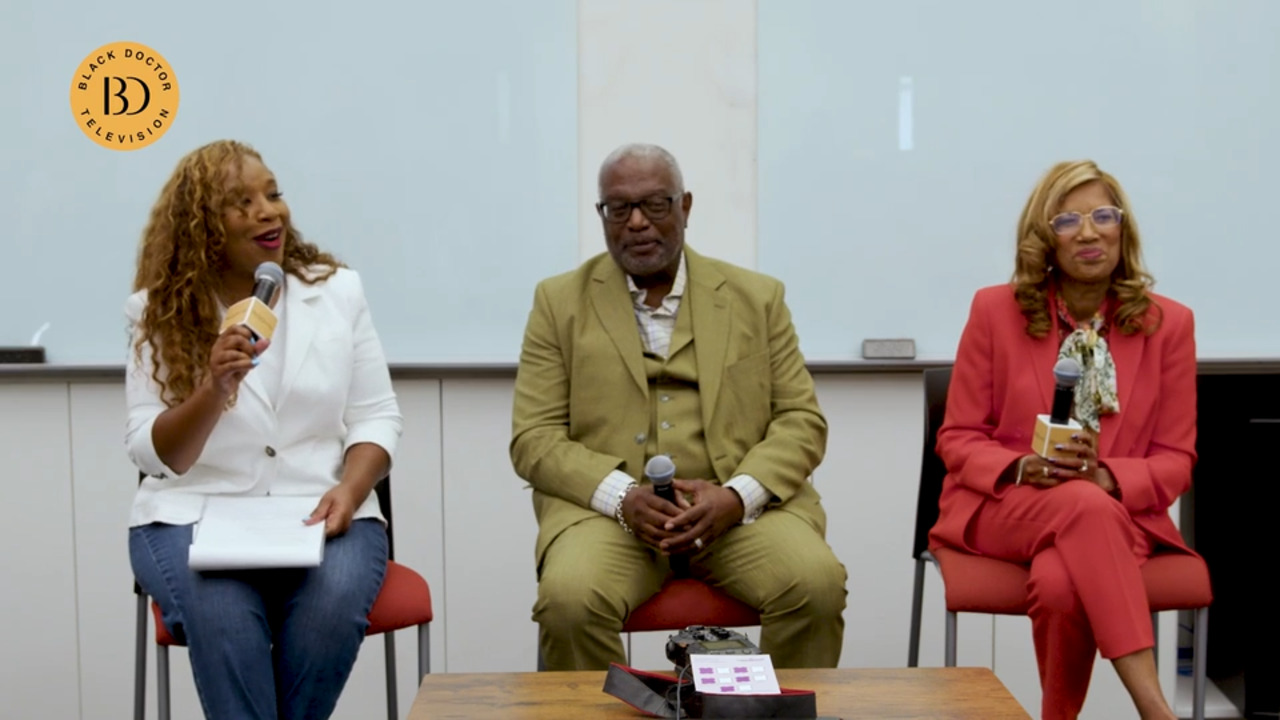
Happy Wednesday evening, y'all. I'm your host, Shemeika Rhymes, and welcome to Soulbration, right here on blackdoctor.com. Before we get started, let me know where you are watching from and how you're doing this evening. Let's see. I wanna see who's checking in tonight. And thank you guys for checking in last week. We had a blast, didn't we? All right, let's see what we got here. I see NYC in the building. Welcome. Welcome. Welcome. I do know Asheville is tuning in. They might not have typed it in quite yet, but we've got, we've got a lot of people checking in tonight. Well, don't forget to share this with your network because this conversation could absolutely help someone who is silently struggling.
So tonight, in honor of Black Maternal Health Week, we're having a real conversation about postpartum mental health and the experiences that often go unheard in our community. And tonight, I'm joined by Dr. Joi Baker, she's a certified OBGYN, and Kay Matthews, she's the founder of the Shades of Blue Project. So let's welcome them onto the stage. Welcome. Thank you for coming to Soulbration. Hi. Hi. Thanks for having me. Hi. Thank you for having me. So glad that you both were able to join. Let's see. And I wanna make sure that everybody knows if you have questions tonight, make sure you drop it in the chat.
as usual, you guys are the co-hosts, so I wanna make sure that everybody's questions get answered, or your comments get, heard. So this question is for both of you. for those that may not be familiar, and I'll start with you, Dr.
Baker, but for those who may not be familiar, what is Black Maternal Health Week? And also, this year's theme is Rooted in Justice and Joy, so what does that mean to you? Well, you know, Black Maternal Health Week is a celebration of Black motherhood, of, Black women who are, preparing to birth, who have had children in the past, or who have mothered in other ways. And so I think it's a wonderful celebration. I love the theme this year, Rooted in Justice and Joy, because we do wanna elevate the health disparities, in that exist in our United States, but also, we want to share the joy and the celebration of what it means to, to mother as Black women.
So it's a exciting time. I look forward to it every week. We get excited for it in my office. It's so It's a, it's a great week of celebration, but also escalating, the concerns that we have about, Black birthing. Okay. Kay, what does it mean for you? Well, as someone who sat at the table to help create Black Maternal Health Week, it is amazing to see the reach. I am a proud board member of BMMA, and the work that has been done across the way always brings me joy, to see us come together collectively, to have our voices uplifted, raising these issues, and continuing to make sure, that we are working towards completely different outcomes than what we're seeing right now.
and the Rooted in Joy piece, will always be. Our hashtag is we choose joy, so any time joy is used in something, I'm excited to see that come together. Oh, I love that.
Yeah. I love that. And you guys in the comments, let me know what it means to you. and I'll read that again in case you missed what the theme is. It's Rooted in Justice and Joy. So Dr. Baker, we hear a lot about disparities, but what is really happening when it comes to Black maternal health in this country? Well, I think, you know, we, we often talk about how the system is broken, but I think the system is actually functioning the way that it was built to function. you know, if we look at the historical context of, of what it has meant to, be Black and female in the United States and, and the historical context of even the building of modern gynecology, we know that, there were lots of expec- experimentations.
There was a lot happening without consent. we did not always have autonomy over our own bodies. and so I think that that sort of stems into what we see today when it comes to, Black women and being able to be heard and seen and cared for appropriately. And so I think we are reckoning now with the things that have happened in the past. so I, I, I've always talked to, my patients about the fact that, you know, we're within a system that we have to, push back against. Mm-hmm. We have to advocate for ourselves against, and that's unfortunate because, you know, pregnancy, birth, and postpartum period can be a very vulnerable time, but yet we still find ourselves having to, you know, sort of push to get the things that we need and deserve, as, as human beings and certainly as women and mothers.
Thank you. Kay, I wanna ask you, because you founded the Shades of Blue Project in 2013, and this was shortly after the stillborn death of your daughter, Troya Simone. Can you- Mm-hmm talk to us a little bit about that journey?Well, first and foremost, I'll be completely honest, 'cause it's my own truth. It's the first time I realized what it is to be treated like a Black woman in America, not receiving the just simple basic care. Yeah. the lack of compassion for my overall, experience in the hospital. Just a lot of things that opened up my eyes, that t- that the nonexistence that happened with infant loss and postpartum depression, that was just not there.
and so I had to save my own self, which is the saddest part of all of this. continues to be actually the saddest part of the story when it's all said and done, because there's always this what if? But what if I wasn't strong enough to do that, and what would've been the outcome? and so not wanting that to be, one, the normal experience that one, goes through when they go to the hospital and, and the outcome is not favorable for our births, what could I personally do? Only once I got better. Here's the thing I set out to say myself, right? Mm-hmm. because I definitely didn't want to be out here trying to help other people and didn't fully, heal or get what it was that I needed for myself.
So that journey alone, I just made this little silent commitment to myself that once I figured it out, I was gonna keep talking about it. Even if people were tired of hearing me talk about it, I was gonna keep talking about it, and just make sure that at least one other person, if it's just one other person, didn't feel like I did.
so that was really the push. it was a hard time. It was an unnecessarily long time before someone believed me when I said, that I was experiencing postpartum depression, simply because that was not the norm. Mm-hmm. doesn't mean that others who, had experienced loss hadn't experienced postpartum depression. They just weren't given that time, right? So for me, I wasn't given a postpartum period because my care to me literally stopped after it ended in loss. So it ended in loss, and so did my care. and so dealing with all of that full circle, I just wanted to know, like, what could be done and that, to change that.
Mm-hmm. And so then that became my push to really validate lived experience. And of course now 10 plus years later, we, we do talk about lived experience. sometimes we do it good, and sometimes we don't do it so well. Right. but we, we do it. right? So lived experience, is valued in, in many ways, but that's really what it is for me. I wanted to make a difference across the board, especially, like Dr. Baker said, in a system that's actually functioning exactly the way it should. It's not designed to care for us, and here we are in the middle of it, and there are going to be things that we have to do for ourselves, and that's where I found myself.
but certainly wanted to keep it didn't want to keep that going for others by being silent. Mm-hmm. or not knowing what to say, so I just said the things. I said exactly what were tied to my emotions, which typically got people to stop and at least listen to what I was saying, because we're so, dismissive of emotions when something bad happens, where we just attribute it to, "Well, this is how you should feel," or, "This is probably happening because of this," when you're not really wholeheartedly listening to the person.
So for me, it was a lot of push towards grief, because that's where people stopped my care at, which was loss. Right. Meanwhile, I was trying to figure out what was happening with me, the person that was still here after this loss. Mm-hmm. And didn't want that to result in another loss, right? so it was a, it was a bunch of things that were just happening all at once, and I just learned to truly take life one day at a time, to be honest, and that was one of the hardest parts. We say take life one day at a time, but we don't actually go into true detail of what that entails and how that takes a toll on you, um- Mm-hmm as well, especially when you're navigating something new that you're not used to.
Right. Yeah. Well, I wanna first, my condolences, to you, and I think that sharing the, the lived experience is, is so important and, and so helpful for those listening that may not know really how to put the words to it. And so I'm my I'm hopeful that tonight they'll, be able to maybe recognize something that is said tonight and maybe figure out what to go say to their doctor or something. Yeah. Yeah. So thank you for, for that- Thank you Kay. Mm-hmm. and I just wanna to backtrack just a little bit. Dr. Baker, for those that are tuning in that may not even know what we're talking about when we say postpartum depression, what is it?
So postpartum depression is actually a mood disorder. It's a major depressive disorder that occurs, We, we say postpartum, but actually the truth of the matter is about 50% of women who are diagnosed with postpartum depression actually started having symptoms during the pregnancy, and may not have been able to name it.
and so that usually is accompanied by depressed mood. There can be several other symptoms, like sleeplessness, sleeping too much, not, eating well, eating too much, not taking pleasure in the things that you used to really enjoy. and, and we see that, quite often. Also, postpartum depression can, present as anxiety or irritability as well. And so I'm a huge fan girl of, of Kay Matthews. I refer patients to Shades of Blue Project all the time, particularly Black patients- Mm-hmm who are dealing with mental health disorders or loss, because that we, we tend to experience that a little differently, and sometimes our experiences, unfortunately, in the clinical setting, are not what they should be.
Mm-hmm. And so the it does stop at loss. Like, "Oh, we're so sorry," you know. "Do you want your baby to go to cremation, or you wanna have a funeral?" You know? Yeah. And that's kinda like, bam, that's it, you know? Yeah. And there's so much more care that really actually needs to go into that. Yeah. We need to be feelingYou know, talking to these patients about how they're doing mentally, physically, emotionally, because there's so much that's happening in that. Like, that is, that is a grief that is just unique in the way that it feels. you know, we're not We don't naturally expect to lose our children, right?
And so it, it's a, a very complex thing, and there are so many ups and downs that occur with it. So I think, you know, as we talk about postpartum depression, there's something a little bit unique about those who have lost a pregnancy or had a stillbirth or lost an infant.
so we need to be prepared to, really wrap supports around, those, those parents and family. Well, I love this, this Black girl magic here that you refer other patients to, to Kay. I love that. I was gonna be like, "Yay!" Thank you. So Kay, coming back to you. Mm-hmm. Can you, a- and, and if, if you're able to- Mm-hmm explain to us, like, what it felt like mentally, like what you were going through. Like, I just wanna be able, just in case somebody's watching that they're just not able to put the, the, a name to it. Maybe w- they don't know what their, the words are- Mm-hmm for what they're feeling or something.
You know, the funny, thing is oftentimes there were no words, and that was the problem. It was, "How can I help you?" Mm-hmm. And I didn't know. And so a lot of times if someone says, "How can I help you?" You say, "I don't know," they're offended, because you should know. How am I supposed to know, a response to something that's new to me? Mm-hmm. So you gotta give me a little time to figure this thing out. But I knew what it wasn't. I knew that it wasn't grief. I can tell you that my grief for the loss of my child was delayed, because I was trying to figure out who I was.
I was completely different. I didn't even recognize myself. Like- Mm-hmm everything was different. I felt like robotic, like I'm just gonna get up, I'm gonna do the things that don't make people ask me so often, "Are you okay?" Mm-hmm. No, I'm not okay. And then if I say I'm not okay, what does that look like and what does that feel like?
And then also keeping in mind they're just looking through the lens of grief. So it was never, "Are you okay?" And then them fully actually listening to what I was saying. It was just like, "Oh, well, you'll be okay because that's, that's just normal. That feeling is normal." Mm-hmm. No, it's not. But the other part of not giving women who have experienced, it You know, even if we're not talking about loss, because I, I also don't want people to get lost, L-O-S-T, in my L-O-S-S. Because even women who have live births felt like I felt once we started talking and being in groups.
Right. It's the inability to understand a feeling that is new that you cannot explain, but you know that something's wrong, right? Mm-hmm. So it's really like this, i- it's your intuition heightened to a whole nother level where that keeps telling you something's not right, something's not right. And if you're not given care in the postpartum period, again, I like to focus on birthing experiences and not outcomes because of this. So if you're not given the care that you need in the postpartum period, a lot of different things can happen. you know, not everybody is told about lactation and other things that may Specifically lactation, being one of those things.
When you have a loss, you can still lactate. That milk's still gonna come in. All these things are still gonna happen. But imagine that happens to women who have live births and go home, and no one in- informed them. And we think that this is happening, but it's not.
I, I, I talk to women all across the country as a national organization, and some of the stories that are told to us about a birthing experience, I was like, they just skipped over basic standard care. Mm-hmm. And so when you just I just felt like I know something is wrong. I am not myself. this is weird. I don't know what I'm thinking, and then most of the time I wasn't thinking. And so there were no words. It's just like a blank stare, but you're operational. Still gonna show up. I had a You know, I ran my own company, so of course I had to show up. Mm-hmm. I still had to do, but I didn't want to.
But I had to. Mm-hmm. but I knew also that this mindset that I was, like, really experiencing didn't happen until, after the birth. It didn't happen, you know, like, this is all pregnancy related. I kept saying like, "I wasn't this person beforehand, and it's getting worse." and so I just really started writing things down and just making notes, because that's how I operated in my regular before this happened, right? Right. So I was kinda using some of the skills that I just had as a person that ended up being tools that of course I now share. But that writing things down and realizing I was just going insane, because I was doing the exact same thing over and over again.
Mm-hmm. Just a week from there, or two weeks, it's the same date at the same time these things are happening, and I was like, "This is crazy." And a lot of it was just centered on me, and not being able to acknowledge that my baby girl was not here.
Yeah. And this life that I am actually now having to rebuild. Mm-hmm. I don't know what that is. I have no blueprint, no foundation to what this is. I'm just literally out here winging it, and that was consuming, me. So you can feel like that, I feel like in any of your birthing experience. It's just a something that tells you, "I'm not okay." Mm-hmm. and when you don't know how to say it, just simply say, "I'm not okay." That's, that's the best advice I can lend. When you don't know what it is, just simply say, "I'm not okay. I don't know what it is, but I know I'm not okay." Mm-hmm.
to prompt people to be able to, at least start to search to get you the help and the support that you need. Thank you. I do wanna remind the audience if they have any questions, please drop it in the chat. Let me actually check the, uh...Yeah. Okay. Sorry. All right. Dr. Baker, I do wanna ask you, what are you seeing from your patients when it comes to, like, what are their biggest concerns when they come to you and they're saying, "Something's off, and I don't know what it is"? A lot of times the s- the phrase that I hear is, "I just don't feel like myself." Mm-hmm. "I can't really put my finger on it." maybe they're having crying spells, maybe they're really irritable.
I had one patient, a while ago, who was just so irritable. She had alienated her support system, the people at work. She was on the verge of being fired because she really just could not control her irritability and her anxiety. And so, you know, it can present many different ways.
There's a whole umbrella of mental health disorders that occur during and after pregnancy called perinatal mood and anxiety disorders. Mm-hmm. and so that could be OCD. Maybe you're washing your bottles 55 times even though you know they're already clean. Maybe you're washing your hands. Maybe you have intrusive thoughts where you're like, "Okay, I can't go downstairs 'cause I'm afraid I'ma drop the baby and the baby's gonna get hurt," and You know, so it's like all of these intrusive thoughts, automatic negative thoughts, like ants. I, I talked to my patients about ants.
It's like they're crawling all over me, all these thoughts. I can't r- self-regulate my, my mental. And so, you know, I definitely see that, quite a bit. I see folks who, you know, say, "Well, everything's okay. I have people that love me, people to help me. I'm able to get some sleep at night, but for s- whatever reason, I just feel down." And you know, it is biologic. It is nothing to be ashamed about. You know, when you deliver that baby and that afterbirth or placenta comes out, there's a huge shift in our hormonal status. Huge shift. And then there's also the stress that the body is put through during the pregnancy and the birth, and then also that stress of if you do have a live birth, that taking care of that newborn, or even if you had a loss, like, just trying to figure out how to navigate after that.
That's tr- tremendous stress. Mm-hmm. And so the hormonal shift plus the stress is what we think actually causes postpartum depression.
And so it really behooves the clinical team and the community as well to be watching for these signs, to be asking people, you know, "Hey, are you feeling like yourself? Like, is there anything, going on?" So that we can begin to sort of help people get to where they wanna be. And, and as Black people in the United States, we don't always have the best history and relationship with some of the traditional, mental healthcare. You know, folks were locked up against their will, put in asylums, and all kinds of strange behaviors that went on in the 1940s, '50s, and '60s. And so, you know, sometimes seeking care, in those, traditional settings is not really what we want to do.
Maybe we wanna talk to our pastor, we wanna talk to our aunt, or we wanna talk to Big Mama, you know? And so it's, it And, and that sometimes doesn't necessarily serve us as well because while they do certainly love you and they wanna see you, be okay, they're not trained professionals, and we're sort of unloading on people who are not really trained to handle, sometimes the, the things that we're thinking and going through, mentally and emotionally. But I think that it is very valid for communities to bond together to support after, live births or losses because these, moms, dads, and, and families really need that support.
So when I see patients in my office that are struggling like that, I like to talk about, we have some validated screening tools. We go over these questions. But nothing really beats that warm touch and connection that you have with your care team.
and I'm very blessed to have just such a fantastic team. They've We've had a patient who was having suicidal thoughts. Mm-hmm. And when I tell you for four hours, my team took turns going in there and loving on that mother- Mm-hmm until she was ready to, you know, to go and get help. And so- Mm-hmm you know, that's the, the warm touch in that conversation and understanding, like, what that person is up against. Maybe they can't verbalize it, like Hale was saying, but we know something is wrong. We have to stand in that gap- Mm-hmm until that person is able to, you know, tell us exactly what they need.
We know basic needs. You need food, you need water, you need air, you need a place, a warm, you know, safe place to lay down at night and clothes. So we take care of those needs until we can figure out what are some of the deeper needs. Well, we don't talk enough about maternal mental health and suicide, and since you just mentioned that, why is that something we need to take seriously? Oh, we have to take that seriously. Yeah. You know, studies are showing that suicidality amongst Black women has ballooned astronomically. I think it's like nine times increase since the 1940s.
So that is something that we I mean, wow. You know, that was something, you know, in our culture we all do that, you know? Right, right. So now we're seeing that. And I can tell you that I've had, you know, a couple of patients in the last 60 days who were really seriously contemplating not being alive. Mm-hmm.
and both were Black, you know? So we kinda s- always used to think of as like, other cultures do that, not us- Mm-hmm but it is us now, you know? It is. That's the part, that's the stigma we have to break amongst our own culture, that, we don't experience these things. We experience all the things. We are not exempt. Mm-hmm. and it feels like we're exempt 'cause we're not talking about it, and it's not being brought to the forefront. But we are definitely, experiencing, all of these mental health conditions. Mm-hmm. and we certainly, um-I was having a conversation today about postpartum psychosis and how many, Black and brown women that I have encountered, in full-blown postpartum psychosis, and folks don't know what it looks like.
I was like, "But it's scary to see firsthand, and what you have to do to get that person to go with you into what needs to happen next." It is a journey that you will go on, and it may feel extended, but you cannot let a person like that leave from you. Like, they landed in front of us for a reason. Mm-hmm. and we can't let 'em go. Like, we kn- You know what it is. You, you see I've seen this condition so many times, that I'm like, "Yeah, we gonna have to, we gonna have to work this one out." Mm-hmm. where I really truly have to convince them, to go into, care immediately.
but for whatever that's worth, that's why this compassion piece of- Mm-hmm doing the work of ment- maternal mental health and mental health across the board has to have compassion with it, because the folks don't really often know what's happening to them.
They know something's happening, but in, in its fullness, we as the ones that they come to and trust, and as a community-based organizer, leader, I always tell folks they don't come in asking for the executive director. They ask for Ms. K. Mm-hmm. and that's the difference. That's because they trust us. They come in and they asking for Ms. Brie. You know, they're asking, for folks by name, because that relationship is there and that trust is there. But the continuum of saying what we don't experience within our culture is something that is actually, that silence of us not talking about it and understanding that it's existed is a part of the issue- Mm-hmm that we are, you know, working to really dismantle those myths that exist amongst us.
What are some warning signs, and this is for both of you, that partners, family members, or friends shouldn't ignore? Because I feel like sometimes, you know, y- we are all going through stuff. We all got our own stuff, and sometimes, you know, you might see a friend or a family member and something's off, but you're like, "Oh, they're just having a bad day," and you go on about your business 'cause you got all this other stuff on your plate. So what are some signs that, you know, those that may need to just keep an eye out for some stuff? I always say for those who are, trying to become pregnant, those who are pregnant and postpartum, if you see, a family member that is altered, like you, you know, that you're kinda like something is off, you should keep an eye on that person.
If they're doing things they would not normally do, if they are behaving in ways that they would not normally behave, if you see them sort of doing some of those, those classic signs of depression, like not getting up and going to work, not doing the things that y'all would normally love to do together, saying, "Yeah, I'm not interested." if you see them, not eating well, eating too much, s- sleeping too much, not sleeping enough, these are all warning signs. You If you know and love that person, y'all have a, a true relationship, you're gonna know, like, something is off.
You know, they're, they're snapping at me. They're not answering the phone. We have to go find 'em. You know, and, and to sort of go back to the story about the patient who had kinda alienated her village, well, she came in and was just very angry about everything. She had rage. And so once we got her treated and she came back a few weeks later, we You couldn't recognize this person, you know? "And now I'm able to reconnect with my family. I'm bonding better with my baby. My partner and I are doing better." And so, I always say if they're not themselves, you know that something is different, be willing to have that conversation with them, but also be willing to step up and do something.
I can't tell you the number of calls and messages, texts, and even Facebook messengers that I get from family members and close friends of my patients. They're like, "Hey, she is really out of character. I'm not sure what's going on, but will you just Don't tell her I said anything," you know?
'Cause nobody wants you to be mad at 'em. "But don't, don't tell her I said anything, but can you just check on her?" Mm-hmm. You know? And that's, that, that's a, an honor to have that trust with that family and with that individual, to be able to call and say, "Hey, girl, how you doing? What you up to? How, how are things going?" And usually by the time you even halfway get the sentence out of your mouth, I like to put 'em on video visit so I can see, like, what's going on in the background and see their face. I Before I can even get a full sentence out, most of the time those tears- Aw just start to come, you know?
They'll just say, "Oh, I'm, I'm, I'm having a hard time." Mm-hmm. You know? And so that opens the door for us to be able to have some discussions about psychotherapy, pharmacotherapy, whatever we need to be okay. I was about to ask, what does the, what does the treatment look like as well, but then I wanna go back real quick, 'cause I meant to ask this earlier. Is it the hormones that is causing all this once You know, I know pregnancy, your hormones change or, you know, all that stuff, but is it the hormones that are causing the postpartum? Is that what it is? Or- So there's a- do we know what it is?
a really steep drop in the hormones after delivery. Okay. And then delivery itself is stressful. having a new baby at home, if you had a live birth, is stressful. Yeah. Sleep may not be what it needs to be, and we get kind of a-It, it's, kind of very technical, but the, the GABA signaling pathways in our brain, these are the things that help us control our mood.
They are completely off- Okay after we have a baby. Some people easily rebound from that and get back to normal quickly, and so the chemicals in the brain balance back out, and they're able, you know, in a couple of weeks they're back. But there are others of us who maybe have had other life stressors. Maybe we've had struggles with depression or anxiety or other mood disorders in the past, and it certainly put- makes us more susceptible to really going down that deep, dark hole into, you know, a deep depression. So it is, it is, it is I talk to my patients all the time, it's biologic.
It is just the same as if you, developed a urinary tract infection or something. It, it happens in the body, and so we do need to be, aggressive about treating it. You know, depending on where that patient is and what their goals are, we talk about therapy. I think, I personally, I, I believe everybody needs a therapist in this day and age. Mm-hmm. but certainly, doing some therapy, like cognitive behavior therapy. there was a recent study that was published in the American Journal of OBGYNs about, EMDR therapy. Mm-hmm. Which, which is, which has been very good for people who had traumatic birth experiences.
and so I've been sending patients off for that. And so there are so many different modalities that we could use. For those who have moderate to severe depression, I'm usually going to have a conversation with them about starting some sort of medication, be it short-term or longer term, or if they were treated in the past and they've been on medications, kind of restarting those.
I think it's, it's very important. It's very important, and I haven't always understood as a physician how important it was until I had a patient that, you know, I was so focused on her diabetes and her high blood pressure and her prior C-sections and all these things, focusing only on the numbers. I, I wonder, sometimes, like how many times did I actually look her in the eye when I'm so busy in this glucose log trying to track like what her sugars have been four times a day for the past two weeks? And everything went fine. We delivered, she went home, had her baby. Mm-hmm.
And then she died by suicide. And I just, it wasn't on my radar, you know? And I was so worried about getting her safely delivered and making sure her sugars are okay and making sure the surgery went well and that everything was good, but it just wasn't on my radar. And so that really, that changed the way that I think about mental health. It is my number one, concern. Because, you know, if you're not able to do well mentally- Right you probably aren't gonna do as well physically. You may not be able to make it to your appointments. You may not, be able to take good care of yourself or your other children or your family.
Like, it is really the cornerstone. Mm-hmm. And once we get that right, it's so much easier to deal with any other complications that can arise. Kay, what kind of treatment options were presented to you? Or were there any? 'Cause, you know, since you said your care kind of stopped. No. The post- my postpartum, was, there was no postpartum period, so there were no treatment, options by the time I did.
And it was just my general practitioner when I went for my well woman checkup. Mm-hmm. I was explaining to him what was happening, and he agreed with me for the first time anybody in medicine did. Oh, wow. He said, "Yes, definitely postpartum depression." I went to a support group that wasn't really just kind of It, it wasn't helpful. it wasn't what I needed. I didn't expect to walk into it and, and see everybody with the same, you know, circumstance that I was under. Yeah. But it's just, it still was alienating. I got to exhale by someone believing me, and then another inhale as to how still again do I get the care, that I need.
So no, none of that was a part of, of, of my journey, which was also why it is a part of my journey to ensure that folks at least know- Mm-hmm what is out there. But first understanding, that, which is the only way you're gonna be able to create a treatment plan anyway, is to understand and see what the person has going on. 'Cause one of the things that is also, rolled into all of this is that trauma informed care. Mm-hmm. because sometimes the trauma of this thing that happened can affect as you go forward, right? And then understanding that each birth is gonna be something different.
You may have not had postpartum depression with your first child, but here you are on your third and all hell is breaking loose, right? Mm-hmm. So even the understanding of, of, of that, because sometimes we just say if it was good the first time, it's gonna be good this time, and then it doesn't work out that way, right?
Mm-hmm. And so you're in a new subset of feelings, emotions, environments that all come along with this. And if it wasn't your, a prior experience, it's all new to you, right? And so I feel like every time a woman ha- gives birth, I don't care how many children she has had- Mm-hmm there should be a, like a first time conversation, being talked to, because there's always gonna be something that may not have happened in the prior birth, to give them like this full understanding. Thank you. and as we, as we're winding down the conversation, I wanna make sure if anybody has any questions, please drop it in the chat either, with- within the link that was posted or if, if you're on Facebook, 'cause I got my eye on both.
So you can drop the li- questions there. I do wanna talk real quick about the, the options that you mentioned, Kay, that, what, what does real support in the community for mothers look like going through this? So what I learned early on, to be honest with you, there's this...Skip over what someone needs in order to function day to day. Mm-hmm. So for us, we are a social support service, organization, meaning we give free diapers, wipes, clothing, those basic necessities. connecting them with the other resources, whether it's from rent, you know, the, aspect of needing rent assistance, needing lights, all those.
Those are what moms are That's what the caregiver mom, head of the household person is concerned about. Yeah. Before I can ever get them into any of our support groups, those things are addressed.
So early on I understood that, and we, we did trade-offs. you know, when I started doing support groups, I used to do them in the park. That meant we had a babysitter that, that was like, you know, the swing and everything. Mm-hmm. We'd go watch the kids play, and then mom could still engage in the conversation. journaling is what saved my life. the ability to write things down and go back and look and see that I was doing the same things over and over. so what I ended up doing is creating over 20 plus journals now, that fit a situation or a, something that may occur, or even just line pages.
You know, just somewhere to write and get these things out of your head. Mm-hmm. because sometimes that overload is what's consuming you as well. Yeah. But real support means that you don't take a one-size-fits-all approach to the care that you're offering. Mm-hmm. We do have a foundation. So our foundation is, what I created was the INSPIRE method, and I had to learn to inspire myself. So it was the one word that kept me going, and I turned it into an acronym. I, one, needed to involve others. That was the hardest thing, is asking people for help. Mm-hmm. Nourishment and exercise.
Did I eat today? Did I get out the bed and go and get on the couch? You know, movement, eating, things like that. And spirituality and prayer is what that S is for, because religion is, is, is, it starts fights, right? Mm-hmm. So you either have a spiritual life or a prayer life, or both, whichever one. and then before anything can change, you gotta identify it.
So identify and then initiate the change. 'Cause some people say that needs to change, but you don't even know what needs to change. Mm-hmm. You haven't had a full, full understanding of what that looks like. the R is rest and relaxation, and the relaxation part doesn't mean you're running on the beach. It means that you're finding 15 minutes to be uninterrupted by anybody, and any and everybody. You're finding this time for yourself, and you're understanding what rest really looks like. and then for me personally, I felt a lot of blame, in many different ways, even though none of what happened was my fault.
Mm-hmm. I had to get to an understanding in place of that. And so the E is each day is a new day to start again. So every day that I woke up and I had the opportunity to be here, I would start again. I would start this process over and over again until it just became the norm. Journaling helped me do that. so it really just, I have taken in every journal that I have created is listening to lived experiences and turning that into support and help for the next person. because what often happens is we figure it out, and we don't share it. Mm-hmm. Yeah. So for me, when we figure out what's working, let's share it.
Like, why, why, why are we keeping it? Why, why, why are we holding it? being able to share that. But understanding that you can't help people in one way. You have to help them how they need your support. And if it's not in your wheelhouse, then you should have a network around you of people who can fill in those gaps.
So for me, it's really support looks like serving with intention. Mm-hmm. again, no one-size-fits-all approach to any of this. Getting folks the care that they need. we offer care in, like, three different steps. You have a support group. Some people just need a, a, a friend group, right? Yeah. Mm-hmm. People who can relate. and then there are folks who need to actually be sitting in a session with a therapist, and then the next level where we, we have a relationship where we can cover six months of therapy at no cost. Like, there's levels to this and understanding, that if we are going to do this, then we do need to not be a part of the problem, but be a part of the solution.
But wraparound services means to us in this way of care, that literally wraps our arms around you, brings you in, and gives you what you need, and then w- we're, you're able to go back out and function on your own. I love that. How can people, if they wanna purchase a journal or reach out to your organization? Oh, yeah. Yeah. Just by going to shadesofblueproject.org, everything, is there. I know we're right here in the middle of Black Maternal Health Week. Mm-hmm. but we are the curators of Black Maternal Mental Health Week that happens in July, where we globally amplify what is happening in mental health across the board.
Because, you know, even though it's Black Maternal Mental Health Week, what I know for sure, Black women are leading the way, and everybody else is behind us. Mm-hmm. So when you care for us, you're caring for everybody.
Until the numbers get better for us, they'll always be bad for Right now they're affecting everyone. They're, they're astronomically bad for us, but there are others that it is also bad. We're not ig- we're not, not acknowledging that. We're just saying if you care for us, you're caring for all in that way. Okay. You'll have to come back in July. I was just gonna say, I absolutely agree with that. Racism, institutionalized and systemic racism hurts everybody. Mm-hmm. It, it makes it bad for, for everyone, regardless of your race or ethnicity, culture or creed. It's bad for everyone.
Yeah. And I think that it's so important what you said, Kay, about, like, finding out where people are and dealing with them there so that they can, help. So when I get an opportunity to talk about Black maternal mental health, my last slide is always Shades of Blue Project. Like how to, how to find them. And so I just appreciate so much the work that you do. Okay. And, you know, for taking this journey and actually, turning your pain and your process into progress for other women. Mm-hmm. Thank you. I really appreciate you being here. Yes. I co-sign that. Yes. Thank you.Well, for, for people who, that have been watching and they wanna support a new mom, what are some things that they can do to really help make a difference?
Dr. Baker, I'll start with you. One of my favorite things, that we started doing a while back when, even when I was, like, in training, postpartum parties. so maybe not the whole baby shower experience.
Mm-hmm. But I think we kinda had a rule with my girlfriends, like, your first baby you get a really nice baby shower. After that, you get postpartum parties where we're gonna come over, we're gonna come through, somebody's gonna cook you some meals that can go in the freezer. Somebody's gonna, help clean up. Somebody's gonna, hold the baby while you either go take a bath or go get a pedicure or something. And we kinda just basically come in and bum rush the situation and make sure everything, is done so that, that mom's not having to worry about that. Mm-hmm. and I think that- that's been something that I've taken with me.
I think that support, you know, people are always wanting to come see the baby, right? So, you know, "Hey, do you mind bringing some dinner over here on your way, like, coming to see the baby?" Or, "Oh, here is the baby. I tell you what, you enjoy some time with them. Y'all watch a movie. I'm going to take a nap." Mm-hmm. You know? I think we sometimes struggle, with that whole superwoman, strong Black woman thing. Like, people are coming to the house to see the baby. You feel like you gotta hurry up and cook and clean up and put your laundry away and all this stuff. No.
Our community has to come in and actually help, help the mom, hold the mama, you know? We always wanna hold the baby, but who is holding the mama? Because she has, you- you know, her body has been through- Mm-hmm a tremendous amount, you know? Not to mention her mental state and her emotional state.
So I always encourage people to, you know, baby's always gonna get what it needs. Let's focus on the mom so that she can be in the right state of mind and the right state of health to, to give that baby, what it needs. I like that idea. Mm-hmm. Thank you for that one. What about you, Kay? I am in hu- just today we had our postpartum mama showers. And so what that is, it is centered around mom. Today we gave out bouquets of flowers and gift cards. It's centered around her. And then we give her the bag that has the diapers and the wipes and all the stuff for the baby, but, you know, always having to show up.
My- we gonna sh- they gonna take care of these babies. They're gonna do that. Yeah. But I want them to understand taking care of themselves. we really try to work to get moms when they're pregnant, of course early on in the postpartum, but nevertheless we meet them where they are, but following them to make sure, did you get your follow-up doctor's appointment? I know you took the baby, but did you go to your doctor's appointment? You know, what is your health looking like? And so we, we definitely s- we ca- we, we stopped using baby showers. We stopped doing baby showers and started doing postpartum showers so that we could follow that journey.
And if we're gonna talk about mortality and morbidity and we're gonna keep saying that these things happen in, the first year postpartum, then that's what we gotta focus on. Now we gotta call them postpartum showers so we understand that when you're coming in here, you're gonna get education.
We're gonna do all these things that you should be doing postpartum, and then you're gonna also get the basic necessities, that you need. So yeah, we love our postpartum showers, and we had one just today. I love this. I've never even heard of these before, but I love this. I love this. Thank you. so I wanna thank you both for, for coming on tonight and, and sharing with us and being so vulnerable, Kay. Thank you for that. and Dr. Baker, sharing your knowledge, but I'm gonna throw one last curve at you guys. This question I ask all my guests. what feeds your soul? Dr. Baker, what feeds your soul?
Oh, wow, that is a really good question. well, my, my name is Joy, and I believe that joy is, a choice, and it's not really based on your circumstances or where you are. I think it's based on choosing to have hope and to have faith and to know that whatever it is that you are called to do, that God will bring it to pass, so that feeds my soul. This job is the hardest job I will ever love, because there's so much to do. There's We have so much work to do, not only in the clinical setting, but in terms of advocacy work, and promotion and education for our patients and, and just sort of education for the community as well.
I love to spend time in the faith community talking about warning signs that we can all notice. Our patients spend way more time with their family and their community than they do in our office and our hospitals. Mm-hmm. And so we have to be able to meet them where they are and provide that support and education.
So, I, I just love women's health because if you, if you educate a woman to do better, in terms of her health and the health of her family, eventually she it's- she's gonna spread that to everyone she knows. The community is going to be healthier because you invested something in that woman. Whatever you give a woman, she will multiply. Mm-hmm. So I love just being able to give that education, that support, that, vote of confidence. and so that, I think, really feeds my, my soul and gives me joy. I love that. And I just- it just connected with me. Your first name is Joy, and when we were talking about joy earlier, it didn't click.
Thank you for that. Kay, what about you? What feeds your soul? to be honest with you, it, it is the word joy. So one of our hashtags is we choose joy, and the key word is choose. it's not always easy. Mm-hmm. And oftentimes it's hard. but the ability to be able to do so is what feeds me. The ability to do this work, it's not a job. I would've quit long time ago. it is work. and it is something, that I know now in this lifetime that it is purpose. It is definitely purpose driven. It feeds my soul to know that I can see progress in this lifetime. as someone who, I feel like I'm a foundation builder.
When you build foundations, you may not, you know, that the, the work outlives you, right? But I have been able to, in this lifetime, see the work that we have been a part of and been able to do and see better outcomes. so that what, that's what feeds my soul to keep me going is I, I, I know that there is something greater on the other side of all things.
and it's just up to me to keep uplifting that, in the midst of and not to leave that out. So that's what feeds my soul, the ability to say, "We're gonna talk about this bad, but we gonna cover it up, and hug it with some good." so yeah. Love it. I love that. I love that. I think I'm gonna, I'm gonna remember joy. Thank you, guys, for the, the word. Joy and inspire. Yeah. That's what I'm taking- Yeah away from this conversation, and I needed that reminder, and I'm sure those watching needed that too. Yeah. Thank you guys for, so much for, for joining. I know this will cut off, and I won't get to tell you goodbye once we, once we end the live, but I just wanna say I, I really appreciate you, both of you coming on to Soulbration.
Thank you- This was fantastic so much for the invite. Yes. Yeah, thank you for having us. Thank you, Dr. Baker, and thank you again for inviting us. Absolutely. Well, thank you all so much for tuning in and being a part of this important conversation. next week on Soulbration, we're shifting the conversation to something else we don't talk about enough, how our bodies change as we age and how some of the foods that we love turn against us and we can't eat them anymore. So we're gonna talk about how to break up with foods that we love. So I will see you guys back here next Wednesday at 7:30.
Have a soul-filled rest of the week. Bye.