
Levan Singletary’s alarm buzzed at 5:15 a.m., telling him to move the car for street sweeping.
It was dark when Singletary, who goes by “Van,” left the apartment he shares with his wife, Angela. They live in Aliso Viejo, California, near Laguna Beach. He trotted down the two flights of stairs and strode about 200 yards to the car, moved it across the street and went back upstairs.
Van was planning to sleep another hour before getting up for work. Angela was already awake but still relaxing in bed.
“Hey, isn’t this your day off?” she asked.
Van usually had Mondays off, but he told her he was scheduled to work. He also had an evening job four nights a week with the city’s parks and recreation department.
Angela said he was working too much and shouldn’t have agreed to go in.
They were both on their sides, facing the same direction. Van put his arm around her. He leaned into her, which she thought was odd given the conversation.
Then he made a raspberry sound, as if he wanted to say something. At the same time, his body jerked back.
Angela turned around.
“Van, what was that?”
No answer.
“Van? Are you OK?”
“I’m fine,” he said.
He looked normal, but his body seemed extra still.
RELATED: Post-Stroke Care: What to do After Having a Stroke
“Can you sit up?”
He said yes but couldn’t. He stopped at a weird angle.
“I think you’re having a stroke,” she told Van.
Angela’s father had had a stroke when he was older. It was the only thing that came to her mind, even though Van was 54 with no health issues.
Van said he felt normal. Seconds later, the left side of his body began to droop.
Angela called 911.
“I think my husband’s having a stroke,” she said.
She then bustled to get him ready for the hospital. Van was in pajamas, and she added socks. She used a cloth to wash his face, then rubbed in lotion. She brushed his beard.
He kept asking her, “What do you see?”
“You’ll be fine,” she said, avoiding the question.
He told her to get his clothes together so he could go straight to work from the emergency room.
“I don’t think you’re going to go to work today,” she said.
Paramedics arrived within 15 minutes. They took him to a hospital with a stroke center, some 15 minutes away.
At the hospital, Van was treated with a drug that dissolves blood clots and improves blood flow to the brain. If administered within three hours (up to 4.5 hours for some patients), the clot-busting drug can improve the chances of recovering from a stroke. In his case, the time-lapse was about an hour.
For Van, the change was immediate.
By the time Angela arrived at the hospital, he was already sitting up and eating breakfast.
Doctors praised Angela for her quick action in getting Van to the hospital. The short period between the start of his stroke symptoms and treatment made all the difference in his recovery, they said.
Doctors said the stroke was caused by a tear in Van’s carotid artery. They gave him a few options to repair it.
The next day, while Van and Angela were waiting to hear from their insurance provider, Van had a second stroke.
Angela was with him, saw the signs and immediately called for a nurse. He was rushed to the operating room. The tear was repaired, and a stent was placed to keep the artery open.
Van was in the hospital for several more days for observation. Physical and speech therapists saw no deficits. By Saturday, he was back home.
On Sunday, Van power walked around Aliso Viejo. He was ready to return to work on Monday.
“Don’t even think about it,” Angela said. His mother concurred.
Five weeks later, when Van returned to his route as a letter carrier for the U.S. Postal Service, he was 2.5 hours late getting back. The delay was due to him greeting all the well-wishers and reading their cards and signs.
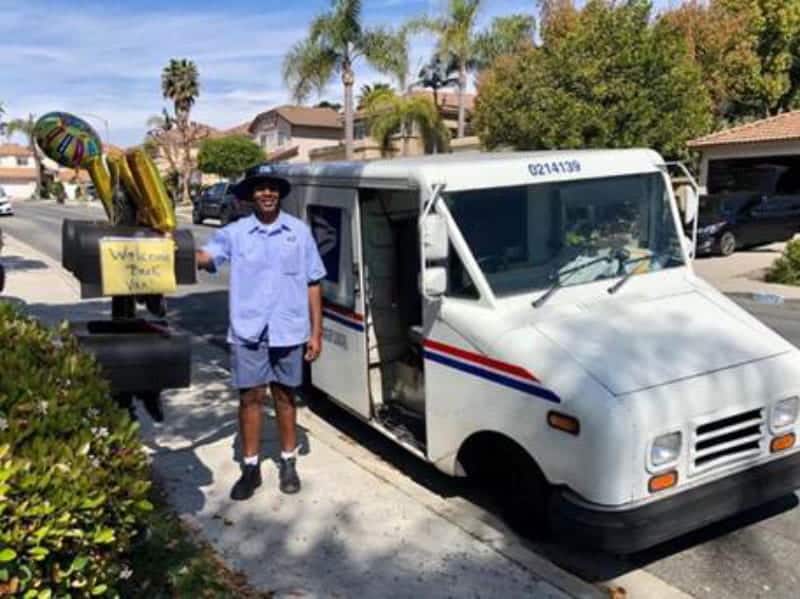
Van and Angela have made a few changes since his stroke.
Instead of delivering mail, Van is now training others. He continues to work for parks and rec.
“By nature, I’m a worker, but I’m ready to slow things down a little,” he said.
Angela, who hadn’t worked outside of the home after raising their two sons, decided she needed to be less dependent on her husband.
“We’ve been married for 33 years and together five years before that, and he’s been the main provider,” she said. “I got a job and I’m establishing credit in my own name.”
Van spreads the word about stroke awareness and how “time is brain” every chance he gets. He’s spoken about it to groups of up to 250 postal workers.
“If you are seeing any signs of a stroke, don’t minimize it,” Van tells them. “My wife acted quickly and that’s what made the difference in my having made a full recovery.”
RELATED: Act “FAST”: Recognize the Signs of a Stroke
Use the letters in F.A.S.T. to spot a stroke:
According to the American Heart Association, you should also watch for sudden:
By American Heart Association

By subscribing, you consent to receive emails from BlackDoctor.com. You may unsubscribe at any time. Privacy Policy & Terms of Service.