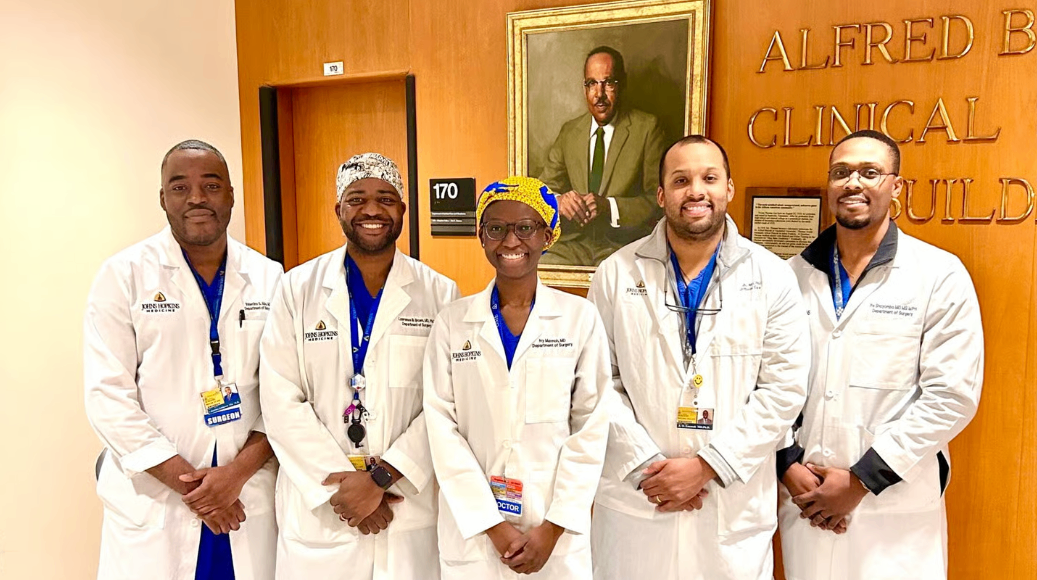
Black surgeons remain significantly underrepresented in medicine today. While Black individuals make up 13.4 percent of the U.S. population, they comprise only 5.6 percent of surgeons currently in training. These statistics highlight a systemic gap, but they also serve as a call to action for institutions and aspiring physicians alike. At Johns Hopkins Hospital, a group of five medical professionals is actively working to shift that narrative, making history in the process.
For the first time in the hospital’s storied history, the trauma and acute care surgery team is led by an all-Black group of residents and fellows. This milestone, recently highlighted by ABC News, features a team of dedicated clinicians: Valentine S. Alia, M.D. (second-year resident); Ivy Mannoh, M.D. (third-year resident); Ifeoluwa “Ife” Shoyombo, M.D., M.P.H., M.S. (third-year resident); Lawrence B. Brown, M.D., Ph.D., M.P.H. (seventh-year resident); and Zachary Obinna Enumah, M.D., Ph.D., M.A. (ninth-year resident and critical care fellow).
This achievement is deeply personal for those involved. For Dr. Enumah, the journey began with watching his parents serve their community. “Growing up in Columbus, Georgia in the 1990s, I watched my parents — my mom, a family medicine doctor, and my dad, a general surgeon — show up to serve patients everyday,” Dr. Enumah told ABC.
As these residents advance in their careers, they walk a path paved by the late Vivien Thomas. In 1941, Thomas became the first Black person to wear a white coat at Johns Hopkins, breaking through institutional barriers that sought to confine his contributions.
Thomas’ life story is a testament to extraordinary intellect triumphing over systemic injustice. Born in Louisiana in 1910, he was the grandson of an enslaved person. Although the Great Depression derailed his dream of attending college and medical school, Thomas did not abandon his passion for science. In 1930, he began working as a laboratory assistant to Dr. Alfred Blalock at Vanderbilt University.
Thomas’ dexterity for surgery was immediate and profound. On his first day, he assisted Blalock with a surgical experiment; soon, he was performing complex procedures on his own. He became an essential collaborator in Blalock’s research into the treatment of traumatic shock and hemorrhagic shock—research that would eventually evolve into the study of crush syndrome.
When Blalock moved to Johns Hopkins in 1941, he insisted on bringing Thomas with him, despite the hospital’s discriminatory hiring policies. At a time when a Black man walking across the segregated campus in a white coat was a jarring sight to many, Thomas continued his work. He eventually played a crucial role in developing surgical techniques to treat tetralogy of Fallot, also known as blue baby syndrome. Though the medical establishment long denied him credentials because of his race, Johns Hopkins eventually recognized his immense contributions by awarding him an honorary doctorate in 1976. Today, the Vivien Thomas Scholars Initiative and a portrait in the hospital corridors ensure his legacy endures.
For the modern team at Johns Hopkins, the weight of this history provides both inspiration and a mandate for the future. Dr. Brown, who holds the distinction of being the first physician in his family, views his role through a lens of duty. “My parents are so proud. I am the first physician in my family,” Dr. Brown told ABC.
To him, the practice of medicine is an inseparable blend of rigorous science and humanitarian service. “That’s why it’s important to me. Equity has to remain at the forefront of how we deliver patient care, how we do research, how we scale programs up in our healthcare system,” he added.
The necessity of this work is clear: research consistently shows that a greater presence of Black doctors improves health outcomes for Black patients and communities of color. In the face of ongoing workforce challenges—particularly for Black women—this team stands as a symbol of progress.
In a widely shared photograph of the five residents, Vivien Thomas’s portrait hangs in the background, serving as a silent, powerful mentor to the group. The image captures a full-circle moment where the struggles of the past have enabled the achievements of the present.
Dr. Shoyombo hopes that their visibility provides a template for future generations of surgeons who may not yet see themselves reflected in the field. “The best part is that I get to save lives and have an impact every single day. To anyone who’s watching, realize that your dream and capacity can only be limited by you. And if you can think it, see it, then you can absolutely reach it,” he concluded.


By subscribing, you consent to receive emails from BlackDoctor.com. You may unsubscribe at any time. Privacy Policy & Terms of Service.