Managing your stress can protect your hair.
The daily grind of life. It’s not uncommon to have days when stress makes us feel like pulling our hair out. But can stress actually cause hair loss?
Medical experts say yes and cite extreme stress as the cause of two different forms of hair loss: telogen effluvium and alopecia areata.
To understand how stress can affect your hair, it is helpful to know how hair grows.
Hair grows from the hair follicles just under your skin’s surface.
Your soft tresses are composed of the same protein (keratin) that your nails are. The follicles produce live keratin cells, but the hair you see is composed of dead keratin cells.
Each follicle has a life cycle of its own, which is divided into three periods: anagen, catagen, and telogen.
The anagen stage is the growth stage and it can last from two to six years. The catagen stage is a two or three-week transitional period between the growth stage and the resting stage. The telogen stage is the resting period, which lasts eight to twelve weeks.
At the end of the resting period, your old hairs are shed and new hair replaces them as the growth cycle starts.
The majority of your scalp follicles are growing hair at the same time, but the rate of growth can be affected by your health, your age, and your stress levels.
It is normal to lose some hair every day. The average adult has over 100,000 strands of hair on their scalp and it is common to lose around 80 – 100 strands a day, this number is based on the natural density or thickness of the head of hair.
Don’t worry about some hair loss, unless it is excessive or you begin to notice that your hair looks noticeably thinner.
Telogen effluvium hair is a condition with a tongue-twisting name that is directly linked to a serious one-time stressful event such as surgery, injury, or sickness. This condition is a very common cause of large amounts of hair falling out.
Telogen effluvium is a slowing of new hair growth resulting from sudden severe emotional, physical, or hormonal stress, followed after a delay of about 2 months by the shedding of hair, sometimes in alarming amounts.
With telogen effluvium, the stressful event induces a higher proportion of hair follicles to enter the resting stage all at the same time.
A few months later, after the stressful event, all of the now-resting follicles begin to shed their hairs at about the same time.
Because the stressful event happened months ago, most people do not connect it with their hair loss.
What Can I Do To Grow My Hair Back After Hair Loss?
It’s your mind and emotions that trigger your body to feel stressed out. So find things and thoughts that help get you back to an un-stressed peace of mind.
If you are experiencing the loss of a loved one, think about and concentrate on the blessings in those who are still here. But if you are experiencing the loss of a job, count your blessings for the life you still have. If you are stressed in your relationship, be rest assured that you are still a great person through and through no matter how your mate has treated/is treating you.
Foods like beans and dark greens such as spinach and kale are good for hair growth.
Also try fruit like blueberries, kiwi, and strawberries. They are all good sources of vitamins and minerals to help your hair grow.
Minoxidil is a direct hair growth stimulator and used for hair loss control in some cases of telogen effluvium; it helps to resume the anagen growth phase from telogen, resting hair follicles.
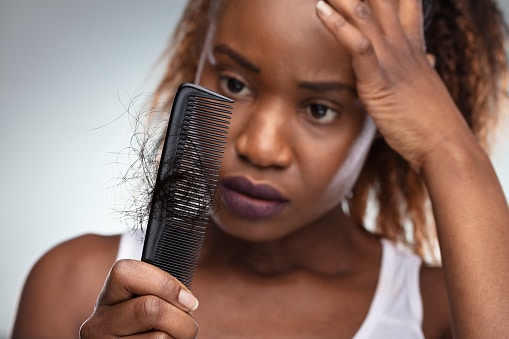
When the body experiences a stressful event such as injury, surgery, or illness it responds by targeting all its energy to recovering from the problem, rather than growing hair, nails, and so on. Many hair follicles enter into a resting stage prematurely. Hair from the resting follicles begins to fall out at a noticeable rate two to three months after the initial problem. You might notice big handfuls in your brush or comb, or on the floor.
This type of stress-related hair loss is certainly alarming, but there is no cause for concern.
You can’t go bald from telogen effluvium hair loss, although on some days it may seem like you might.
Experts assure us that hair loss from this form of stress will return in six to nine months. It will likely be just as thick and healthy as ever.


By subscribing, you consent to receive emails from BlackDoctor.com. You may unsubscribe at any time. Privacy Policy & Terms of Service.