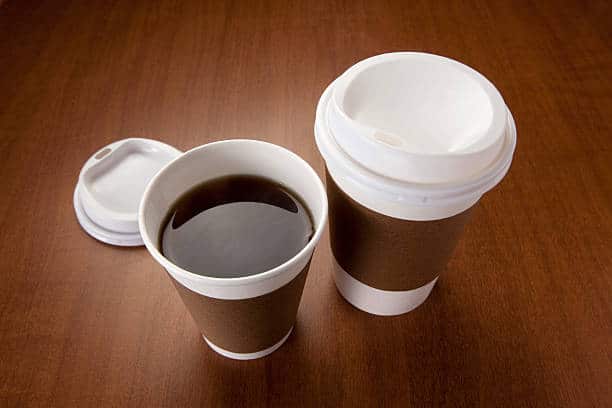
Maybe you ask the barista for cream with your coffee, and possibly sugar as well.
But new research shows that paper cup of joe you grab off the coffeehouse counter contains another ingredient, and it’s one you might not care for — trillions of tiny plastic particles that leach into your hot java from the cup’s plastic lining.
Single-use paper coffee cups are lined with a thin plastic film that helps keep liquids hot and prevent them from leaking through the cardboard. That lining releases more than 5 trillion plastic nanoparticles per liter when hot liquid is poured into a 12-ounce single-use cup, according to lab results published recently in the journal Environmental Science & Technology. A liter is about 34 fluid ounces.
“For reference of size of these particles, 1,000 particles with a diameter of 100 nanometers can fit across a human hair,” says lead researcher Christopher Zangmeister, a chemist and acting group leader with the Material Measurement Laboratory of the National Institute of Standards and Technology in Gaithersburg, Md. “These are very small particles.”
The researchers estimated that by the time you’ve downed 13 paper cups of hot coffee or tea, you’ve consumed the equivalent of one nanoplastic particle for every seven cells in your own body.
The liquid doesn’t need to be boiling hot to spur this release of plastic nanoparticles, either, the investigators found.
“The number of particles released into water increase rapidly with water temperature from room temperature up until about 100 degrees Fahrenheit, and then it levels off and stays constant,” Zangmeister adds.
Hot beverages typically are served at temperatures between 130 and 160 degrees Fahrenheit, according to a 2019 review in the Journal of Food Science.
RELATED: 5 Steps To A Healthier Coffee Order
The researchers were quick to note that the total amount of particles that leached into hot liquid from single-use cups fell
well under safe human consumption levels set by the U.S. Food and Drug Administration.
Environmental experts agree — to a point.
“I read that sentence and go, well, is it time for us to re-evaluate the guidelines?” says Christopher Reddy, a senior scientist of marine chemistry and geochemistry with the Woods Hole Oceanographic Institution in Woods Hole, Mass.
According to David Andrews, a senior scientist with the Environmental Working Group, “There is a visible global environmental crisis caused by plastic pollution, but this new research study indicates that invisible plastic nanoparticles released into our food and beverages from common plastics may be insidiously harming health.”
Andrews adds that “the Food and Drug Administration should move expeditiously to require more testing and disclosure of the chemicals and nanoparticles being released from plastic food contact materials, and take necessary action to ensure that these materials are not harming health.”
These nanoparticles are small enough to slip into your bloodstream and can wind up lodged in tissues and organs located throughout your body, Rolf Halden, director of the Center for Environmental Health Engineering at Arizona State University notes.
“We really don’t know what the impact of these particles is,” Halden adds. “Human exposure is increasing, and we lack the tools to even measure what is arriving in our bodies, where it is deposited and what it does there.”
Halden says asbestos causes harm because its tiny particles are inhaled and accumulate in lung tissue, causing inflammation that can lead to scarring and cancer.
Coffee Vs. Tea: Is One Better For Your Health?
“Asbestos itself is relatively benign. It’s an inorganic material,” Halden shares. “What makes it toxic and makes it kill 90,000 people a year is that it has particles that lodges in human tissue.”
For this study, Zangmeister and his colleagues poured ultra-high purity water into nylon slow-cooker bags and polyethylene-lined paper coffee cups, all obtained from different retailers.
Plastic cooking bags are used to keep food moist in the oven and make clean-up easier for slow cookers. A bag in a slow cooker kept hot for an hour leached about 35 trillion plastic nanoparticle per liter of water, the researchers found. Similarly, hot water poured into 12-fluid-ounce cups for 20 minutes and allowed to cool wound up leaching 5.1 trillion plastic nanoparticles per liter.
Reddy and Halden both praised the study, calling it landmark research due to the meticulous way the scientists eliminated all other potential sources of plastic pollution.
People concerned about these levels might consider bringing a metal or ceramic travel mug with them to the coffee shop, Zangmeister says.


By subscribing, you consent to receive emails from BlackDoctor.com. You may unsubscribe at any time. Privacy Policy & Terms of Service.