
There’s nothing like a sudden, unstoppable itch to make you sit up in bed and wonder what’s going on with your skin.
If you’ve reached the point of Googling “what is scabies?” you’re not imagining things because relentless itching is one of the most common early signs of scabies.
Scabies is a highly itchy skin condition caused by tiny mites that burrow into the skin. It can appear as a pimple-like rash, lines under the skin, or scaly patches, and it tends to worsen at night.
Understanding what is scabies can help you spot symptoms early and get treatment faster AND avoid passing it to others.
RELATED: Is Itchy Skin Normal?
Scabies is caused by the human itch mite, a parasite that lives and lays eggs in the upper layer of your skin, the CDC explains.
Under magnification, the mite is creamy-white, round-bodied, eight-legged, and about the size of a needle tip.
These microscopic bugs get into the outermost layer of your skin. They lay eggs inside the skin, and when those eggs hatch, the larvae move to the surface and continue the cycle.
Despite its sometimes-terrifying symptoms, scabies is not a sign of poor hygiene. It affects all kinds of people.
According to the World Health Organization, over 200 million people worldwide are estimated to have scabies at any given time, making it a truly global health issue.
If you’ve never had scabies, symptoms may take anywhere from four to eight weeks before appearing, according to the American Academy of Dermatology (AAD).
If you’ve had scabies before, it can show up in just a few days, because your immune system already recognizes the mites.
Intense itching happens especially at night. According to a report published recently in the journal Frontiers in Medicine, this is caused directly by the mites and the body’s immune response to them. This is often the first and most persistent symptom of scabies.
Rash or bumps on lighter skin might look red or pink. On darker skin, it can appear almost skin-colored, slightly lighter, or have a purplish hue, which makes it harder to spot.
Burrows are tiny, thread-like lines under the skin where mites tunnel. (Yes, it’s as unsettling as it sounds.) They are often found between fingers, on the wrists, elbows, or around the waist and nipples.
Pimple-like bumps or scaly patches. These can resemble eczema, acne, or hives.
Secondary sores or infections occur if you scratch too much. Those bumps can break open and become infected.
RELATED: Bug Bites 101: 10 Common Bites and What They Could Mean
Before we talk about how scabies spreads, it helps to understand what is scabies: a highly contagious skin condition caused by mites that move from person to person through close contact. Here’s the lowdown:
This is the most common route. Living with someone, close cuddles, or long hugs are more likely to spread the mites than a quick handshake.
Because scabies spreads via extended skin contact, it’s often transmitted between sexual partners.
If someone with scabies has used bedding, towels, or clothing, and they’re not washed in hot water, mites can transfer.
Places like nursing homes, prisons, dorms, and childcare centers are hotbeds for spread because of close quarters.
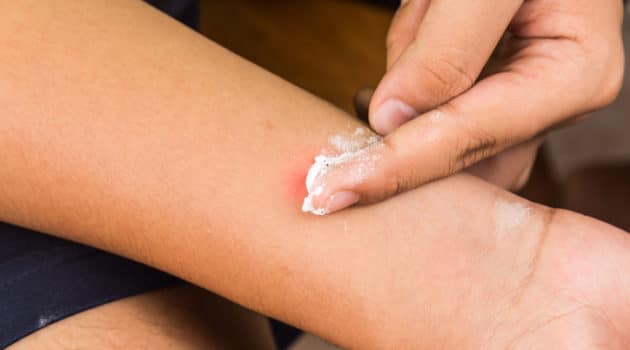
Fortunately, scabies treatment is very effective when done correctly, according to the Mayo Clinic. But remember, it’s not enough to just kill the mites. You also have to prevent them from coming back.
Here are the main scabies treatment options:
Permethrin cream is the go-to prescription treatment. You apply it to clean, dry skin from your neck down (and sometimes the scalp, for kids), leave it on for 8–14 hours, then rinse. Most people need two rounds of permethrin a week apart to kill the newly hatched mites fully.
For more severe cases, oral ivermectin comes in pill form and is usually prescribed in two doses, spaced a week or two apart, according to a recent HealthDay report. It’s very effective, but not typically recommended for pregnant or breastfeeding individuals or small children under 35 pounds.
What to expect during recovery:
After treatment, itching and bumps can continue for a few weeks. Even though the mites are dead, your body’s still reacting.
Over-the-counter antihistamines, cool compresses, or soothing lotions can help you manage the itch during that period.
Important: Anyone who has had close, prolonged contact with the infected person should also receive treatment at the same time. This helps break the transmission cycle.
Experts also advise cleaning your environment thoroughly—washing all bedding and clothing in hot water, drying on high heat, or sealing items in a plastic bag for several days.
Diagnosing scabies on darker skin can be especially tricky. A 2025 study published in the National Library of Medicine database showed that dermoscopy (a skin surface microscope) works well for spotting scabies in dark African skin, even though traditional visual cues (like the “delta sign”) may not always appear.
The delta sign helps confirm that you’re not just looking at an irritated rash or eczema—you’re seeing the actual mite. It’s considered one of the most reliable visual cues in lighter skin tones.
Verywell Health notes that on darker skin tones, scabies rashes can blend in, appearing just slightly lighter than the surrounding skin, or almost invisible, so close inspection is often needed.
Children often show scabies on the scalp, palms, and soles—areas adults don’t usually get it.
And in people with weakened immune systems, there’s a more serious form called crusted scabies, featuring thick, crusty patches of skin with potentially hundreds or thousands of mites.
These variations can make it harder for parents and caregivers to recognize what scabies looks like on kids, especially when the rash doesn’t appear in the typical adult locations.
Scabies isn’t just annoying, it can lead to serious complications, explains the World Health Organization, if left untreated.
Bacterial infections. Scratching breaks the skin’s barrier, which opens the door to infections like impetigo.
Chronic skin damage. Ongoing itching and inflammation can lead to thickened, damaged skin over time.
Crusted scabies. This severe form affects people with weakened immune systems — and it’s highly contagious because of the high mite load.
Broader health risks. Repeated infections and inflammation may contribute to other health issues, especially in vulnerable populations. In some cases, repeated infections can lead to kidney inflammation or more serious systemic issues.
These risks make early diagnosis and treatment critical.
RELATED: Your Eczema Isn’t Just Dry Skin: What Every Black Person Needs to Know!
So, what is scabies? It’s a widespread but treatable skin condition that affects millions globally. While the itching and rash can feel overwhelming, the good news is that scabies is very responsive to treatment.
The more you understand what scabies is—and how it behaves on different skin tones—the easier it is to get ahead of it. It’s important to pay close attention to symptoms, especially if you’re experiencing persistent itch or unusual bumps.
With the right treatment, support, and prevention, scabies doesn’t have to take over your life.


By subscribing, you consent to receive emails from BlackDoctor.com. You may unsubscribe at any time. Privacy Policy & Terms of Service.