I’ve been a personal trainer for five years, but when I first graduated college, I had a desk job where I was sitting 8+ hours a day. Within two years, I had lower back pain. I stopped working out, thinking rest was the best thing, but my back pain got progressively worse.
I sought the help of a physical therapist and a chiropractor, and I learned just how common lower back pain is—some studies have found that up to 23 percent of adults worldwide experience long-term lower back pain.
I was far from alone in my pain, but understanding the causes of low back pain helped me later on as a personal trainer to figure out what exercises could help bring some relief to me and my clients with the same issue.
What causes low back pain?
Low back pain may be brought on by a largely sedentary lifestyle, and according to the World Health Organization (WHO), 60 to 85 percent of people worldwide live sedentary lives.
When you spend most of the day sitting, your hip flexors may become tight, and the lack of blood circulation and movement may cause stiffness in your lower back.
Sitting also allows your abdominals and glutes to become underactive. This muscular imbalance may cause your pelvis to tilt forward, causing back muscle and nerve pain.
What may help lower back pain?
Low back pain may be helped with certain exercises, specifically those that strengthen the muscles in your core and glutes and stretch your hip flexors.
Always consult with your doctor or healthcare provider before starting a new exercise routine.
RELATED: 5 Ways To Treat Lower Back Pain Without Pills
5 best exercises for lower back pain
These are the lower back pain exercises I swear by for myself and my clients. You can do all these moves at home, using your body weight for resistance.
Complete this routine 3 times a week for best results.
1. Bird Dog
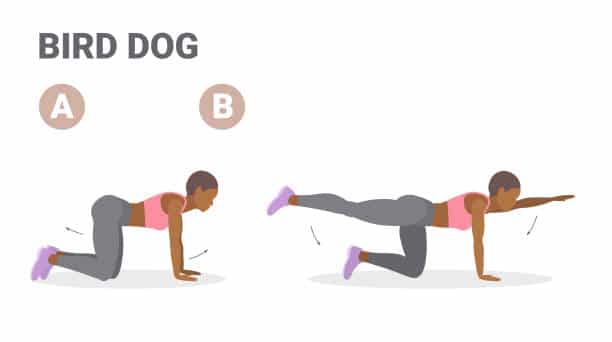
I love this exercise because it’s great at stabilizing the entire core and helps counter the muscle imbalance caused by sitting.
How to do a bird dog:
1. Start on your hands and knees, making sure to have a neutral spine so that there’s no arch in your lower back (pull your belly button in and make your entire body stiff to help).
An easy way to do this is to pretend someone is going to try to push you over, and you make your body rigid so they can’t.
By doing this, you’ll help tighten your core and glutes, along with other stabilizing muscles.
2. Without shifting your weight, lift and extend your right arm forward and your left leg straight behind you, then return to your hands and knees.
3. Repeat on the other side with your left arm and right leg.
Do 8 reps on each side. Repeat 3 times.
2. Glute Bridge
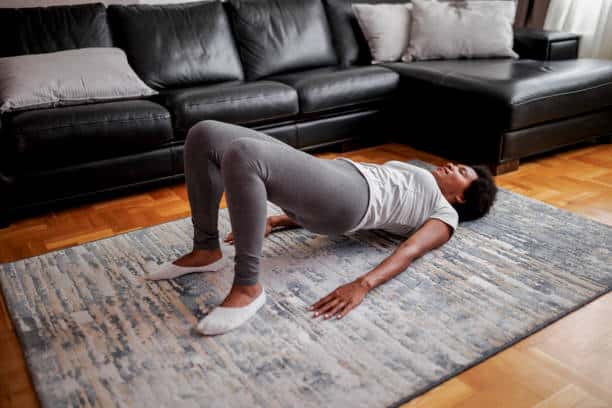
The glute bridge exercise helps strengthen the glutes while also stretching the hip flexors. Because you begin by lying on your back, it’s also easier to ensure your pelvis is properly aligned to counter the muscle imbalance created by sitting.
How to do a glute bridge:
1. Lie on your back and bend your legs with your feet planted on the floor. With your arms at your sides, your heels should be just below your fingertips.
2. Tuck your tailbone and drive your heels into the floor as you lift your hips toward the ceiling. Stop when your body creates a straight line from your knees to your shoulders.
3. Slowly lower back to the ground one vertebrae at a time.
Do 10 reps. Repeat 3 times.
3. Superman
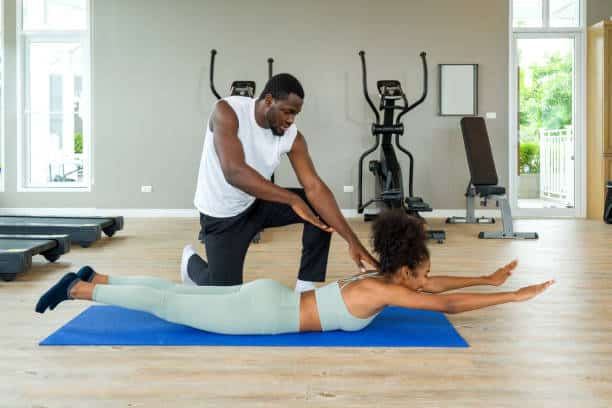
Not only does the Superman exercise work your core and glutes, but it also works your entire posterior chain (the muscles along the backside of your body). When sitting and rounding our bodies forward, the entire posterior chain may be underutilized, and this is a great exercise for countering that and reducing lower back pain.
How to do a Superman:
1. Lie on your stomach with your arms above you in a “Y” shape.
2. Simultaneously lift your shoulders and your legs off the ground, feeling a “squeeze” along the entire backside of your body. Hold for 3 seconds before slowly lowering back to the ground.
Do 10 reps. Repeat 3 times.
4. Dead Bug
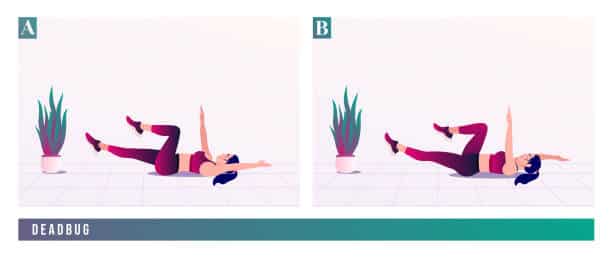
The dead bug is my favorite core exercise for lower back pain because it’s great at isolating the core while supporting the lower back and maintaining proper pelvic alignment.
How to do a dead bug:
1. Lie on your back with your arms straight above you and your legs lifted and bent at 90 degrees. Create a stiff core.
2. Similar to the bird dog exercise, lengthen your right arm and left leg at the same time, with your leg extending straight out in front of you and your arm straight behind you. As you do this, don’t let your back come off the ground.
3. Return to the starting position.
4. Repeat on the other side with your left arm and right leg.
Do 8 reps on each side. Repeat 3 times.
5. Donkey Kicks

Donkey kicks are sometimes simply called hip extensions, meaning you stretch your hip flexors to squeeze the glutes. The hands and knees position of this move also works the core similar to the bird dog exercise, but with a larger emphasis on the glutes.
How to do donkey kicks:
1. Start on your hands and knees. Pull your belly button in and make your entire body stiff, similar to the bird dog exercise.
2. Raise one knee until it’s in line with your glute, keeping your leg bent to 90 degrees (the bottom of your foot will face the ceiling).
3. Hold for 1 second and squeeze the glute on that side.
4. Return to the starting position on hands and knees.
5. Repeat on the other side.
Do 8 reps on each side. Repeat 3 times.