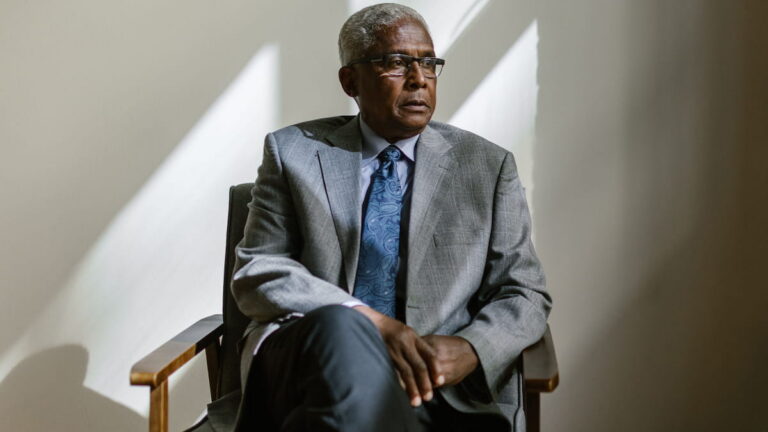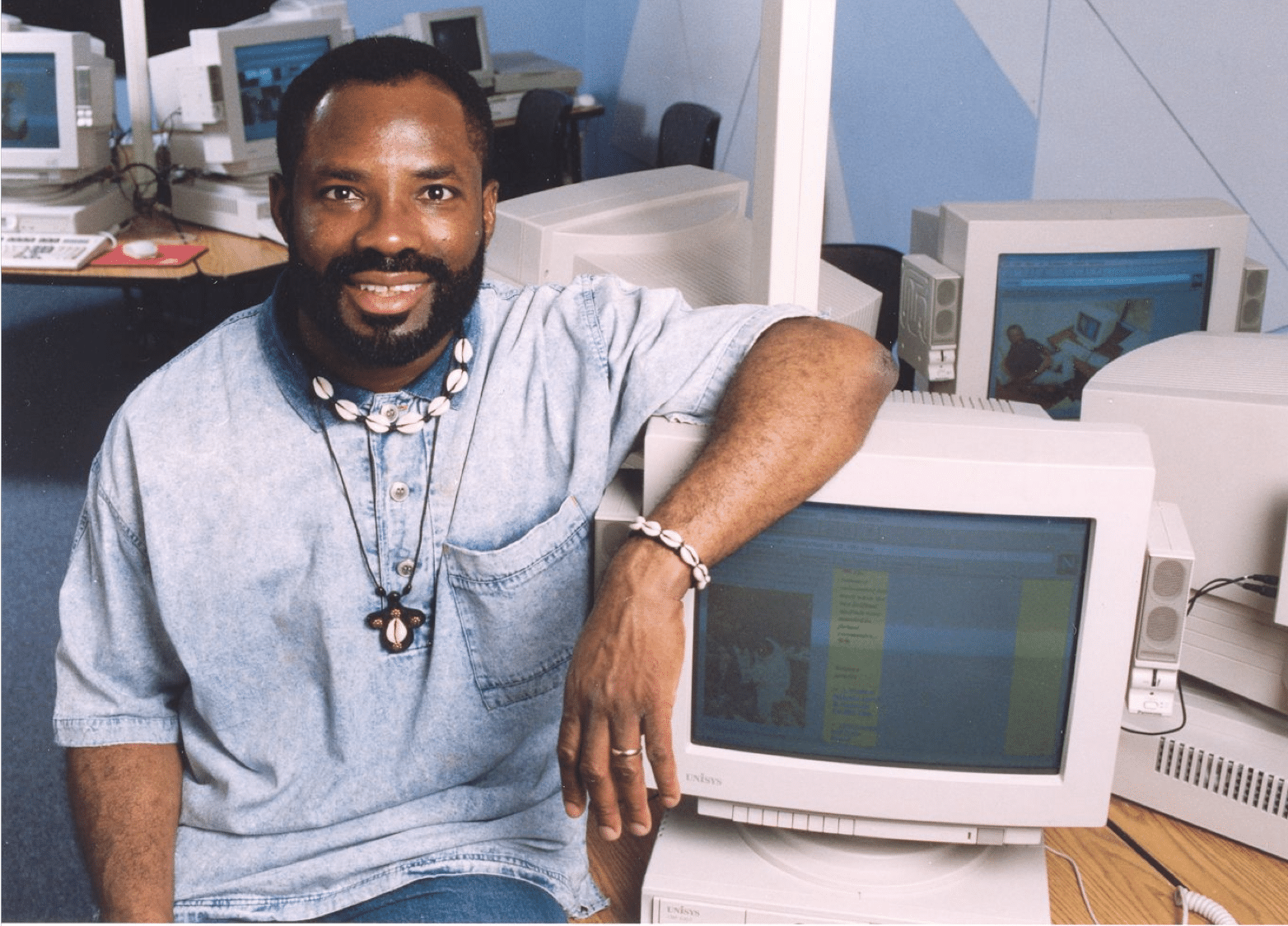
The internet is something we can’t live without. It’s used not only in our phones, but in our homes, our cars, just about everywhere–it’s apart of our life. But it’s hard to say who invented it. There were many mathematicians and scientists who contributed to its development; computers were sending signals to each other as early as the 1950s. But the thing that we know now as the world wide web owes much of its existence to man known Philip Emeagwali, a math whiz who came up with the formula for allowing a large number of computers to communicate at once.
Emeagwali was born to a poor family in Akure, Nigeria, in 1954. Despite his brain for math, he had to drop out of school because his family, who had become war refugees, could no longer afford to send him. He traveled to the United States to study under a scholarship following completion of a correspondence course at the University of London. He received a bachelor’s degree in mathematics from Oregon State University in 1977. He later moved to Washington DC, receiving in 1986 a master’s degree from George Washington University in ocean and marine engineering, and a second master’s in applied mathematics from the University of Maryland. In addition to those, he also received a doctoral fellowship from the University of Michigan.
At Michigan, he participated in the scientific community’s debate on how to simulate the detection of oil reservoirs using a supercomputer. Growing up in an oil-rich nation and understanding how oil is drilled, Emeagwali decided to use this problem as the subject of his doctoral dissertation. Borrowing an idea from a science fiction story about predicting the weather, Emeagwali decided that rather than using 8 expensive supercomputers he would employ thousands of microprocessors to do the computation.
According to Time magazine, the only step left was to find 8 machines and connect them. (Remember, it was the 80s.) Through research, he found a machine called the Connection Machine at the Los Alamos National Laboratory, which had sat unused after scientists had given up on figuring out how to make it simulate nuclear explosions. The machine was designed to run 65,536 interconnected microprocessors. In 1987, he applied for and was given permission to use the machine, and remotely from his Ann Arbor, Michigan, location he set the parameters and ran his program. In addition to correctly computing the amount of oil in the simulated reservoir, the machine was able to perform 3.1 billion calculations per second.
His discovery revealed that Emeagwali programmed each of the microprocessors to talk to six neighboring microprocessors at the same time.
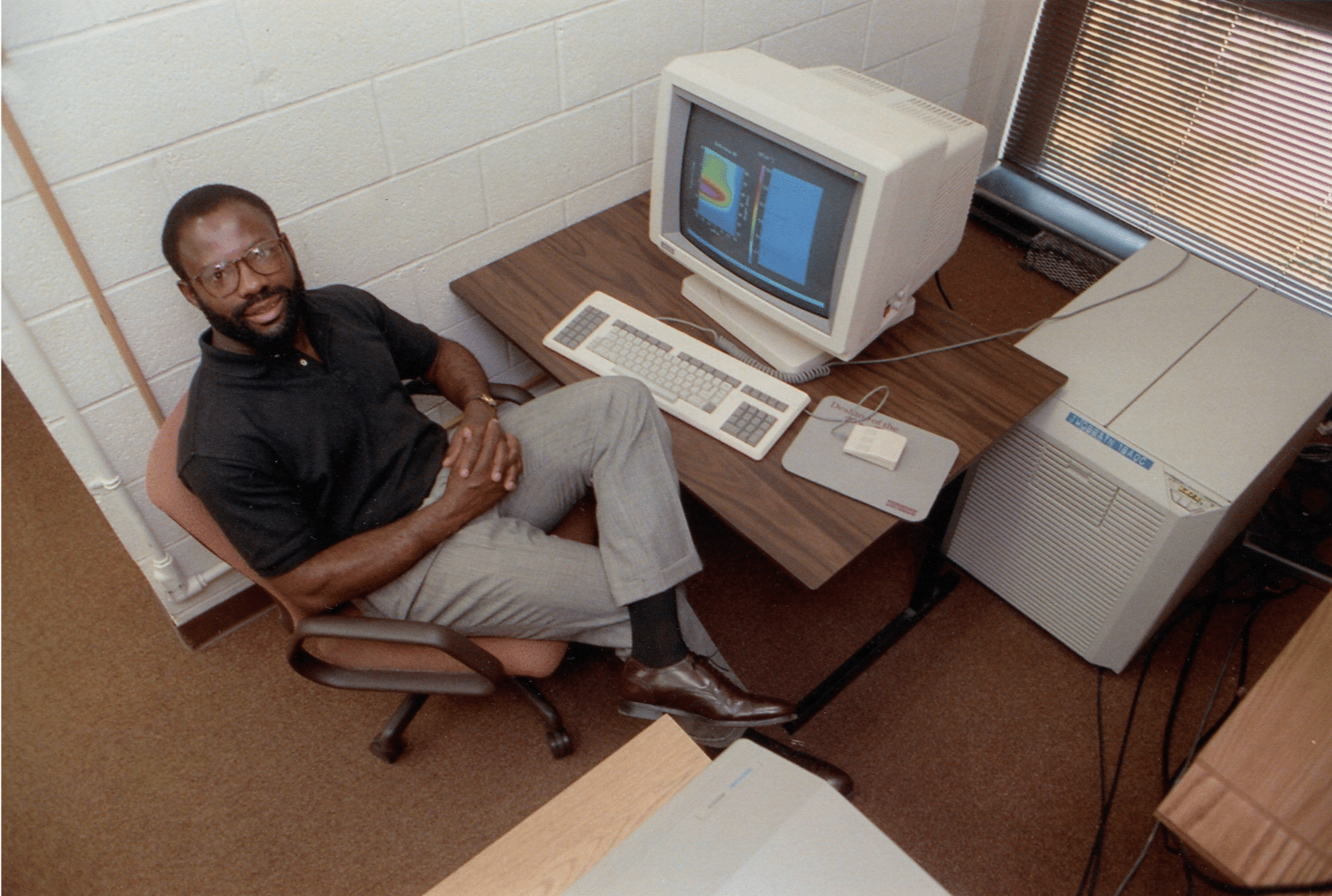
The success of this record-breaking experiment meant that there was now a practical and inexpensive way to use machines like this to speak to each other all over the world. Within a few years, the oil industry…
… had seized upon this idea, then called the Hyperball International Network creating a virtual world wide web of ultrafast digital communication.
The discovery earned him the Institute of Electronics and Electrical Engineers’ Gordon Bell Prize in 1989, considered the Nobel Prize of computing, and he was later hailed as one of the fathers of the Internet. Since then, he has won more than 100 prizes for his work and Apple computer has used his microprocessor technology in their Power Mac G4 model. Today he lives in Washington with his wife and son.
“The Internet as we know it today did not cross my mind,” Emeagwali told TIME. “I was hypothesizing a planetary-sized supercomputer and, broadly speaking, my focus was on how the present creates the future and how our image of the future inspires the present.”



By subscribing, you consent to receive emails from BlackDoctor.com. You may unsubscribe at any time. Privacy Policy & Terms of Service.