Former Destiny’s Child singer Michelle Williams has revealed she’s now happier and healthier after recently seeking professional medical help for mental health issues.
In an Instagram post, Michelle said that as a mental health awareness advocate, she “listened to the same advice” she’s given to others.
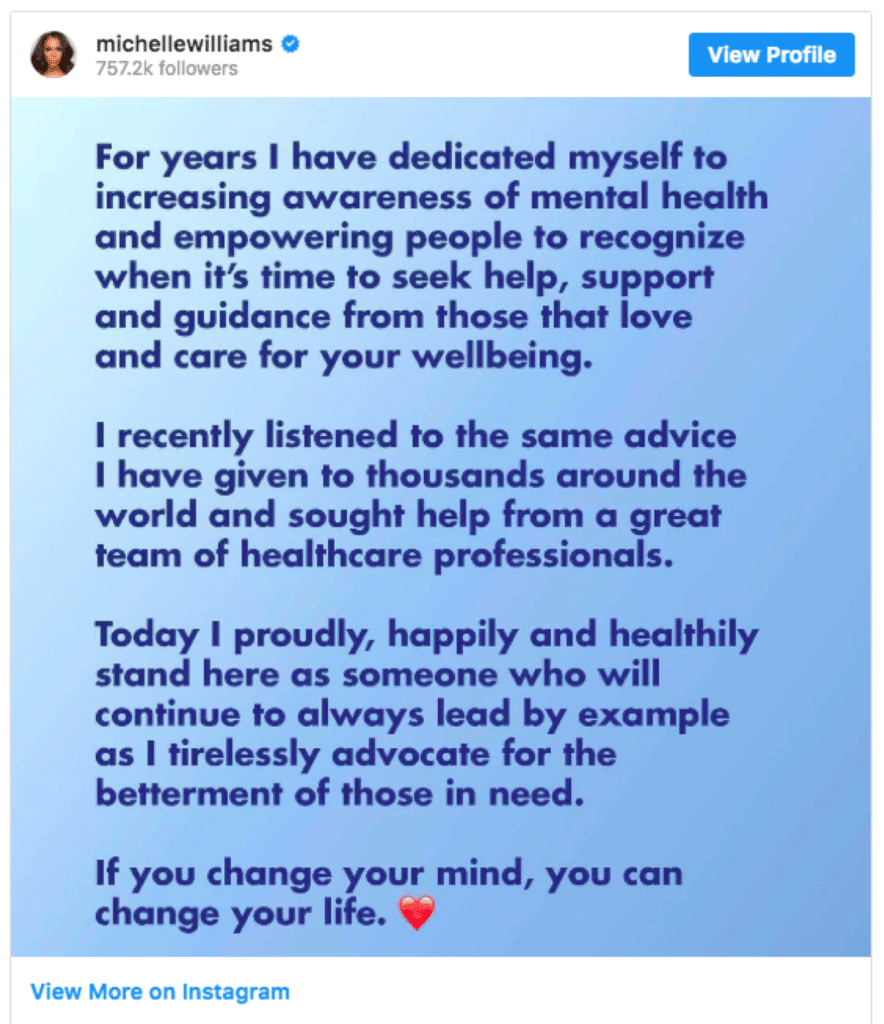
“For years I have dedicated myself to increasing awareness of mental health and empowering people to recognize when it’s time to seek help, support and guidance from those that love and care for your wellbeing. I recently listened to the same advice I have given to thousands around the world and sought help from a great team of healthcare professionals.”
After posting her confession, Michelle has had a number of messages of support from artists and celebrities including original Destiny’s Child member LaTavia Roberson and Missy Elliott.
Williams did not disclose the nature of the condition or conditions for which she sought treatment, but she has previously opened up about her battles with depression and even thoughts of suicide.
“For years, I’m in one of the top-selling female groups of all time suffering with depression, Michelle Williams said in an interview on The TALK in October 2017.
“It got really, really bad, to the point of being suicidal.”
She added: “I was at that place where it got so dark and heavy because sometimes you feel like ‘I’m the provider, I take care of people, I’m not supposed to be feeling this way – what do I do?’
“I wanted out.”
In her statement on Tuesday, Williams assured, “Today I proudly, happily and healthily stand here as someone who will continue to always lead by example as I tirelessly advocate for betterment of those in need.”

According to World Health Organization report, “The Global Burden of Disease” depression is considered to be the greatest burden in women when compared to all other diseases. Women, in general, are reported to have a higher risk of initial episode and earlier onset of depression as compared to men. African American women have reported three million mental health’s visits each year.
National study of American life (NSAL) survey reports that the lifetime prevalence of depression is higher for whites (17.9%) than for African Americans (10.4%) and Caribbean blacks (12.9%), but when the course of depression is considered, depression in African Americans persists for a longer duration. Thus, major depression is considered a chronic disorder for blacks. Due to the larger exposure to…
… community and domestic violence, African Americans have a higher risk for depression comorbidities, such as substance abuse, generalized anxiety and posttraumatic stress disorders.
The first step in helping those in need like Michelle said, is recognizing when to seek help.
Some of the symptoms of depression that should prompt a visit with a health practitioner include:
– A persistent feeling of emptiness
– Physical symptoms that don’t get better with treatment, like headaches and stomachaches
– Inability to take pleasure in once-enjoyable activities
– Irritability and general unhappiness
– A change in appetite, with accompanying weight loss or weight gain
– Problems with memory, concentration, and decision-making
– A decrease in energy or motivation.
– Feelings of hopelessness, helplessness, or worthlessness.
– Getting too much or too little sleep
– Thinking about death or suicide
People who have five or more of these symptoms for more than two weeks should see a doctor. You also should go if any of these symptoms are interfering with your ability to function or if you are thinking about suicide.
Beyond improving mental health, getting help for depression may reduce heart disease and improve quality of life.


By subscribing, you consent to receive emails from BlackDoctor.com. You may unsubscribe at any time. Privacy Policy & Terms of Service.