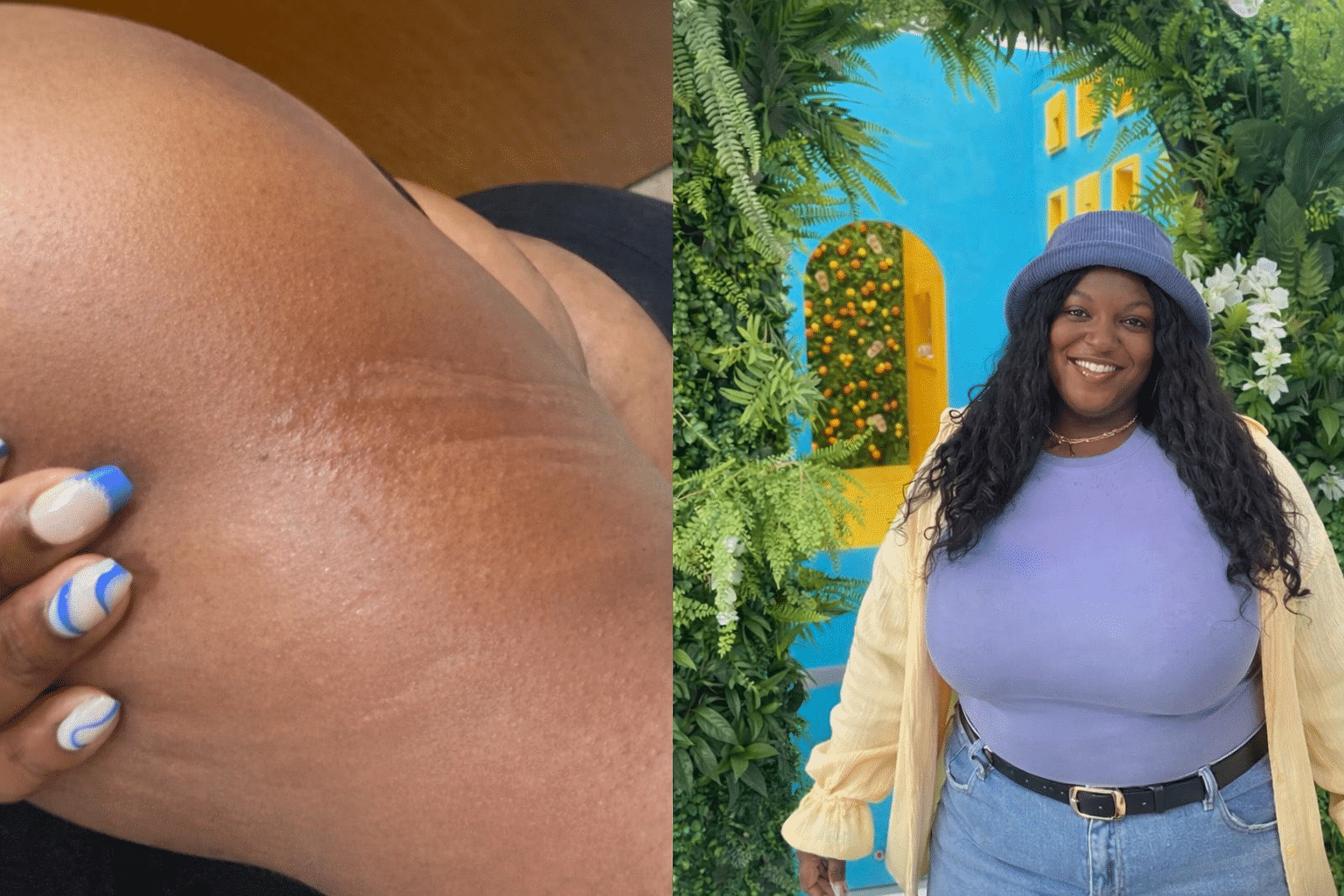
In April 2020, while the world was retreating indoors due to the pandemic, Emmeka Hawkins was navigating a personal crisis that wouldn’t stay quiet. Like most, she was quarantined with her partner, sticking to her familiar nightly routine. But after one ordinary shower, everything changed.
“Once I got out of the shower, I dried off, and then I started to feel this really intense itch on my back,” she tells BlackDoctor. “Like the itch that like you get some type of relief instantly or like it’s gonna drive you crazy.”
Unable to reach the spot, she asked her partner to investigate. He saw raised welts that appeared irritated but not quite inflamed—a common nuance for inflammatory conditions on darker skin. They applied Aquaphor for temporary relief, but within 15 minutes, the “crazy” itch was back.
RELATED: Hives With No Trigger? Here’s What An Allergist Wants You to Know
Determined to find a cause, Hawkins turned to the internet, only to be met with a digital void of representation. “I wanted to find what it looked like on my skin since I couldn’t see my back very much,” she says. “I was only going off what I could see. And I wasn’t finding very much.”
The visual data she did find led to more confusion. She initially suspected Dermatographia—a condition where pressure on the skin causes raised welts—but realized her flares were spontaneous. This lack of visual representation is a known barrier. The Allergy and Asthma Network notes that hives on melanin-rich skin may appear skin-colored, dark brown, gray, or purplish, rather than the “bright red” often shown in medical textbooks.
Assuming it was an allergic reaction, Hawkins began a grueling process of elimination. “I started to even change my shower routine. I started to change my body care… I didn’t really put on perfume,” she explains. She even overhauled her diet, cutting out dairy entirely.
“It completely consumed my life for that entire year and a half before I was able to actually talk to a physician,” she says. The physical toll was massive. At her lowest point, she was taking up to six Benadryls a day just to keep the itch at bay.
The mental weight was just as heavy. “It almost felt like my body was betraying me. It was like the mix of the physical thing that I feel and the mental thing of I don’t know what’s going on… and I was out of control of my body,” Hawkins recalls. “It was very mentally taxing.”

Seeking professional help during the height of the pandemic added another layer of frustration. Telehealth appointments proved insufficient for a condition that is notoriously difficult to capture.
“I actually did have a flare-up, but she couldn’t see it because it’s something that really needs to be examined up close in person,” Hawkins notes. “It was so frustrating to not be able to know what was going on… And knowing that I didn’t know when I was going to be able to get answers.”
When she finally secured an in-person visit and a diagnosis of Chronic Spontaneous Urticaria (CSU), the moment was bittersweet.
“I felt relief that I had a name for it… But the relief also came with some frustration because I was hoping for a fix,” she shares. Her doctor’s prognosis—that it might last another 24 months—felt like a sentence rather than a solution. “It was disappointing…It’s like, ‘Oh, okay. Well, now I have to deal with this for two more years, possibly, give or take… But it didn’t come with reassurance.”
Today, Hawkins still manages daily flare-ups, but the relationship with her body has shifted from fear to awareness. “Usually, it’s either my head, my hands, or my feet,” she says. “I keep antihistamines on me. Even if I don’t have one on me, I know how long I could go without taking anything before I’m in absolute chaos, I can’t function mode.”
She credits her support system for helping her navigate the spontaneous nature of the condition. “My partner will always keep antihistamines on him when we’re out, just in case I forget, so I don’t feel like my whole day was ruined because I was having a flare-up.”
Despite the challenges, Hawkins has found a sense of empowerment. “I’m almost grateful to have this experience because I don’t think I would have ever come to a realization [that] my body is really the most important part of me,” she shares.

As a content creator and advocate, Hawkins encourages others to become the “experts” of their own bodies to speed up the diagnostic journey.
“I think that helps physicians really bring into perspective… I’m going to sit and listen to my patient because they’ve done the work themselves to pay attention to their bodies and be in tune with their bodies to let me know to rule out other things that it could possibly be,” she says.
“CSU doesn’t divine who you are,” Hawkins concludes. “It may be a part of your story, a part of your journey, but it shouldn’t completely rule.”


By subscribing, you consent to receive emails from BlackDoctor.com. You may unsubscribe at any time. Privacy Policy & Terms of Service.