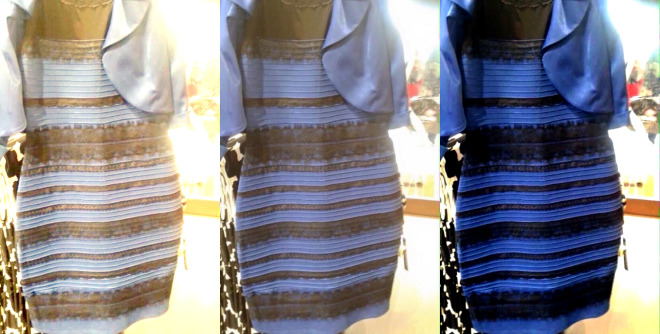
The infamous dress which has been the talk on social media, between friends and family and debates all over. The debate has everyone discussing which they see: a blue and black dress or a white and gold dress. Which do you see? But more importantly, why do we all see such different color dresses?
Here’s why:
A layer of tissue at the back of the eye, called a retina, contains cells called photoreceptors.
The photoreceptors convert light rays into nerve signals, which are then processed by nerve cells in the inner retina, sent to the brain, and translated as images.
MUST READ: What Really Happened To Slick Rick’s Eye?
The two types of photoreceptor cells are known as rods and cones. Rods are responsible for peripheral and night vision. They detect brightness and shades of gray. Cones are responsible for day vision and colour perception.
Humans have a low concentration of rod receptors and a high concentration of cone receptors, which is why we can’t see as well at night but can detect colours better, than say, cats.
We have three types of cones, each tuned to pick up green, red, or blue wavelengths of light. When light hits our eyes, the receptors turn these colours into electrical signals that are sent to the brain. Our brains determine the colour that we see by blending the signals that each receptor senses — like how a TV screen made of millions of different-coloured pixels makes an image.
In person, the dress is clearly blue and black. The lighting of the image, which has a bluish tint, appears to be what is throwing people’s brains off. It makes the blue part look white and black part look gold.
Light enters the eye through the lens—different wavelengths corresponding to different colors. The light hits the retina in the back of the eye where pigments fire up neural connections to the visual cortex, the part of the brain that processes those signals into an image. Critically, though, that first burst of light is made of whatever wavelengths are illuminating the world, reflecting off whatever you’re looking at. Without you having to worry about it, your brain figures out what color light is bouncing off the thing your eyes are looking at, and essentially subtracts that color from the “real” color of the object. “Our visual system is supposed to throw away information about the illuminant and extract information about the actual reflectance,” says Jay Neitz, a neuroscientist at the University of Washington.
Show that same patch on a neutral black background and it would appear orange.
The point is, your brain tries to interpolate a kind of color context for the image, and then spits out an answer for the color of the dress. Some brain’s attribute the blue to the illuminant. Other people attribute it to the dress.


By subscribing, you consent to receive emails from BlackDoctor.com. You may unsubscribe at any time. Privacy Policy & Terms of Service.