Good afternoon, everyone. I know this is kind of the session, with all the, the energy you have taken in already, and the session before, you get a little bit of break, oftentimes, food and, and all that. So we thank you, for being here. I thank my panelists, hopefully I can see all of them- Yeah. -uh, uh- -and friends as well, for being here today, to help talk about something that has always been really important as, as a thread through my career in terms of narrative. narrative, for those, just to break it down quickly, very simply, is that the narratives of which we kind of believe, and we adapt, we tell, really drive our actions in so many different ways.
And that's not That could be for the good, bad, ugly, all of it. Just know we know that the narratives and the stories we tell drive the actions that we have. And so a lot of how we understand even our health around us is driven by what we believe about it. and do we believe if health is a human right? Do we believe, I like to say now, that all policy is health policy? You know, it will drive action. Now, we don't really adopt those fully in this country, as we know, but these are all things that we know will drive, the actions that we have. And so generational health, you know, is this opportunity and kind of the way of, of how we tell the stories, how we expose them, as well as amplify the stories and the opportunities that we have, and how they impact really across, the generations that exist.
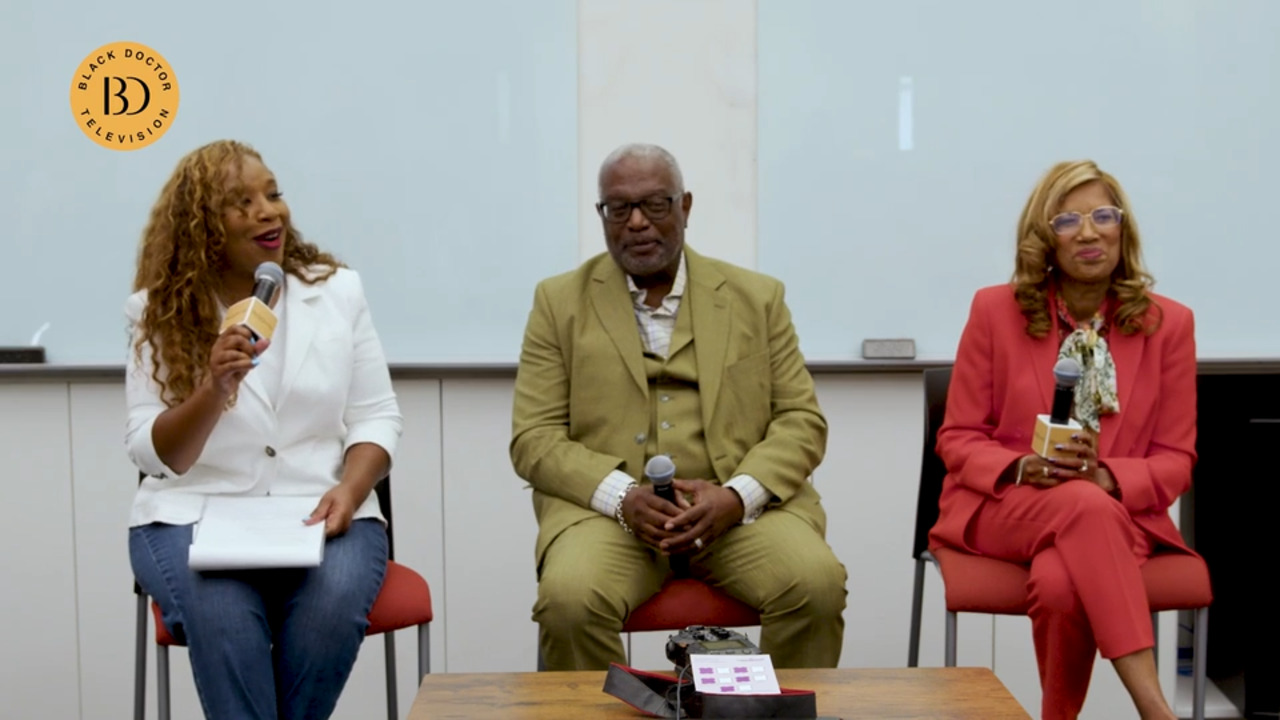
And so today I have, with me, a policymaker who's, a legend, you know, in, in my own eyes for sure, in many's eyes, actually, a lot of people's eyes, and really in the space of, of health and public health and health equity.
we have a filmmaker with us and, and a regulator, but filmmaker is how I met Denise, and just really honored. And we have, from Pharma, we have, like, a collaborator and a collaborator who brings people together in order to drive and think about how we're driving change at many different levels. So just really, excited to be here with you all, today, and thank you. So I'm gonna start with Let's see. I'm gonna start with, Denise, and I'm go- because there's a I think people have an obvious, and I'm gonna start with the obvious, more so about filmmaking and, you know, its power to tell stories.
And I, and one of the things that I say about equity, is that what we've learned is data is really important. We understand we need data, we know, we know we have to look data at many different ways. But what I've found about data, numbers alone, they don't always move people to do change and create change, right? Yeah. It's oftentimes our proximity to people, the stories we tell, and how are we really moving and shifting the heart- Mm-hmm. -to change the will. Mm-hmm. And that's what I see as the power of filmmaking. And so can you just speak to that and how you got into that?
And then just talk about that intersection as being also a regulator, and what that means as well for the folks that are here in the audience. Yeah. so I've been in, in entertainment for a long time, so, we just showed a menopause film. It's called The M Factor: Shredding the Silence on Menopause- -to look at how do we shift the narrative of silence and suffering for women?
What do we You know, how do we do that? How do we make that story kind of come alive in a way in which an action can happen? The action that we were looking for is: how do we shift from storytelling into telling, you know, what is exactly happening and causing that situation? So what's happening? What are the failures in the system? It was training, coverage of insurance, the workplace not supporting it. How do we do that? We show those stories of women, that that's happening to women. So then we shift the sort of hot flashes from a punchline to a pro- problem statement.
And then, as a C-suite person, I can work with a problem statement. As a, as a legislator or a lawmaker, I can work with a problem statement, and then we can start moving the agenda along. And so that's kind of how I use film to do storytelling, where I know I'm creating a problem statement, showing you solutions to that problem, and now people who watch it, lawmakers, policy people, the women themselves, in the case of a menopause film, the women themselves feel, "Now I'm empowered. Hey, that, that story reminds me of myself. I feel like that." And that woman feels empowered to then go to her doctor.
She does She believes that, "I deserve to have care." The policy person sees the, that there is a problem in the workplace. "Maybe I can put forth a, a piece of policy that would require workplaces to support women during this stage of their life." someone who is, in, in the insurance business sees it and goes, "My, wow!
I wonder if our company covers menopause insurance," right? And that's how I use filmmaking to play itself out, to change the narrative of what we believe or to awaken us to what we don't know, right? To, to create the awareness, to create the action that will come afterwards. As a regulator, I mean, my, my job as a regulator, it really is to protect the public. So anybody who is a regulator, honestly, in any state, that is what you do in any profession, is to make sure that you get the safety, the quality, and the professionalism of that person you're going to see, or that person who y- you're gonna hire as a contractor, or go and get my hair done, or in this case that I regulate, is physicians.
and that's what regulators do. That is our, that is really our role, and you should be comfortable coming to a regulator if you have a problem with a physician that has not serviced you or a family member.... A lot of people don't know that they're there, and they do exist for us. Thank you, and I'm gonna, I'm gonna come back to asking you kind of why film and what got you into that space in, in a little while. But Emma, and, and all the work that you've led, and Dr. Andrews, I-- so I, if I need to call you by the doctors, let me know. I get a little comfortable, so I apologize if that's the case, but, Emma, I appreciate you being here.
so Pfizer, and, and I've experienced and have been part of some of these meetings and collaboratives and convenings that you've done to bring a lot of folks together.
I would love for you to talk a little bit about this collaborative, and, and just give us a sense of, you know, the work over the years, but also kind of the, the discussion and the focus and the shift over time as health equity has really grown and expanded, in the space. And, you know, what are the things, at- that you think have had most impact? and what are the key learnings from that? 'cause I would imagine as you convene collectives, your whole, the whole intention, right, is to drive action. And, and, and what has led to that, you know, for people? What are the narratives around, do you think, that that has happened?
But just talk about the collective first. Sure. Thank you so much. And again, thank you, Dr. Maybank. Thank you, the fellow panelists and APA, blackdoc- doctors.org, for convening us here, and couldn't have asked for a better p- platform for us to have than at APHA twenty twenty-five, where the agenda is on prevention. So the other hat I wear at Pfizer is I have the privilege and honor of co-leading the Pfizer Multicultural Health, Health Equity Collective, or as we refer to it, as the Collective. So as you said, the collective has been around for This is our eleventh year.
And what it does really, it's that it's a cooperative of Pfizer colleagues and over forty community-based organizations, healthcare professionals, and advocates. And the goal is simple: How can we close the care gap? And how can we make sure there's equitable access, especially for marginalized and un- and underrepresented communities in across the United States?
So what the collective does, it's a convener. It brings around leaders across the healthcare ecosystem to come together to really learn, collaborate, and most importantly, act on moving the needle on disrupting health inequities. So we work with a group of advisors that we call the Pfizer, Pfizer Multicultural Advisory Council. And what they do, these are, these are organizations, a core group of organizations we work with. They help inform how we do this work, and they also Our priorities on how we engage on policy and equity issues, but they also offer us counsel on our health equity, community engagements.
And we, we work, with them. We co-created something called the Action Guide. And the Action Guide really forces us to really look at four pillars on, on, in terms of how we're gonna disrupt health inequities. And those four pillars are, maybe not a surprise to this audience, is that the first one is around, really healthcare facilities delivery, making sure that we build community-centered healthcare facilities. The next one is res- research and data. We do know that there's bias in data. How can we disaggregate that data, but also make sure we have inclusive research? The next one is on policy issues, on policy.
How can we make sure that we s- we support, policy issues at the local, state, and federal level that are really gonna help disrupt health inequities? And then the last one that's really, to me, very, very important is, is, is on the workforce deliveries. How can we make sure that we are really supporting and encouraging the future generat- generation to make sure that there's diverse representat- representation when it comes to the healthcare workforce?
So those are the four pillars, and I say that, you know, when you look at, you know, when we talk about generational health and narratives, I feel that, you know, if you're working, if you're doing any work across those four pillars, you are gonna be moving the needle on disrupting health inequities, and thus you're contributing to, the conversation around generational health. Appreciate that. Thank you. Mm-hmm. And I think it, with, I, as you were talking- Mm-hmm ... what you named are, are narratives, right? They, they are narratives that you've shaped. Oftentimes, we don't, we don't call them that or name them that.
Mm-hmm. But oftentimes, the strategies that we lay out are a nar- a narrative or story we're telling that we're hoping is going to drive action in a particular way. Yeah. So thank you for that. And you mentioned the policy piece. So I'm gonna, I'm gonna go to, Brian at the end here, and Brian, I have known, Brian, I read before I knew Brian. you know, I- Brian's one of those folks that doesn't seem to age. I guess he was just much younger then. I was four when we met, right? You were five. Yeah, I don't know about that, but, but it's an honor to be here always with you.
So Brian, I would love for you to talk about just historically, you know, you wrote or you were co-editor, co-author of Unequal Treatment. Most of us, if you were in health equity, right? How many people know Unequal Treatment? If you don't know Unequal Treatment, you have to go back and read it because that's really kind of our first entrée, many of us, into this space of equity, and Brian was the co-author of that.
Editor. And editor. Yes, editor, I forget. Editor of that, along with, one of the former presidents of AMA, actually. and from that book, it inspired, or piece of work, I don't know if it's, you know, but it was a book. It inspired a lot of action, right? You set forth a narrative that inspired lots of action. Can you just speak to that? One, what it was it like pulling that together? Because I think when we talk about generational health, that is a piece of it, how we're remembering the history that is guiding us now. Can you speak to that? And then, how is it ending up today?
You know, how do you see that particular document right now?... Well, thank you, Aletha, and thank you for organizing this panel, blackdoctor.org. This is so important to be having this conversation. So I think about generational health in different ways. Some, aspects of that story are, are not uplifting at all. and so, when I think about, the harms that have been caused to past generations, our ancestors, who faced structural racism, institutional racism, interpersonal racism, that harm is carried in the body and carried forward, as we know. because those kinds of experiences and that racism, can cause epigenetic harm, and that can be carried forward in future generations.
But there are two other ways that I think about generational health that are much more inspiring. I think about the resiliency of communities that have been able to help each other through multiple generations in the same home. We see this time and time again.
I think about my mother, single woman, raising two boys on her own from the get-go. Where would she and we be without our grandparents in that home in Detroit? We could not have-- I, I would not be here today without that influence. So, so multigenerational resilience. But then I'm also thinking forward more optimistically, because we know from indigenous traditions that when we're thinking seven generations ahead, that provides a lens, a way of being-- thinking about the future and, abandoning our present orientation, which I think is too prevalent in policymaking in the US.
So taking this back to unequal treatment, you know, I've shared privately with Aletha that I worry about the legacy of that work. I look at the world as it is now, and I wonder, are we making progress? And I, I'm not so optimistic about that progress. But I do know, and Aletha and I have talked about this, that this present moment, with this administration dismantling the federal health infrastructure, causing misery and suffering, we know there's gonna be a higher burden of disease and morbidity. There's gonna be higher rates of mortality. People are not gonna have access to healthcare.
Healt- healthcare is gonna be prohibitively expensive. this moment that we're in is gonna cause a rupture. It's gonna cause a demand for new approaches to health, new systems, new ways of thinking about how do we produce health, and how do we be accountable to the communities that we're serving? To me, that's the next generation of unequal treatment and those kinds of efforts.
Thinking really radically about getting outside of the current systems that we operate in, because those systems were, of course, never created to produce health and equity. They were created, in most cases, to produce profit. And so once we realize that, and I think people are waking up to that, we're gonna see the power of people coming together to demand new approaches, new systems. So that part gives me hope, and I'm, I'm hopeful that folk in twenty years from now won't know what unequal treatment was 'cause we will have solved it. Go, go ahead, Emma. Were you gonna add on to that?
Please go. No, no, no, no. I was just gonna say, brilliantly said. so thank you. So building on that Well, first I want to know, is there any experience-- 'cause Bryant had talked about his lived experience, and I think those lived experiences really inform our work, how we are, who we are, how we show up. And so any lived experience that, you know, you have had and, and that you wanted to share with anyone, you know, in terms of what drives you? It's like, it's your personal narrative of what drives you and, and how and why you do the work. Sure. Thank you so much for that question.
So I remember when I got the call from Sherry, and she's like: Well, I'm gonna have this panel about generational health. What do you think? I was like: Count me in, and I'll tell you why. So, I, I, I was born in Uganda. I'm Ugandan, and my parents actually met when they were in college in the UK. And obviously, they fell in love, and then went back to Uganda, to start their family.
So we're a family of nine, seven kids. So we tr-- you know, lifing, going on with our lives, six kids. And then our final, the last born, my sister Tebby, was born, and to everyone's surprise, she was born with sickle cell disease. So unfortunately, my sister Tebby passed away when she was six. But the reason I share this story is that here you have two individuals, my parents, both highly educated, went to the Royal College of Nursing, London School of Economics, did not know their trait, did not know that they both had sickle cell disease, sickle cell trait. They carried the trait.
Never knew. So, I mean, you had this conversation, and this happened to them, and it was, it was-- it's been It devastated our family. But I really, I'm so proud of my parents because even through-- now that I'm a parent myself, through that pain, they said, "It stops now." So they made sure that all of us were tested and knew our status and made sure that they know, and repeatedly as we grew up, that you have to have these conversations about your health with your future partner and with your children when you get to have them. So I've had that conversation with my now husband and my daughters because I carry the trait and one of my daughters carries the trait, so she knows now to go on and have that conversation.
So I say that because that's what drives me. That drives me to do the work I do. I, I'm, I'm a doctor of pharmacy, and even, even then, when I was in community pharmacy before I joined Pfizer, I was so surprised that patients would come to pick up their prescription, just leaving their doctor's office....
still not knowing what their condition was or what their medication was. So there is, I knew there was work to be done. I knew there was work to be done, so that really propelled me then at Pfizer, wherever I was across the organization, I've had multiple roles, to always embed health literacy in what I do, but also to make sure that these narratives that, that are so important are passed down. Whether you're at a family level, at a community level, at an institutional level, we all have roles to play to make sure that people know your family history. Like, in the opening session, people say that, you know, you go to your doctor's office, and they ask you to fill out family history, and a lot of people leave it blank because nobody talks about it.
So I think, we have to get to a point where we understand the importance of, of generational health. How can we spend so much time on saving money, building trust for our financial freedom for our families, but we don't talk about generational health? That m- that, all that effort that's put into building that generational wealth should also be put into generational health because without health, there's no wealth. Absolutely, yes. And I would say we need to mo- have more conversations about wealth as well- ... and building wealth, too, you know, and, and what does, what does that mean within the context?
'Cause I think, to what your point, is that there's absolute interrelation of them. and, you know, more and more, we know that wealth is actually the greatest predictor of one of the greatest predictors of health- Mm-hmm ...
in this country and everywhere. So Denise, so what, your story, and what's the narrative that kind of Now I'm coming back to that. What's the narrative, that kind of shaped you entering this space of filmmaking? You know, I was l- I was trying to figure out, "What's my story?" and I don't really have a personal story in that there was someone who had, you know, a health issue, you know, in my early development, really because my films are social justice driven. So for me, it really was about the difference that I would see in society, right? Statistics that I would read.
My mother was white. she's passed, like, 28 years, but I would see how people would treat her, and then I would see how people would treat my dad. And that lens of having to flip-flop back and forth, you know, be with my mom and all the access and all whatever she needed, and then with my father, n- not so much, right? and so just, you know, always straddling that difference. and then I grew up, and I end up getting into the entertainment space and knew that I could look at changing narratives by telling the real stories about us and about how it doesn't have to be like that, right?
How do we bring in Black joy in some of our stories? How do we bring in how we actually have experience into our stories? How do we get people to see who we are beyond the stereotypes of the stories? And so that's what I try to do every time that I go out to, to do a film. we're doing another menopause film, and one of the stories that we don't do, and even in my, film before the last one, is there is this story that, you know, all Black women are single, that all the men have left them in their lives.
They don't wanna be with them. And so I make sure that my stories don't perpetuate that story, 'cause that wasn't the story of my life, and that's not the story of a lot of my friends' lives. And so in this next film, we show, Black men talking about menopause and about their wives and how they wanna be supportive. and they share And it's funny, you know. One guy says, "We're going through menopause now," right? Love that. You know how men will say, "We're, we're pregnant now." and to So you can see the humanity and a real lived experience to knock that stereotype that Black men are not in the home, even at this stage of a woman's life.
And so for me, that's where the filmmaking comes from. That's the origin, of my story. It's not that anyone had any particular health issues. And actually, I just wanted to add that, I just saw the screening of The M Factor, at 2:00 PM upstairs, and I have to say it was unbelievable. Honestly, kudos to Den- Denise because, I mean, what you've done is really Film, I think you're meeting people where they are, you know, and it's really empowering. And, and there's so much resilience that comes in there, and you're also destig- destigmatizing something. Because you imagine, like, you know, you say in the documentary that we spend so much time supporting women during puberty, during reproductive years, and then menopause comes along, and it's crickets.
Crickets, and yet it's something normal. I mean, if we're fortunate enough, we'll go through menopause, and how much- how come there's no conversation?
So all I can say is everyone has to see The M Factor. Thank you so much. Thank you. Thank you. Yes, thank you. it, it Denise has been everywhere, and this film has been everywhere, and I'm very happy to see the amplification 'cause to your point, half, where half of the population is women- Half the population. ... right? And so little information from research- Mm-hmm ... to understanding data, to understa- having policies- Mm-hmm ... that actually support half of the population. Mm-hmm. It's, it's mind-boggling- Mm-hmm ... and it's something that I've actually, you know, thought about a lot.
Mm-hmm. So Brian, do you have any other, anything to add to this part of the conversation? But I'm, I have another, I have a question for you. My wife and I are going through menopause. I love that. No, but, this is so important to be able to tell these stories through many different mediums. I'm often frustrated with my colleagues in the research space- who really feel that the data tell the story, and nobody's moved by data. Nobody's moved by data except the people producing. I'm, I'm not disparaging the data collection. It's critically important, but it's not moving people.
We need to be talking about narratives in addition to collecting the data. one of the things that, comes to mind for me when we're talking about generational health, is the failure of this country to address some of the foundational insults to Black and Indigenous people in the form of stolen labor and stolen land.
So we have to look back generations to see it, but that legacy, that impact, persists. The vestiges of, of colonial ideology persist in ways, and we have to counter those narratives because they're often so subtle. They're often buried in our subconscious in ways that we don't f- we're not fully aware of it, but if we've been socialized here in the United States, that's what we're exposed to. It's that history, those broadly held cultural narratives. We have to reshape those narratives radically. So I'm so grateful to be sitting with folks who are telling the story in powerful ways, much more powerful than folk in my community of researchers.
So let me just jump in and say, data is very important. Everything that I do is operated off of data. So the data alone, no, but the data utilized in, for me, in storytelling, yes. So data, the research, it's, it's really, it's really, really important. Well, it- Brian, talk about how you are building, though. So can you talk about CARS and the, the, you know- Yes. Yeah. So I have the great honor of co-chairing with Dr. Aletha Maybank and Dr. Zindzi Bailey, a commission on anti-racism and solidarity. Eighteen really distinguished scholars, working across a range of disciplines.
We've come together. Our charge is to critique the history of settler colonial ideology, white supremacist ideology, the persistent belief in human hierarchy, which persists to this day, again, often in very subtle ways. So Aletha, Zindzi, and I are trying to work to unearth that history, critique it, but then to offer a decolonial, anti-racist vision going forward.
We contend that the systems and structures that we've built in this country are shaped by those early narratives, the settler colonial narrative. They include, views such as, "You're on your own. you are responsible solely for your own health status and your own, future." We know that that's not true. We know that everyone is i- interdependent. We are bound together in communities and families. That narrative, that myth, needs to, needs to be, abandoned. The persistent belief in human hierarchy, even among our health professionals I'm still shocked to see studies that find that medical students, for example, believe in large numbers, that Black people have a different pain threshold than white people.
How does this persist to this day? Because of those narratives, because of that history, that we have not critically examined. So our task is to offer a vision going forward, that can help us to reconstruct our systems, to have a new approach to health that's explicitly decolonial, explicitly anti- anti-racist, and draws on Indigenous tradition, draws on traditional health knowledge that Black people have been carrying in this country for a century. When we return to those sources of knowledge and begin to build community power for health, then we have a powerful way to reimagine, how we take care of each other going forward.
So we will be publishing a series of manuscripts beginning this winter, that start to outline this vision. We offer a framework for thinking about, how to move from our present colonial mindset to a decolonial, anti-racist mindset.
And so I'm excited about the potential to tell new stories within that work, but then to really activate people. Every individual here has a role, a, a responsibility, as part of what we're trying to build, as part of the movements and campaigns that we need to be supporting. Because when we get out of this current period of dismantling, our approach to health, we need to have a new vision that people can embrace, and we believe this is one that people across the political spectrum will embrace. Thanks, Brian. And I, and I think the important- one of the important contexts, and, and, and I'm coming to you, is around kind of the, the many different folks that are at the table, in, in pulling all this together.
And in all honesty, it is not easy, right? what Brian and Nevaeh, and I'm sure you've experienced this in some of the work, that while we may have, like, a very similar vision, the pathway to get there, very different and sometimes hard to bring people together to really move us collectively forward, in order to get there. And so, you know, the future is now, you know, relates to what you often discuss, which is the importance of moving into co-created initiatives that amplify change at the community level and working towards a structural change, and, and leveraging the opportunities to disrupt health inequities and share the power.
And so can you talk about that, and, and how you've leveraged that to, to have success from your end of it, but also, what does that mean for generational health as well?
Yeah. So when I think about, I'll start from the Pfizer narrative, then extend it out to the community, communities and, and, and institutions. Because when we think about us, why we exist as a company, really is to bring breakthrough medicines and vaccines that change patients' lives. Also, our ambition is to change a billion lives a year. Well, we know that we cannot do that if we're not working with community-based organizations. We know we cannot do that if our medicines and vaccines are not for just some people, but for all people.... So how can we make sure that we're really increasing our access?
Part of that, part of that means that, you know, at times, we are not the trusted messenger to relay information to communities. That means that we need to partner with community-based organizations, who are then the trusted messenger, to make sure that information about our breakthroughs reach, reach the communities, and that, that, that information is shared in the manner that they can understand, and is as culturally relevant. So what that's forced us to do is really look at co-creation. Co-creation of our materials, co-creation of solutions. Because, you know, and, and one thing, one thing I, I, I can talk about, for example, is that, you know, when we think about research in our clinical trials, we canno- we cannot do that in a vacuum.
Meaning that, you know, we have to meet You know, we say we want diversity in clinical trials. Well, that means that we have to go to the communities, hear what the barriers are, and work with them to co-create solutions.
And one thing that we're doing is really, for example, decentralizing clinical trials. How can we use digital technology to meet the communities where they are? Meaning, do they have to come to an academic center, or can we have a clinical trial where they are, right in the communities? So that's just one, one aspect of that. And then when it comes to, you know, the narratives around generational health, it's again, you know, how can we-- w- when we say that we h- we want this information to filter down and really make a difference and disrupt health inequities, that means even the narratives.
What narratives are we, are we a part of, that might not be at, at, you know, attributing to that? You know, so it's really, again, partnering with community-based organizations to help us disrupt some of the misinformation that's out there. so I, I think I'll leave it at that, to just say that really for us, it's really, again, realizing that we're not always a trusted messenger, realizing that we need to partner with community-based organizations if we really want to meet our ambition of making sure that we have equitable access to all our medicines, and that they're not just for some people, but for all people.
Thanks for that. And so what that brings to mind for me is, is then again, not only the messenger, but the message, and how it's created, and does it really land, right? And so I want to kind of move into that. One of the st- the stories that I remember when Tina Turner passed away, she died of kidney failure, and she said if she would have known that hypertension led to kidney failure, she may have done something differently.
She didn't know that connection, which blew my mind, because most of us in, who are health professionals that are in that particular space, kind of thought that, you know, that everybody had this understanding of that, you know? But that's not the case, right? And I, when I started to ask my friends that as well, and they didn't know that connection either. But we put so much effort and energy into raising awareness about high blood pressure, less about kidney failure, but for some reason made this assumption. So I think about the power of not just the story, but how the story is told.
And so Brian and I, we talk a lot about this, right? While we may have our ideas around what everything You know, Brian mentioned a, a lot, and sometimes they are considered big words, words that people don't typically use on an everyday language to talk. And so what is it that we need to do to translate a message, not just the messenger, but the message itself, so that it lands? 'Cause I think that's an important aspect of storytelling. And so Denise, I'm gonna start with you first. How do you know, and what, or what do you do? What's your process to know that the films that you're taking and the messages are going to land?
Do you test them? Do you show them? Like, what, what do you do? Because what- the work, it's so critical. Yeah. You know, for Emma to sit here and say what you just said- And I did! ... It's a really po- right. And, and it's a really powerful thing, 'cause that's what you would want as a filmmaker, right?
You want it to hit, and you want it to land. But how do you know that's going to happen before you put it out into the universe? You know, that's a great question. What we do is we do a lot of research. So when you see a film, it's years before that, that film has been imagined for us. And we have met with, organizations, we've met with the individuals, to, to your point, to understand what you just said, what is it that we need to understand as we go and tell this story? Why- what is it that we need to know, understand about access? What is it we need to understand about coverage?
What is it we need to understand how the person shows up at work? What is it we need to understand how they are, engaged in inside of a s- a healthcare facility? what is it even like as they walk into the facility? so we really put ourselves inside the shoes of the people we're trying to tell the story about, both the healthcare provider as well as the person on the other end, the patient. so th- that's what we really do in order to tell the story the right way. and then we go into shaping, how are we gonna tell the story that you say, "So what?" Right? Like, every time that I do a film and someone's watching, in my mind, that I say, "So what," as we're producing, "Why should I care?" Right?
and I'm constantly answering that every time that we have an expert on, every word the expert is saying, the lived experience of the person. So what? So what? So what? Until I've answered it, and then you have the experience.
And just to add on that, I really love what, how you say that, because really the, the, the point of it is just really not to watch the film or not to see the materials that are co-created, but to really, to lead to activation. How, how is that person then gonna act? Like, for me, I left that movie saying, "Okay, I'm gonna tell everyone I know that they need to watch The M Factor." So there's an action, you move to act. And that, to me, I feel I always say, "An empowered patient shows up differently." so if you're empowered, you're empowered to take action, 'cause an empowered patient is gonna show up differently when they meet with, with their healthcare professional, when they meet with a policymaker.
Whoever they meet, they're gonna show up differently, 'cause they've been empowered, and you empowered me by watching that movie. That, that's beautiful. Thank you for that. I like that frame. So Brian, how are you gonna take what you just explained? I'm really hard on Brian about this- ... because I just think, I think I'm critical of, of us, and, and I've re- I've been-- well, I resigned almost a year ago, so I've had a lot of time to think and reflect. and just thinking about how we're moving forward at H- Health, Health Equity Leaders, I don't think we've done anything wrong, so just I want to be really clear about that.
Because folks have been very critical of us, that we should've done this, that, and that, and I'm like, "Nah, that's not really it." We can evolve and learn, and I think part of the learning is, how do we communicate what it is that we're doing in a way that connects with the values of people?
And so I, you know, and you can you know, I know we're still working on that, but can you talk about some of the ways of which you're going about doing that through the CARS? Yeah, and- And, and the work, you know, meeting with all these folks, I mean, and all that. Yes, and you're absolutely right, Aletha, that, part of the challenge that we face is that we're throwing a lot around, a lot of fancy four- and five-syllable academic terms, and we're trying to convey something very important to people. we are primarily, at this stage, interested in taking this knowledge that we're creating and trying to create tools, and put it in the hands of people that are working on the ground, organizing folks, telling new narratives, telling new stories.
Our story is a complex one, but it's essentially this: Our history is embedded in our bodies and our brains, and we have to question that history is past, but it lives with us today. We have to question the vestiges of thinking that does not serve us and that does not ensure health and justice for people of color. So we have to be clear that that story can't be told solely by people like me, who are doing the research. It has to be told by people with lived experience. It has to be told by people who understand the power of bringing communities together and mobilizing folks, getting people organized around particular issues of concern.
So, while it's a complex story, I think that once people get it, they see the power of trying to change that narrative, of trying to make the light bulb go off.
"I've been thinking in a certain way, but I don't have to be thinking in this way," 'cause that's a relic of what we have been taught, what has been absorbed in our bodies and minds, if you've been socialized here in the United States, and many other countries across the globe, that are explicitly racist. So telling that story, about that history and trying to figure out how do we chart a course going forward that ensures that we have health and justice in the future, it's hard, but we're gonna try to figure it out. But it starts with working with the folks on the ground who are building power by organizing folks.
And a lot of the folks who have been really doing this work already, like again, not doing it by ourselves, but other people who have been leaders that are here all throughout the conference, who are narrative kind of translation experts in that way, and doing a lot of research around that. We're, we're getting close to the end of, our time. I wanted to one- you know, I'm gonna ask you, one, definitely for, like, a, a key message. But for the context of generational health, and blackdoctor.org, you know, it's I consider it a, a medium platform and opportunity to amplify a lot of information.
What do you think, you know, is the opportunity when you have media, health, culture, power of storytelling, and people? You know, you know, what does that speak to you in terms of generational health? And I'll start, Denise, you were looking at me, so go ahead. I think, you know, using film to tell health stories has us re-examining our own, our own health, right?
In the way that maybe reading about health isn't or someone telling you about health isn't. because, again, you're able to go, "Huh, that kind of happened to me," or, "Maybe that might happen to me." And so they're able to take themselves into that situation, and then if we do that storytelling right, which is what you deserve from a health perspective, then I believe that I deserve a particular kind of treatment. And so I show up in a more advocacy way for myself as I go through that. So that's kind of the lens that I'm trying to use when I'm using storytelling f- in the health space, that I'm helping you to feel empowered to show up a certain way.
And so it may be, I'm gonna learn more about, in the case of menopause, I'm gonna learn about menopause. When I did the Birthing Justice film, I'm gonna learn about the maternal journey for myself and how that is supposed to be. I'm not supposed to be having intermittent bleeding, and when I go to the doctor, there are these things the doctor is supposed to do, so I can say, "Doctor, hey, are these the things we're gonna do right now? Because I'm having intermittent bleeding," as opposed to you showing up and just saying that, and the doctor says, "Well, let's see what happens in the next three days." Well, v- doom could happen in the next three days, honestly.
So I've, that's how I sort of try to use film around health, is that you see yourself, and you believe that there's a way that you're supposed to have an experience, and you feel emboldened by that....
Great, and I would see, you know, BDO to be kind of a platform to share those stories, right, and in that sense. Brian, how about you? What, what are you thinking in terms of how can an entity that has a, you know, called Generational Health, it's a medium, you know, amplification platform for the work that you're doing, not just with what we talked about, but a lot of the work you're doing in the context of policy? Yeah. So, BDO has the opportunity, I think, to curate, and to create messages, bringing together knowledge from different sources, from film, from research, from lived experience, and curating that information in ways that, that are immediately accessible and useful.
In our work, we're trying to create tools, toolkits, that where people can begin to understand, how does our history affect a particular structure or system? How does our history being expressed through policies that we are enacting today that perpetuate racial injustice? Making what is not often apparent, clear, making it visible is, I think, the task that, that we have, and, once that becomes visible for folks, we've gotta have a, a better vision, a better story to tell going forward. Right, so I hear making it visible and making it compelling. Emma, you have worked with blackdoc.org for a, for a while, and, and can you talk about kind of how you've leveraged that platform in that way through Pfizer?
No, blackdoctor.org is actually, a, member we work with, a member of our collective. So really, what we do is make sure that we get, stories told, and not necessarily as stories, but stories or patient stories told.
And that's why I love the, the power of diverse perspective. Here we are, sitting here on a panel from different, different perspectives, and this, you know, having this conversation about generational health through different lenses. But I feel that one lens that we need to really, highlight and elevate that might not be here is the patient voice. So I know we were supposed to have a patient advocate here, but they were not, they could not make it. So I just say, really, a lot has been said that I agree with, but I just- I'm just gonna leave you with one quote from a patient advocate who said that, "Family secrets, when it comes to health information, kill families." Not to be dramatic, but this is something that came from a patient advocate.
So whether you're at an individual level, whether you're a policy maker, whether you're a community, leader or at an institutional level, let's remember that quote, and let that drive us to make ch- to, to change. Thank you for that as well. You, you Good. Yeah, like- Yeah, that was- I told you were, you're brilliant. Thank you. so we're getting ready to close. I'm gonna ask any last, you know, remaining, you know, calls to action. You just provided one right there I think was beautiful, but if you have any others. And I wanna also expand on what you just said. I think as, especially professionals of color and Black leaders, we are in so many different spaces, and when I, I learned when I was at the AMA, especially jumping from public health then to healthcare, the great divide, really, and how often so many brilliant leaders within healthcare didn't know public health and public health didn't know healthcare.
However, we're aligned with the same vision, but we are, it, just we're not talking. And then I also then learned more of the space of pharma and technology and the payers, and all of these leaders and brilliant leaders, filmmakers, regulators, of where we show up within the ecosystem of health, but rarely brought together. And so really, I think, you know, I think, I really thank, blackdoctor.org and Sherry for being really willing to bring together the ecosystem, that sometimes we're not always in the same space, and sometimes there's politics that happens of why. Like, that's just true.
But I appreciate everyone being able to come together, and appreciate the space for us to have conversations, and to encourage the audience to also do that within their spaces and places, your communities that you are. We tend to operate as public health people with our public health people, right? we may interface with some healthcare, but not always, right? And so how we push ourselves to do that, and not only within the health ecosystem, but outside of it as well. I'm sure you know the context of culture, and that's why, you know, Matthew Knowles was on here earlier, and just the importance of culture.
Culture is where people are at in so many different ways, so how we leverage that is important. So that's all that I'm gonna say. Anything that you all have to say as we, we close out here? I just wanna, comment on your observation about the schism between healthcare and public health. I'm gonna submit that that, too, is a residue, it's a legacy of the settler colonial experiment.
Because healthcare systems in this country were built to produce profit. That's why we still are the last wealthy Western nation that doesn't have a national healthcare system. So this is the kind of uncovering of history that I'm interested in trying to do to make people say, "That's not, that's not right. That doesn't serve us well." So we should reject the systems that were created from that history, from that legacy, and create new systems, and I hope that that system better harmonizes and merges together the work of public health and healthcare. Thank you. Um- I just would say to know what your state medical boards do, you can go to carematters.org.
It's just a collective where you can easily get to your state board, 'cause sometimes it's hard figuring out what your state board name is, what they go by. And just understand that they are there to, protect the public. You are the public, whatever state that you're in, and your family in those states, and to know what the lic- you know, what, how, you know, they license the doctors in your state, how they, you know, m- sort of oversee that license. I mean, that's our right to have and to know and to be protected by. So carematters.org. Emma, anything? Well, wow, h- nothing really much to add, except that really, honestly, like, I feel that we're all gonna have to work together to really disrupt health inequities, and not to underestimate the power of policy to change and move the needle.
So, if you don't know about policy, we need to do more there, but really, policy is really gonna help change the We have to change policies.
Thank you. Well, thank you all, for being in conversation. I'm sure I'll be in conversation with you further. Thank you all for being here and being present at this point in the time. We actually s- have a lot of people still here, so this is exciting, to see. and thank you again for blackdoctor.org. I know it's gonna come up and, and close us out, but thank you for creating this space here at A- APHA. Oh, and, and we're done. Thank you.