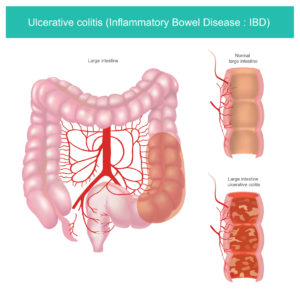
Ulcerative colitis is a disease that causes inflammation and sores, called ulcers, in the lining of the rectum and colon. Ulcers form where inflammation has killed the cells that usually line the colon, then bleed and produce pus. Inflammation in the colon also causes the colon to empty frequently, causing diarrhea.
When the inflammation occurs in the rectum and lower part of the colon it is called ulcerative proctitis. If the entire colon is affected it is called pancolitis. If only the left side of the colon is affected it is called limited or distal colitis.
Ulcerative colitis is an inflammatory bowel disease (IBD), the general name for diseases that cause inflammation in the small intestine and colon. It can be difficult to diagnose because its symptoms are similar to other intestinal disorders and to another type of IBD called Crohn’s disease. Crohn’s disease differs because it causes inflammation deeper within the intestinal wall and can occur in other parts of the digestive system including the small intestine, mouth, esophagus, and stomach.
Ulcerative colitis can occur in people of any age, but it usually starts between the ages of 15 and 30, and less frequently between 50 and 70 years of age. It affects men and women equally and appears to run in families, with reports of up to 20 percent of people with ulcerative colitis having a family member or relative with ulcerative colitis or Crohn’s disease. A higher incidence of ulcerative colitis is seen in Whites and people of Jewish descent.
The most common symptoms of ulcerative colitis are abdominal pain and bloody diarrhea. Patients also may experience
About half of the people diagnosed with ulcerative colitis have mild symptoms. Others suffer frequent fevers, bloody diarrhea, nausea, and severe abdominal cramps. Ulcerative colitis may also cause problems such as arthritis, inflammation of the eye, liver disease, and osteoporosis. It is not known why these problems occur outside the colon. Scientists think these complications may be the result of inflammation triggered by the immune system. Some of these problems go away when the colitis is treated.
Many theories exist about what causes ulcerative colitis. People with ulcerative colitis have abnormalities of the immune system, but doctors do not know whether these abnormalities are a cause or a result of the disease. The body’s immune system is believed to react abnormally to the bacteria in the digestive tract.
Ulcerative colitis is not caused by emotional distress or sensitivity to certain foods or food products, but these factors may trigger symptoms in some people. The stress of living with ulcerative colitis may also contribute to a worsening of symptoms.
Many tests are used to diagnose ulcerative colitis. A physical exam and medical history are usually the first step.
Blood tests may be done to check for anemia, which could indicate bleeding in the colon or rectum, or they may uncover a high white blood cell count, which is a sign of inflammation somewhere in the body.
A stool sample can also reveal white blood cells, whose presence indicates ulcerative colitis or inflammatory disease. In addition, a stool sample allows the doctor to detect bleeding or infection in the colon or rectum caused by bacteria, a virus, or parasites.
A colonoscopy or sigmoidoscopy are the most accurate methods for making a diagnosis of ulcerative colitis and ruling-out other possible conditions, such as Crohn’s disease, diverticular disease, or cancer. For both tests, the doctor inserts a long
endoscope—a long, flexible, lighted tube connected to a computer and TV monitor—into the anus to see the inside of the colon and rectum. The doctor will be able to see any inflammation, bleeding, or ulcers on the colon wall. During the exam, the doctor may do a biopsy, which involves taking a sample of tissue from the lining of the colon to view with a microscope.
Sometimes x rays such as a barium enema or CT scans are also used to diagnose ulcerative colitis or its complications.
Treatment for ulcerative colitis depends on the severity of the disease. Each person experiences ulcerative colitis differently, so treatment is adjusted for each individual.
Drug Therapy
The goal of drug therapy is to induce and maintain remission, and to improve the quality of life for people with ulcerative colitis. Several types of drugs are available.
Aminosalicylates, drugs that contain 5-aminosalicyclic acid (5-ASA), help control inflammation. Sulfasalazine is a combination of sulfapyridine and 5-ASA. The sulfapyridine component carries the anti-inflammatory 5-ASA to the intestine. However, sulfapyridine may lead to side effects such as nausea, vomiting, heartburn, diarrhea, and headache. Other 5-ASA agents, such as olsalazine, mesalamine, and balsalazide, have a different carrier, fewer side effects, and may be used by people who cannot take sulfasalazine. 5-ASAs are given orally, through an enema, or in a suppository, depending on the location of the inflammation in the colon. Most people with mild or moderate ulcerative colitis are treated with this group of drugs first. This class of drugs is also used in cases of relapse.
Corticosteroids such as prednisone, methylprednisone, and hydrocortisone also reduce inflammation. They may be used by people who have moderate to severe ulcerative colitis or who do not respond to 5-ASA drugs. Corticosteroids, also known as steroids, can be given orally, intravenously, through an enema, or in a suppository, depending on the location of the inflammation. These drugs can cause side effects such as weight gain, acne, facial hair, hypertension, diabetes, mood swings, bone mass loss, and an increased risk of infection. For this reason, they are not recommended for long-term use, although they are considered very effective when prescribed for short-term use.
Immunomodulators such as azathioprine and 6-mercapto-purine (6-MP) reduce inflammation by affecting the immune system. These drugs are used for patients who have not responded to 5-ASAs or corticosteroids or who are dependent on corticosteroids. Immunomodulators are administered orally, however, they are slow-acting and it may take up to 6 months before the full benefit. Patients taking these drugs are monitored for complications including pancreatitis, hepatitis, a reduced white blood cell count, and an increased risk of infection. Cyclosporine A may be used with 6-MP or azathioprine to treat active, severe ulcerative colitis in people who do not respond to intravenous corticosteroids.
Other drugs may be given to relax the patient or to relieve pain, diarrhea, or infection.
Some people have remissions—periods when the symptoms go away—that last for months or even years. However, most patients’ symptoms eventually return.
Occasionally, surgery is a viable option. Surgery is necessary if you experience large blood loss, chronic and debilitating symptoms, perforation of your colon, or a severe blockage. A CT scan or colonoscopy can detect these serious problems.
Surgery involves removing your entire colon with the creation of a new pathway for waste. This pathway can be out through a small opening in your abdominal wall or redirected back through the end of your rectum.
To redirect waste through your abdominal wall, your surgeon will make a small opening in your abdominal wall. The tip of your lower small intestine, or the ileum, is then brought to the skin’s surface. Waste will drain through the opening into a bag.
If waste is able to be redirected through your rectum, your surgeon removes the diseased part of your colon and rectum but retains the outer muscles of your rectum. The surgeon then attaches your small intestine to the rectum to form a small pouch.


By subscribing, you consent to receive emails from BlackDoctor.com. You may unsubscribe at any time. Privacy Policy & Terms of Service.