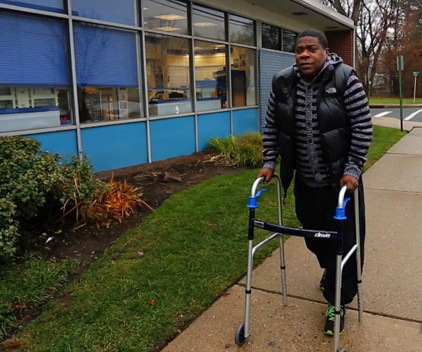
Tracy Morgan, best known for his off-the-wall humor, funny voices and uncanny ability to make us laugh by just being himself returned to television for the first time in his first television interview almost a year after the horrific traffic accident. The accident wounded his body and injured his brain. Tracy said in the NBC interview that he is on the road to recovery, although he still walks with a cane and has headaches and memory problems.”I have my good days and my bad days when I forget things,” he told Today’s Matt Lauer. “There are times when I have the headaches and the nose bleeds.”
“I wonder how I’m gonna be funny again,” Morgan said. “Remembering my identity, what do I do?”
You May Also Like: Chris Tucker Says: “The Best Comedy Comes From Pain”
Holding onto a cane, Morgan was overcome by emotion when talking about his fans, who he said have encouraged him to “come back.”
“I can’t wait to make them laugh again,” he said.
“I don’t want to walk my wife down the aisle with a cane or in a wheelchair,” Morgan, told PEOPLE. ” So I had to go hard with the therapy.”
“I had to get better,” he continues. “There was no ifs, ands or buts about it.”
When it comes to his ongoing journey to heal, Morgan says that learning how to sit down, stand up and walk again has been the most physically challenging obstacle, but his wedding has served as a big motivator.
Tracy is one of 275,000 Americans who suffer a brain injury each year that is severe enough to require hospitalization, according to the Centers for Disease Control and Prevention.
Tracy’s Recovery
Morgan’s beginning of recovery things looked pretty grim right after the accident on June 7, 2014. His lawyer, Benedict Morelli told the Associated Press, “when you have a traumatic brain injury, it takes a very long time to…
…find out how you’re going to do and how much you’re going to recover. You just don’t know. He’s still fighting and trying to live his life at the same time and trying to get better, and he’s just not better. We’re hoping and praying to get him back to where he was. But the jury’s out.”
A period of confusion and disorientation often follows a traumatic brain injury. A person’s ability to pay attention and learn stops, and agitation, nervousness, restlessness or frustration may appear. Sleeping patterns may be disrupted. The person may overreact to stimulation and become physically aggressive. This stage can be disturbing for family because the person behaves so uncharacteristically.
Inconsistent behavior is also common. Some days are better than others. For example, a person may begin to follow a command (lift your leg, squeeze my finger) and then not do so again for a time. This stage of recovery may last days or even weeks for some. In this stage of recovery, try not to become anxious about inconsistent signs of progress. Ups and downs are normal.
The fastest improvement happens in about the first six months after injury. During this time, the injured person will likely show many improvements and may seem to be steadily getting better. The person continues to improve between six months and two years after injury, but this varies for different people and may not happen as fast as the first six months. Improvements slow down substantially after two years but may still occur many years after injury. Most people continue to have some problems, although they may not be as bad as they were early after injury. Rate of improvement varies from person to person.
“I can’t wait to get back,” he told Lauer. “But right now my goal is just to heal and get better ’cause I’m not 100 percent yet. And when I’m there you’ll know it. I’ll get back to making you laugh.”


By subscribing, you consent to receive emails from BlackDoctor.com. You may unsubscribe at any time. Privacy Policy & Terms of Service.