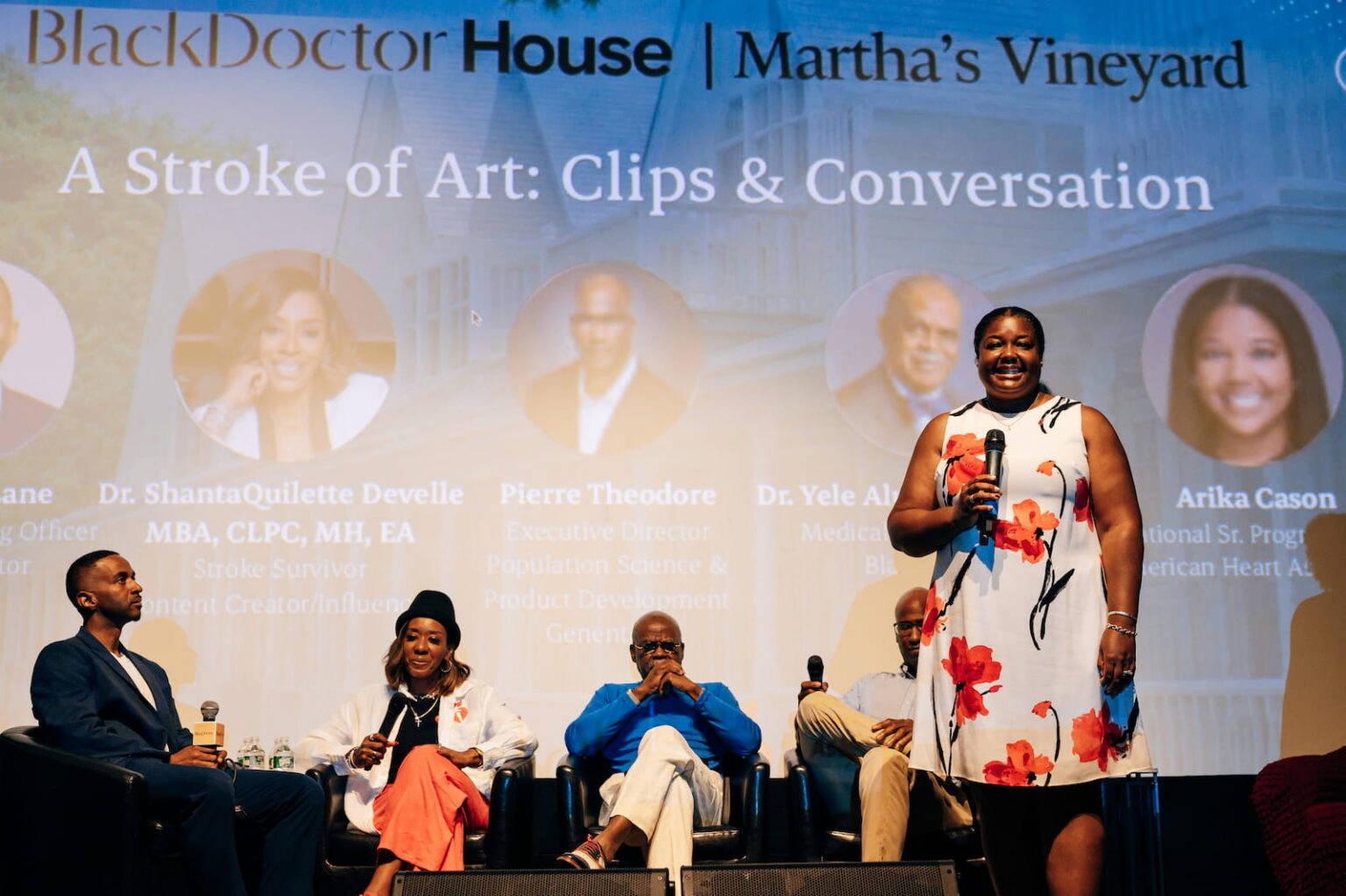
A stroke can change nearly every part of a person’s life. However, a stroke is not necessarily the end of the story — and a family history of stroke or cardiovascular disease is not a life sentence. That was the message from “A Stroke of Art: Clips and Conversation” at BlackDoctor House on Martha’s Vineyard on Aug. 12.
The discussion was part of BlackDoctor’s two-day programming at The Strand Theatre in Oak Bluffs, where workshops, fireside chats and conversations centered on health, family and the idea of changing health outcomes across generations.
Moderated by BlackDoctor Chief Marketing Officer Derrick Lane, the conversation brought together an expert panel of physicians with experience treating cardiovascular disease and stroke, as well as a stroke and heart attack survivor whose own experience has fueled years of advocacy.
“Stroke Is Not the End of Your Story”
For Dr. ShantaQuillette Delleve, the subject was personal.
A two-time stroke and heart attack survivor, Delleve described how a stroke affected not only her health but also her career, marriage, parenting and sense of identity.
“Stroke shattered my career,” she told the audience. “It shattered my life.”
Before her stroke, Dr. Delleve had worked for approximately 15 years as a forensic accountant with the IRS. She said she was at work preparing to seize someone’s property on the day of her stroke. She never returned to that job.
What people often fail to understand, she said, is that surviving a stroke does not mean the recovery journey is over.
For Dr. Develle, recovery remains a lifelong process that includes ongoing appointments with neurologists and cardiologists and heightened awareness of symptoms that might otherwise seem routine. She has also experienced transient ischemic attacks, or TIAs, since her strokes.

“Stroke is not the end of your story,” Delleve said. She explained that even when a survivor looks healthy on the outside, the effects can continue to shape everyday life. “I look good, y’all,” she said. “People always say, ‘You look good. You don’t look like you have a stroke.’ But that’s not the important part. It’s what you can’t see.”
That experience is now part of her advocacy work. She said she has been advocating for people of color since 2019, driven in part by the knowledge that recognizing the signs of stroke quickly may have saved her life.
“I’m thankful that I was at work and people did know what the signs of a stroke was, because I may not be here,” Develle said.
Now, Delleve said that her goal is to help make sure others don’t become her — and to promote prevention over treatment.
Life Before Stroke: The Opportunity to Prevent
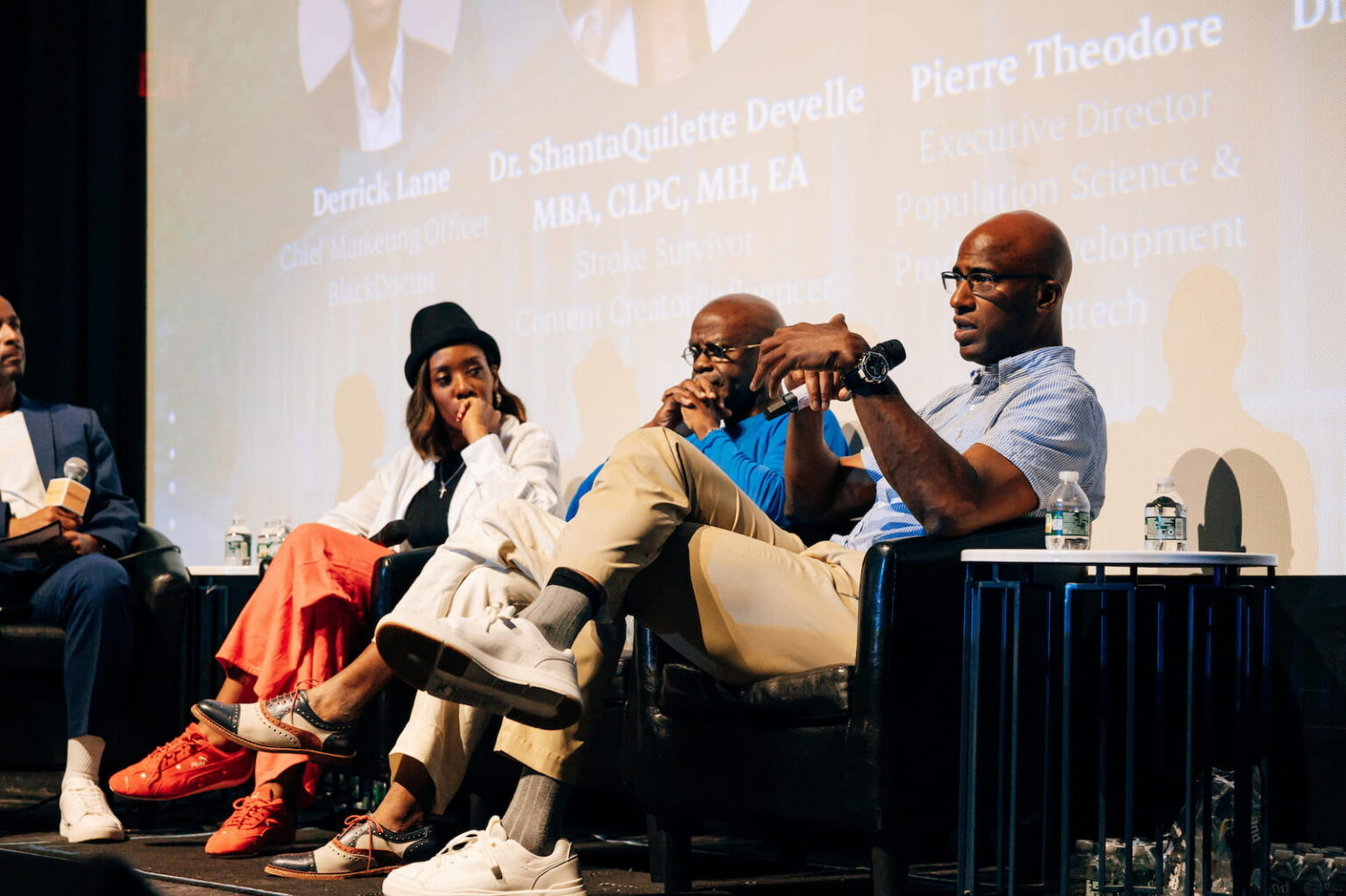
Dr. Pierre Theodore, executive director of population science and product development, at Genentech, shifted the conversation toward what happens before a stroke.
A cardiothoracic surgeon on the faculty in the Department of Cardiac Surgery at Stanford University, Theodore pointed to advances in preventive medicine over the past decade. He also emphasized the importance of ensuring that medications, medical devices and clinical research work for patients across different ethnicities, geographic locations, backgrounds and insurance situations.
“Have they been researched and is there a reflection on how they reach all patients regardless of ethnicity, where people live, what their background is, their insurance status, all those things?”
He described this as a more inclusive and individualized approach to clinical research — one that can help patients understand whether a particular treatment or intervention is appropriate for them.
But the broader message was equally important: medicine now has more tools to identify cardiovascular risk before a major event occurs.

Lane asked Dr. Yele Aluko, a BlackDoctor Medical Advisory Board Member, to address one of the most persistent questions surrounding cardiovascular health: Why are Black Americans often described as being at greater risk for stroke?
“There is a misperception that there’s a genetic driver that provides increased risk to Black and brown Americans,” Aluko said.
He acknowledged that genetic predispositions to disease exist, but said it is misleading to view Black and brown Americans as having a blanket genetic predisposition to stroke or cardiovascular disease.
Instead, he pointed to what he described as generational patterns of behavior and health-system interactions.
For example, poor diet choices can be passed from one generation to the next. Habits, patterns of interacting with the healthcare system, missed appointments and chronic stress that goes unattended can too, Aluko said.
“It is more likely a perpetuation of behaviors within a family unit,” Aluko said.
That distinction matters because many strokes — particularly ischemic strokes caused by blocked blood vessels — develop over a long period of time.
Aluko explained that when cholesterol, calcium and other factors contribute to blockages in blood vessels, the process may have been developing for decades.
That creates an opportunity for primary prevention: identifying and managing risk before a stroke or heart attack occurs.
Once an event has happened, the focus shifts to secondary prevention — identifying the collection of risk factors that contributed to the event and managing them over time.
“We must know what those risk factors are, each and every one of them.”
For stroke survivors, he said, rehabilitation is only one part of the process. Long-term management of the underlying risks is essential.
One of the panel’s most memorable moments came when Dr. Theodore tied in the island location into a health lesson to help the audience remember the invitation. He used the major cardiovascular risk factors he associated with American Heart Association guidance. Here’s how Theo broke it down:
V — Vascular health
Pay attention to cardiovascular health and emerging laboratory measures such as ApoB and Lp(a).
I — Inflammation
Understand inflammation and tests such as high-sensitivity CRP that can provide additional information about cardiovascular risk.
N — New guidelines
Stay informed about updated recommendations and guidelines for cardiovascular disease.
E — Early diagnosis and evaluation
Ask whether assessments such as a coronary calcium score or echocardiogram may provide useful information about cardiovascular risk.
Y — Your individual efforts
Lifestyle and individual health choices—including maintaining a healthy weight—matter.
A — Actively monitor your health
Tools such as home blood-pressure monitors and glucose monitors can help people track important health information.
R — Recognize and respond
Know what stroke and heart-attack symptoms look like and understand when immediate action is necessary.
D — Direct advocacy
Ask questions. Know your risk factors. And ask your healthcare provider whether your care reflects current guidelines.
The mnemonic was more than a clever Martha’s Vineyard reference. It reflected the panel’s larger argument that prevention requires people to be informed participants in their own healthcare.
“When you hit that primary care office, you have this way of really pinning that provider down on what are the risk factors, what needs to be done, and is that provider following these updated guidelines for the management of heart disease?” Theodore said.
When Lane asked the panelists to name one action they wanted people to take to help prevent stroke, Dr. Develle returned to the basics: know the warning signs. F.A.S.T. stands for:
But Dr. Develle’s answer went beyond memorizing an acronym.
She urged people to understand what their bodies feel like when they are healthy, so they can recognize when something has changed.
“You have to be an active participant in your own rescue,” Develle said.
She also challenged the cultural expectation that people — particularly Black women — should simply push through exhaustion and discomfort. She pointed to symptoms such as arm weakness, headaches, palpitations and chest pain that people may dismiss while continuing to work or care for others.
“We wear exhaustion like it’s a badge of honor,” Develle said. Her message was ultimately about self-advocacy and self-care.
Prevention Requires Health Literacy
Dr. Aluko returned to the healthcare system and the importance of prevention. While he credited institutions, such as the Mayo Clinic and Cleveland Clinic, and the country’s medical technology. Aluko argued that the system remains heavily oriented toward treating illness rather than preventing it.
“The industry itself is not a health industry. It is a sickness industry and illness industry.”
Aluko cited a 97-to-3 split between healthcare spending on treatment and prevention during the discussion, using the statistic to underscore his argument that prevention receives relatively little attention.
His larger point was that people need a clearer understanding of their own risk profiles.
That means asking questions that go beyond stroke: What is my cardiovascular risk? What are my hypertension numbers? Am I at risk for cancer? What other conditions should I be monitoring?
“We need to know the risk and we need to walk out of doctor’s offices with a complete understanding as to what one’s risk factor profile is.”
For Aluko, health literacy and personal responsibility work together: understand the risks, manage them and maintain them over time.
As Lane asked the panelists to close with their final thoughts, Theodore returned to the idea that had threaded through the conversation from the beginning: family history matters, but it does not necessarily determine the outcome.
“Genes are not destiny,” Theodore said. “The fact that you have a first-degree relative or someone else has been affected by them is not some form of a sentence for each of us. We have the ability to modify that” whether it’s stroke, cardiovascular disease and Alzheimer’s disease.


By subscribing, you consent to receive emails from BlackDoctor.com. You may unsubscribe at any time. Privacy Policy & Terms of Service.