What does your body feel like when it’s completely at peace? When the body is so relaxed that the mind follows, and you feel safe and completely rested.
There aren’t many positions that allow the body to completely rest. One stands out as not only a position that relaxes the body but also one that gives the nervous system the calm it needs to reset.
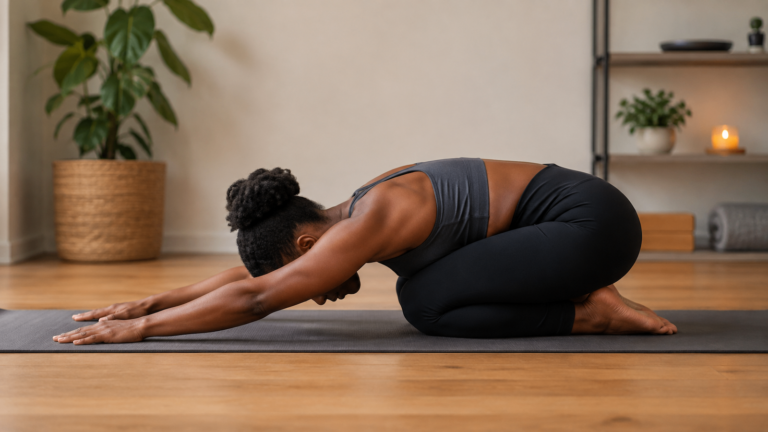
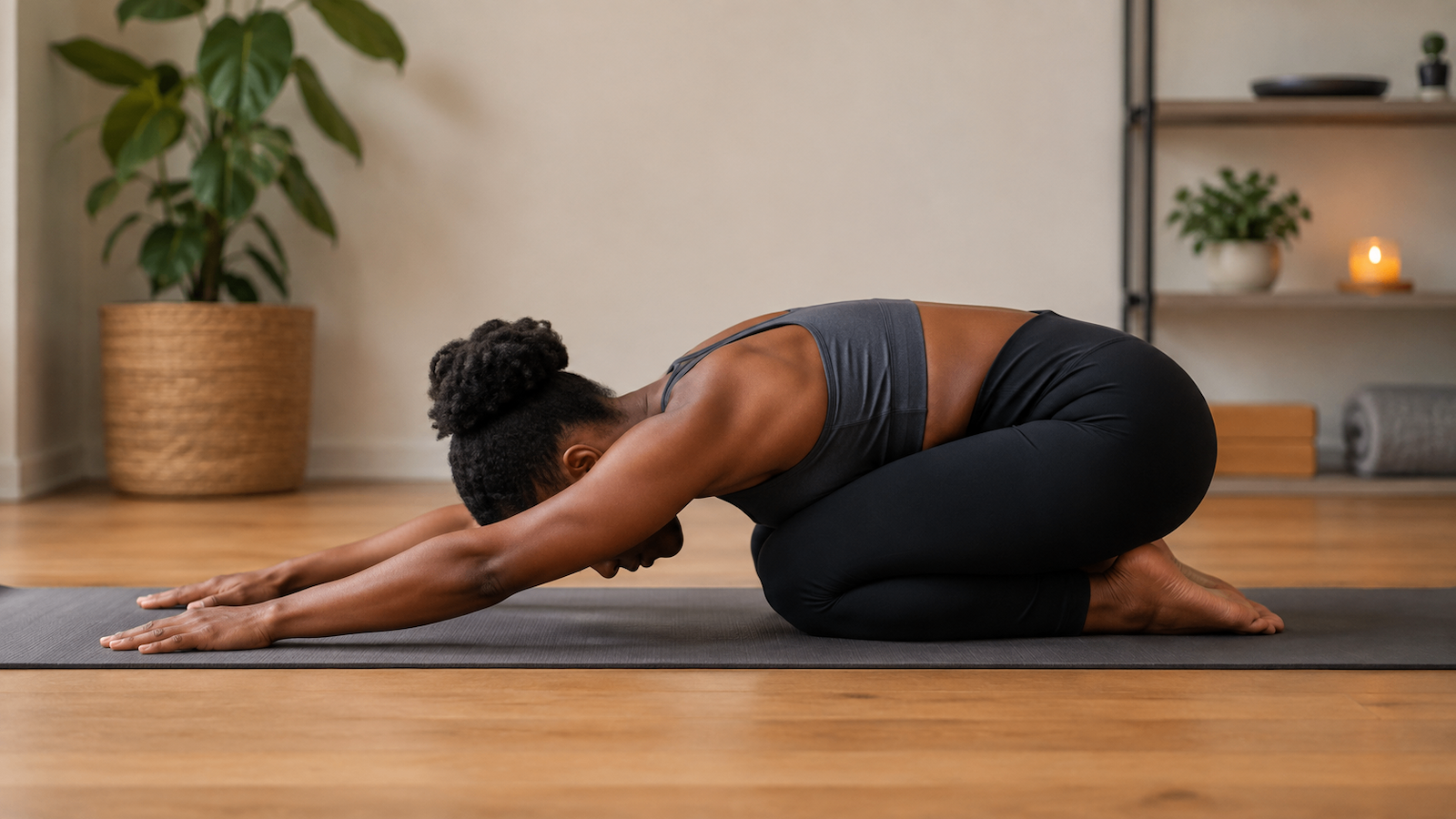
Child’s Pose is a gentle forward fold in which you sink your hips back toward your heels, walk your hands out in front of you, and rest your forehead on the floor. It looks like a spot to catch your breath between harder movements. Held on its own for a minute and a half, it works more like a reset button for your entire body and nervous system.
Here is what happens when you incorporate Child’s Pose into your daily wellness ritual.
Your nervous system spends most of the day scanning for threats. Deadlines, traffic, a full inbox, a hard conversation you are bracing for. It reads all of that as danger and keeps you in a low, humming version of fight-or-flight. You may not feel it as fear, but your body treats it that way.
Child’s Pose interrupts that pattern with something surprisingly simple: your shape. When you curl inward, tuck your torso over your thighs, and lower your head and bring it forward, you make yourself small, rounded, and protected. The body understands this position as safety at an instinctive level. Folded and shielded is how a body rests when nothing is coming for it.
Your brain reads the position and begins to lower its guard, shifting you out of that revved-up state and into what is called the parasympathetic mode, the rest-and-digest side of your nervous system where healing and repair happen.
RELATED: The 15-Minute Yoga Sequence that Tones Your Entire Body
The single most powerful part of the pose is also the easiest to overlook. When you rest your forehead on the ground, you gently put pressure on an area rich with vagal nerve influence via the trigeminal-vagal reflex arc, part of the pathway your body uses to switch from alert to calm. The light, grounding pressure signals that you can rest in peace. Many people notice their breath slowing and deepening within a few seconds of their forehead touching the floor, without ever consciously trying to change it. That is the pose doing the work for you.
If the floor feels far away, rest your forehead on a stacked pair of fists, forearms, a folded blanket, yoga blocks, or a pillow. The contact matters more than how and where.
Most of us spend the day compressing our lower backs without realizing it. Hours of sitting shorten and crowd the lumbar spine, and by evening that low, achy tightness in your lower back has set in.
Child’s Pose does the opposite of sitting. As you reach your hips back toward your heels and let your spine lengthen forward, the vertebrae in your lower back gently draw apart, decompressing the area that carries so much of the day’s load. It’s the length your spine needs to support you without strain and can literally be the medicine you’re missing to treat chronic back pain.
Deep in the front of your hip sits the psoas, a long muscle that connects your spine to your legs and absorbs a remarkable amount of your stress without you ever noticing. When you are anxious, bracing, or even just sitting for hours, the psoas tightens and holds. Over time, it stays contracted, tugging on your lower back and keeping your whole system on edge.
Child’s Pose gives this deep hip flexor a chance to lengthen and let go. Releasing the psoas is one reason the pose can leave you feeling lighter and calmer in a way that seems disproportionate to how little you did.
RELATED: The One Yoga Pose You Should Do Every Morning
Here is the part that makes this genuinely doable: you do not need a full practice or a free half hour to feel it. A minute or two in the pose is enough to begin the shift, because the real work is happening in your breath. Slow, steady breathing has been shown to nudge the body toward its calm, parasympathetic setting within a few minutes, and Child’s Pose gives that breath intentional time and space.
A couple of minutes is short enough to tuck into the cracks of a real day. You can drop into Child’s Pose first thing in the morning before the chaos of a busy day, on the floor beside your desk when your workday pauses, or in bed as the last thing you do before sleep. While you are there, let each exhale run a little longer than the inhale, and let the ground hold your weight completely. That longer, slower breath is what carries the message to your nervous system, so let it lead.
The more often you return to the pose, the more your body learns the shortcut. Eventually it becomes a cue, and your system starts to settle the moment you begin to fold.
Comfort is the whole point, so adjust freely. Here are some adjustments that will make Child’s Pose comfortable and accessible in every body:
Anyone with knee, hip, or back concerns should ease in slowly and talk with a doctor or physical therapist about what is right for their body. There is no prize for pushing through discomfort. A version of the pose that feels good is the version that works.
It is easy to believe that caring for yourself has to be a whole production, that relief lives at the end of a long to-do list filled with self-care habits. A ninety-second fold you return to most days will do far more for you than the elaborate routine you keep meaning to start. You don’t need to buy anything, book anything, or become anyone new. You need the floor, your breath, and a minute and a half. Everything else, your body already knows how to do.



By subscribing, you consent to receive emails from BlackDoctor.com. You may unsubscribe at any time. Privacy Policy & Terms of Service.