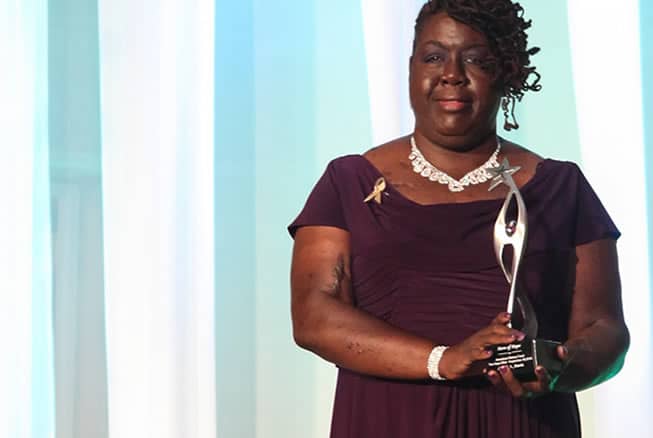
Angela L. Davis is the founder of For Kidney’s Sake, a nonprofit based in Queens, New York, that helps dialysis patients overcome isolation and depression by participating in fun and educational social events. She was honored as the American Kidney Fund Hero of Hope in 2015 for her commitment to making life better for the patients in her community. Here she shares with BlackDoctor.org her personal story of coping with kidney disease.
Dialysis, isolation, depression, anger. Each of these words has a separate meaning but they seem to go hand-in-hand with each other. For many dialysis patients, these words combine to form a “new normal” state brought on by living with kidney failure. I know this, because I live it.
READ: 25-Year-Old Son Donated Kidney To Mother & Saved Her From Dialysis
I started this journey in January 2008 and I have seen, heard and shared a lot with other chronic kidney disease and dialysis patients in the past eight years. Many patients, myself included, have many co-morbidities. We have to see multiple physicians and specialists, and they prescribe a myriad of drugs. Going to dialysis three times a week and constantly having to visit different doctors often brings on a flood of anxiety and feelings of depression. This disease has a way of taking over your life.
Having kidney failure changes a lot of things, and that can contribute to feelings of depression and isolation. One of the first things that can change quickly is your social life. Throughout my eight-year run on dialysis I have lost many friends who stopped coming to visit or just no longer wanted to get together. I could no longer eat the same foods or drink alcohol, and I had to limit my fluid intake.
I couldn’t travel on a whim anymore—it’s hard to be spontaneous when you have to be attached to a machine for four hours, three times a week. Eventually these friends felt they could no longer hang out with me; others were just put off or freaked out by the entire process of dialysis and my physical changes.
READ: These Symptoms Could Be A Sign Of Kidney Failure
I was not prepared for the physical changes this disease would wreak on my body. My skin became four shades darker, extremely dry and flaky, often peeling and itching. Every inch of my body…
…itched and/or flaked from my scalp to my feet. My legs and feet would expand between treatments due to the fluids retained in my body. To this day, I break out in dry patches, or in pimples on my face and back. These changes are hard to look at in the mirror every day. They can make patients feel ugly and not want to be seen by others, increasing their isolation.
READ: 4 Steps To Clean Your Kidneys
Many patients, myself included, experience extreme fatigue and a sense of confusion or forgetfulness. We nickname this “Kidney Brain”—you feel “fuzzy” or have problems remembering things or find yourself losing your place in thought. I have heard patients say they feel this sense of “fuzziness” is often at its worst right after their dialysis treatments.
This is not an easy topic to write about but it’s something that we need to bring into the open.
We need dialysis care teams to have this conversation with patients not once, not twice, but ongoing. I believe we need more collaboration between the mental health community and the renal community so that caregivers can help identify patients who are isolated or may be depressed. In an ideal world, dialysis centers would have a mental health professional—a psychologist, therapist or some form of counselor—on staff or at least affiliated with the center. Since patients are at treatment so often it would be convenient if there were a mental health professional available for them on-site.
I am doing my part to help patients in my community reduce isolation by creating opportunities to meet others facing similar challenges for socialization, fun and recreation through a small nonprofit, For Kidney’s Sake. I don’t think the only time a patient goes out of her house should be to go to the doctor’s office or dialysis. I don’t think a patient should be embarrassed by how he looks. I am convinced that the lives of dialysis patients can be improved dramatically by creating these kinds of connections.
READ: 9 Ways To Take Better Care Of Your Kidneys
This issue should become a national movement. If we talk about it, we can improve it. We can improve the lives of dialysis patients, one day at a time!


By subscribing, you consent to receive emails from BlackDoctor.com. You may unsubscribe at any time. Privacy Policy & Terms of Service.