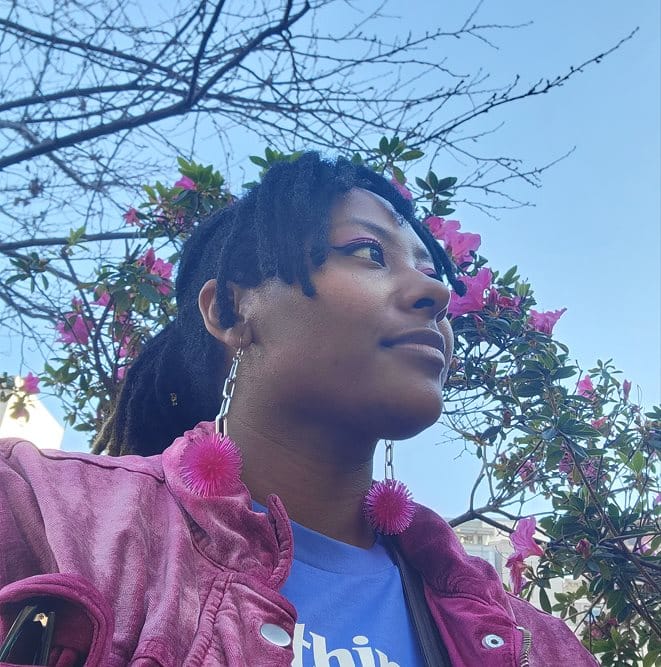
Living with a chronic condition often involves navigating uncharted territory, facing unexpected challenges, and building resilience along the way. For Roshelle, her diagnosis of migraine disease became the catalyst for a life of advocacy, empowerment, and community building.
Roshelle’s migraine journey began in the spring of 2019 during her time serving in the Air Force. What initially appeared to be isolated incidents quickly turned into debilitating attacks that affected her speech, mobility, and cognitive abilities.
“At first, I thought maybe it was a fluke—maybe something I ate or just exhaustion—but as these episodes became more frequent and debilitating, I watched as my quality of life and ability to perform my duties were severely impacted. My work at the time required me to spend most of the day in front of computer screens under bright office lights, and I found myself struggling because the lights became unbearable. The physical toll made it difficult for me to attend training or even get to work some days,” Roshelle tells BlackDoctor.org.
Despite these challenges, her initial attempts to seek medical help were met with dismissal—a common experience for many dealing with invisible conditions.
“Seeking answers, I went to my primary care manager, my doctor at the time. Unfortunately, it was one of those experiences where my symptoms and concerns were dismissed, which was devastating. I was already feeling scared, but on top of that, I felt unsupported. So I turned to my inner grit—I knew my experience was real and needed to be addressed. I advocated for myself, and that started with getting a new medical provider,” Roshelle adds.
Changing her medical provider marked a turning point in her journey. With the help of a supportive team, she was granted medical leave, enabling her to focus on her health and ultimately receive a diagnosis of migraine disease in May 2019.
“Having a name for what I was experiencing was a turning point—it allowed me to pursue treatment and develop strategies to manage my condition,” Roshelle shares.
Roshelle spent her month of leave resting and making adjustments as she processed what all of this meant.
“I was eventually able to return to work and even go on to complete my military contract, serving another year and a half. This experience shaped how I manage my migraines today, but it also taught me the importance of self-advocacy,” Roshelle notes.
RELATED: From Bedridden to Award-Winning: My 16-Year Journey with Migraine
For Roshelle, receiving a diagnosis was only the beginning. It empowered her to pursue treatment and build strategies to manage her condition. However, her experiences highlighted a broader need for advocacy. Inspired by another advocate she encountered online, Roshelle joined the Alliance for Headache Disorders Advocacy (AHDA) and began participating in their annual “Headache on the Hill” event. This initiative connects advocates with legislators to push for meaningful changes, including increased funding for headache research and improved accommodations for students and veterans with headache disorders.
“Volunteering with AHDA has taught me how to effectively use my story and voice to make an impact, especially when speaking with legislators. Often, policymakers are just looking at numbers and statistics—there are no faces or personal stories attached. But when people like me share our experiences, we make these issues real for them,” Roshelle shares.
For Roshelle, connecting with other advocates, including people with headache disorders and allies, has been incredibly empowering.
“It reminds me that even when the system feels overwhelming, there are people and organizations fighting to make it better. It’s amazing to see how my story can help put a face to these issues and make legislative asks feel more personal for lawmakers,” Roshelle adds.
A lifelong gamer, Roshelle has also turned her attention to improving accessibility in the video game industry. For her, gaming has always been a source of connection and creativity, but many games remain inaccessible to players with migraine disease.
“Gaming has always been my escape—a way to find comfort, connection, and creativity. But as someone who experiences migraine attacks, I know how inaccessible some games can be,” Roshelle shares. “Things like overly bright graphics, overwhelming motion effects, or a lack of customization options can make gaming unbearable during an attack. I became really interested in gaming accessibility after taking the Certified AbleGamers Practitioner training, which teaches how to design games that are inclusive from the start.”
After completing the Certified AbleGamers Practitioner training, Roshelle began researching ways to address these challenges, aiming to make gaming a more inclusive experience for everyone.
“I’ve seen promising improvements in the industry, such as motion stabilization settings and customizable brightness and sound controls. I hope to contribute to this progress because I believe gaming should be for everyone—no one should have to give up something they love because of a disability, visible or not,” Roshelle says.
RELATED: Breaking the Migraine Stigma: How to Advocate for Yourself at Work
One of the greatest barriers for those living with migraine disease is societal misunderstanding. Roshelle is passionate about debunking the myth that migraines are “just headaches.”
“For me, cognitive fog, difficulty speaking, and physical weakness can be worse than the actual pain because they last longer. Another misconception is that migraines affect everyone the same way—what works for one person might not work for another,” Roshelle notes.
According to the American Migraine Foundation, migraine is a common and disabling condition reported in approximately 12 percent of the population.
Another key focus of Roshelle’s advocacy is language. By shifting from dismissive phrases, Roshelle aims to foster a culture of understanding and respect for those living with this invisible condition.
“Changing the language we use is also important. For example, I say, ‘I’m having a migraine attack’ instead of just ‘I have a headache’ to help people understand the severity of what I’m experiencing,” she says.
For those navigating a similar journey, Roshelle offers three key pieces of advice:
Moving forward, Roshelle plans to build on her advocacy and research efforts. As one of AbbVie’s 20 Migraine Career Catalyst Award winners, she is more motivated than ever to push boundaries and drive meaningful change. With this recognition, she has expanded her research into accessibility and strengthened her commitment to creating inclusive spaces for those living with migraines.
“Winning the award was one of the most validating experiences of my life. I didn’t expect to win, and when I did, it felt like recognition—not just of my advocacy work but of my personal journey,” Roshelle concludes. “The award has allowed me to dive deeper into projects I care about, like writing about my experiences, researching accessibility in gaming, and amplifying diverse voices. It’s a reminder that my work matters and that I have the power to create meaningful change.”

By subscribing, you consent to receive emails from BlackDoctor.com. You may unsubscribe at any time. Privacy Policy & Terms of Service.