Every year, around Christmas time, you may hear some Black folks talking about celebrating Kwanzaa. many of them jokingly because they don’t know the history or roots behind the holiday. Here’s how it all came about and why celebrating it could be more important than ever.
Maulana Karenga created Kwanzaa in 1966, as the first specifically African-American holiday. According to Karenga, the name Kwanzaa derives from the Swahili phrase matunda ya kwanza, meaning “first fruits of the harvest”. The choice of Swahili, an East African language, reflects its status as a symbol of Pan-Africanism, especially in the 1960s, although most of the Atlantic slave trade that brought African people to America originated in West Africa.
Kwanzaa is a celebration that has its roots in the black nationalist movement of the 1960s and was established as a means to help African Americans reconnect with their African cultural and historical heritage by uniting in meditation and study of African traditions and Nguzo Saba, the “seven principles of African Heritage” which Karenga said “is a communitarian African philosophy”. Karenga believed and stated that “you must have a cultural revolution before the violent revolution. The cultural revolution gives identity, purpose and direction.”
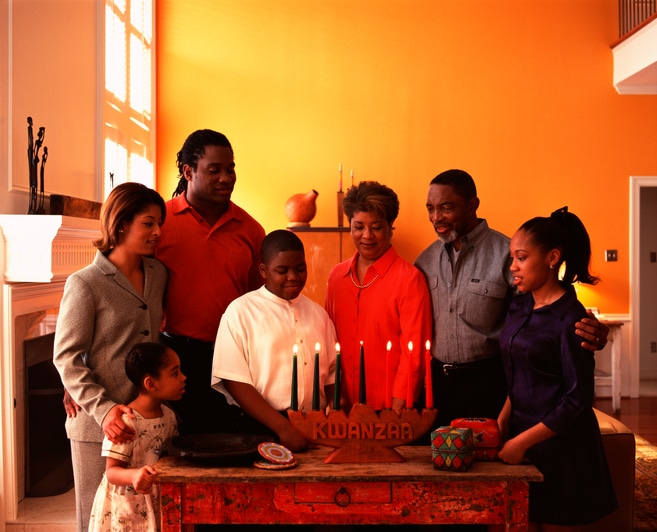
Kwanzaa was not created to give people an alternative to their own religion or religious holiday. Many African Americans who celebrate Kwanzaa do so in addition to observing Christmas.
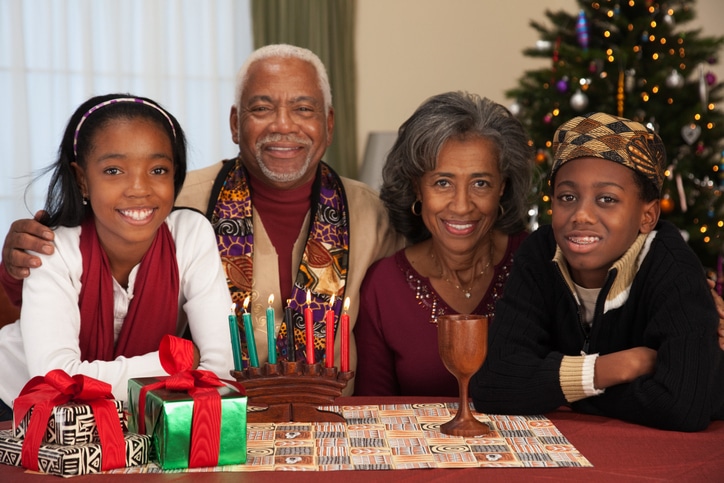
Kwanzaa spans over seven days with each day focusing on a specific principle in the Black community. A Kwanzaa ceremony may include drumming and musical selections, libations, a reading of the African Pledge and a discussion of the African principle of the day or a chapter in African history and a feast known as the “karamu.”
Each day also consists of a candle-lighting ritual. You have what is called a kinara (candle holder) and seven candles (one black candle, three green candles and three red candles). The black candle is lit first then used to light each of the other candles on the day that is celebrated, going back and forth with lighting the red and green.
The seven principles of Kwanzaa are as follows:
To strive for and to maintain unity in the family, community, nation, and race.
To define and name ourselves, as well as to create and speak for ourselves.
To build and maintain our community together and make our brothers’ and sisters’ problems our problems and to solve them together.
To build and maintain our own stores, shops, and other businesses and to profit from them together.
To make our collective vocation the building and developing of our community in order to restore our people to their traditional greatness.
To do always as much as we can, in the way we can, in order to leave our community more beautiful and beneficial than we inherited it.
To believe with all our hearts in our people, our parents, our teachers, our leaders, and the righteousness and victory of our struggle.
Besides the candles and the candle holder, other Kwanzaa celebratory symbols include a mat (Mkeka) on which other symbols are placed: a Kinara (candle holder), Mishumaa Saba (seven candles) mazao (crops), Muhindi (corn), a Kikombe cha Umoja (unity cup) for commemorating and giving shukrani (thanks) to African Ancestors, and Zawadi (gifts). Supplemental representations include a Nguzo Saba poster, the black, red, and green bendera (flag), and African books and artworks – all to represent values and concepts reflective of African culture and contribution to community building and reinforcement. With corn being the primary symbol for both decoration and celebratory dinning.
The greeting for each day of Kwanzaa is Habari Gani? which is Swahili for “What’s the news?” or “How are you?”


By subscribing, you consent to receive emails from BlackDoctor.com. You may unsubscribe at any time. Privacy Policy & Terms of Service.