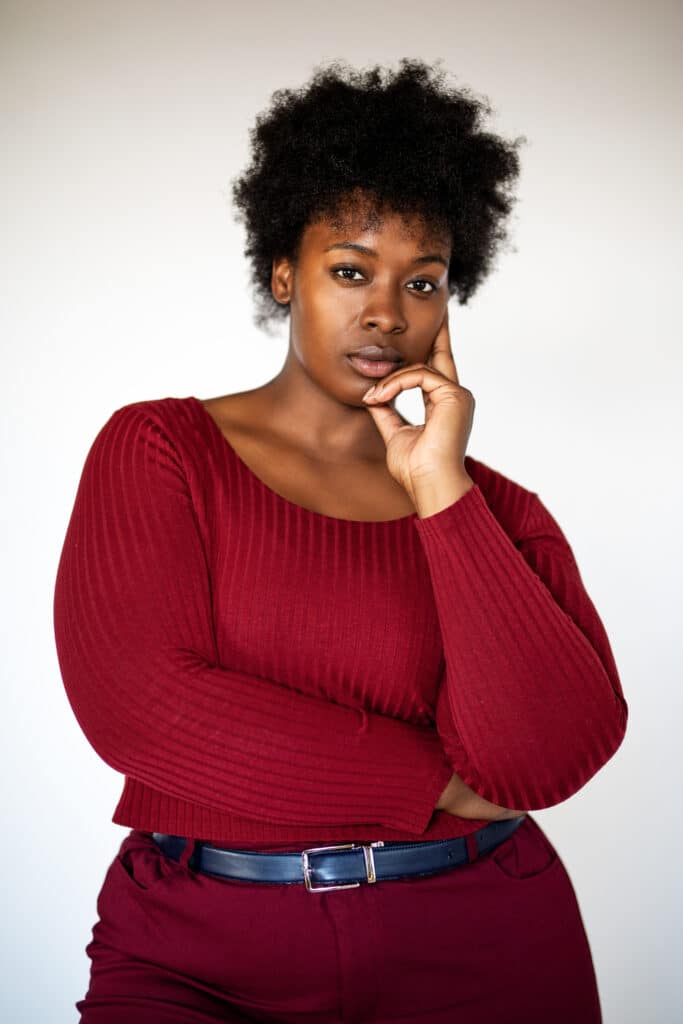
“Ooooh, she thick!” That’s usually a phrase that is used in a good way. Some men say they don’t want a woman who is too skinny, so being “thick” is in. But what is “too thick” when it comes to our health?
“Thick” and “obese” are not interchangeable terms. “Thick” is a subjective descriptor often used to describe someone with a larger build, particularly in their hips and thighs, and can be associated with a healthy amount of muscle and fat. “Obese”, on the other hand, is a medical term based on a person’s Body Mass Index (BMI) (a measure of body fat based on height and weight). A BMI of 30 or higher indicates obesity.
With the term “thick” rapidly being accepted as embracing a few extra pounds, fitness champion and author, Laticia “Action” Jackson cautions Black women to put aside the images portrayed to us in our homes, communities, as well as mass media and take control of their well-being. Recently, BlackDoctor.org had the opportunity to catch up with the 2008 Fitness Olympian, who stressed the urgency of making time for ourselves.
“One of the things I really try to encourage women is I don’t care if you only get 20 minutes – doing something for yourself each day is important,” said Jackson.
When asked about the inspiration behind her latest book Jackson replied: “I’ve been in this field for 16 years. As a professional athlete, I’m usually the only Black woman inside my circle and one thing I noticed is that while there’s an overabundance of health, fitness and nutrition books available for today’s consumer, the health and wellness market really wasn’t paying attention to African American women and the challenges we face when trying to shed extra pounds, proper nutrition, and fitness.”
As health fanatics know far too well, obesity has been linked to type 2 diabetes, heart disease, hypertension, stroke and many forms of cancer. “If you look at the health disparity of African American women, we are literally dying,” Jackson stressed. “The data is alarming. According to the CDC, 4 out of 5 African American women are obese. So, I just said you know what? I’m going to take the next six months and write a book that’s just for us.”
One of the most commonly used tools to define “healthy weight” is the Body Mass Index (BMI)—but did you know it was never designed for Black women or even non-white populations?
The first thing to know about the BMI is that it was created by a Belgian mathematician — not a doctor or health practitioner.
In the 1830s, Lambert Adolphe Jacques Quetelet set out not to devise a test to quickly diagnose obesity (which was still years away from being widely perceived as a problem) but to find the “l’homme moyen” or the “average man.”
He thought you could take thousands of measurements, compare them, and find the ideal weight. He calculated these samples and found that weight typically increases concerning a person’s square height.
But Quetelet’s experiment had big limitations. For one, all the participants were Western European men. The experiment also had nothing to do with measuring individual health. Despite its outdated origins, doctors still use BMI today to diagnose obesity and health risks.
Black women naturally have the following:
Studies have shown that Black women with a BMI in the “overweight” or “obese” range can still have perfectly normal blood pressure, cholesterol, and metabolic health—proving that BMI alone is not a reliable indicator of health.
BMI is a flawed, outdated tool that doesn’t account for body composition. Being “thick” according to BMI does not automatically mean you’re unhealthy.
RELATED: Queen Latifah Sheds Light on BMI Chart Flaws: “I’m Just Thick”
If BMI is inaccurate, what should we use to determine health?
Waist-to-Hip Ratio measures where fat is stored, a better predictor of health than BMI.
How to measure:
Example:
Instead of focusing on weight alone, check:
Many Black women with a “higher” BMI have normal blood pressure, cholesterol, and blood sugar—meaning they are metabolically healthy despite having extra weight.
Bottom Line: Your weight alone doesn’t determine health: blood markers, muscle mass, and fat distribution matter more.
A person’s ability to move, lift, and sustain physical activity is a much better indicator of health than weight.
Ask yourself:
Your ability to move well, maintain strength, and stay active matters more than the number on a scale.
Fitness extends beyond the gym into daily lifestyle choices. Your nutrition, sleep quality, and stress management strategies can significantly impact your health. Eating a balanced diet rich in nutrients fuels your workouts and aids recovery.
Prioritizing sleep is equally vital, allowing your body to repair and replenish energy. Incorporating stress-reduction practices, such as mindfulness or yoga, can improve your mental well-being and enhance physical performance. Understanding that every small lifestyle change matters can lead to sustainable habits and long-term fitness success.
Many Black women struggle with the pressure to shrink themselves, whether it’s from diet culture or societal beauty standards. But here’s the truth: Being strong is more important than being thin.
To live longer and feel better, prioritize strength and weight loss.
One of the biggest myths is that lifting weights will make women look too muscular—but that’s not true, especially for Black women.
Strong = Thick & Fit. You don’t have to be skinny to be healthy.
Measuring waist circumference can help to assess obesity-related health risk. Even at a healthy weight, excess fat carried around the waist can increase your risk of high blood pressure, high [blood] cholesterol, heart disease and type-2 diabetes. The best way to find out if your waistline is increasing your risk of heart disease is to measure it.
Where you carry your weight is just as important as how much weight you carry when it comes to your health. This two-minute video will help you determine if you’re at risk for overweight-related diseases such as high blood pressure, high blood cholesterol, type-2 diabetes, heart disease and stroke by providing the proper steps to assess your waistline size with a measuring tape.
So yes, you can be healthy and thick.


By subscribing, you consent to receive emails from BlackDoctor.com. You may unsubscribe at any time. Privacy Policy & Terms of Service.