
Menu

Fewer Black Women Are Dying from Breast Cancer—Here’s Why

Table of Contents
breast cancer

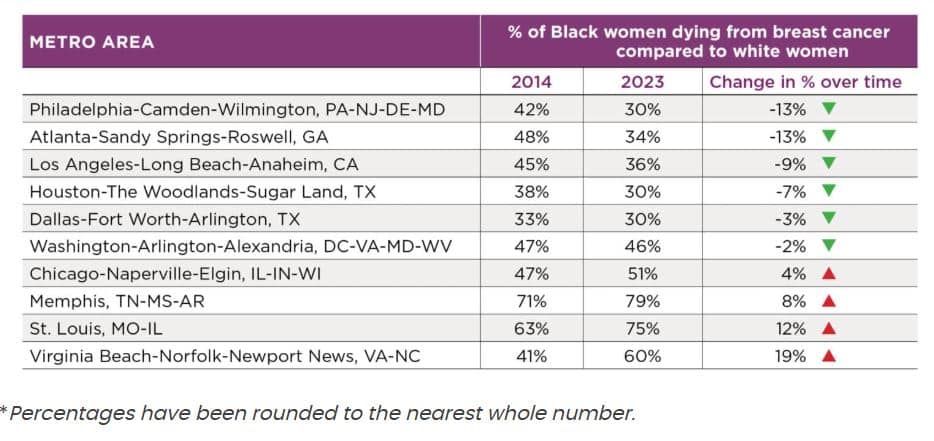
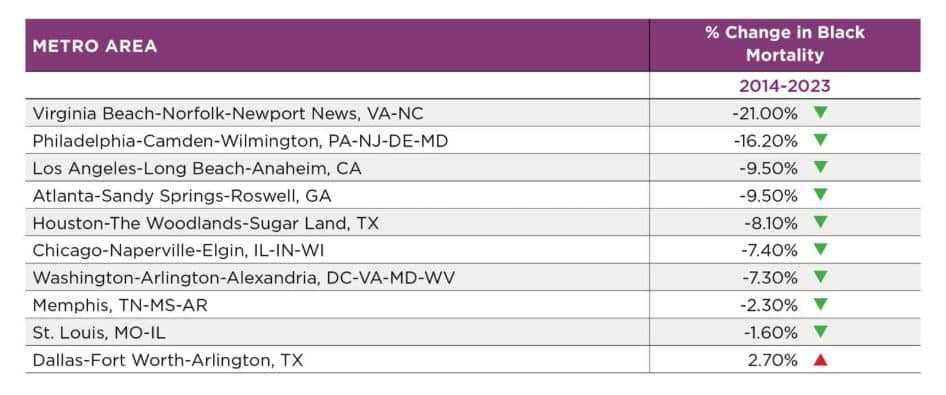
The numbers are stark: Black women are about 40 percent more likely to die from breast cancer compared to white women, even though they are diagnosed at similar rates. This isn’t just a statistic; it represents systemic barriers that Susan G. Komen is fiercely working to tear down. BlackDoctor spoke with Dr. Sonja Hughes, an experienced OB-GYN and Vice President of Community Health at Susan G. Komen, about the hopeful news from Komen’s recent analysis (comparing 2014 and 2023 data by the Centers of Disease Control and Prevention (CDC) and National Cancer Institute (NCI)), which reveals that fewer Black women died of breast cancer in nine of 10 major metro areas studied. “Our recent update indicates we’re making some progress. In some of the cities, the gap improvement was double-digit,” Dr. Hughes says.  This progress shows that when resources are targeted, lives are saved. However, the fight isn’t over. In areas like Memphis (79 percent more likely to die) and St. Louis (75 percent more likely to die), the disparity remains alarmingly high.
Your Empowerment Plan: Tools and Resources from Komen

Komen’s strategy is designed to meet you, the patient, wherever you are on your health journey, offering support that is both culturally sensitive and directly actionable.

1. Personalized Support and Guidance

  • The Helpline is Your First Advocate: If you have questions about screening, need emotional support, or are facing financial hardship (like paying for transportation or housing), call the national helpline at 877-GO-KOMEN (877-465-6636). They are ready to connect you with resources, including financial assistance.
  • A Navigator Who Understands You: Komen’s Patient Care Center offers culturally sensitive patient navigation. You can be paired with a navigator who may share a similar background, ensuring the guidance you receive is relevant and supportive.

2. Knowledge is Power: Know Your Body, Demand Your Care

Dr. Hughes offers three crucial steps for every woman to take charge of her health:

Featured on BlackDoctor
  1. Know Your Normal: Make it a habit to know how your breasts look and feel regularly. If you notice any change, large or small, discuss it with your healthcare provider immediately.
  2. Know Your History: Be prepared to discuss your family health history (on both your mother’s and father’s sides) with your provider. This history is key to determining the right age and type of screening you need.
  3. Demand What You Deserve: Komen’s research revealed that many Black women were not being offered the same life-saving screenings or genetic testing as others. If you believe you need a screening based on your history, speak up and ask for it. Your health is worth advocating for!

RELATED: Closing the Gap: How Black Women Are Leading the Fight Against Breast Cancer “What we learned and what the data reports is that many times Black women are not offered some genetic screening that others are. That has improved over time. We did two specific programs, one in Dallas and one in Philadelphia, working with a healthcare system where we had features to actually work with the healthcare systems there to be the recipients of genetic screening to find out if they were at increased risk for breast cancer. And the providers, as well as the patients, were astonished by how many women would actually accept that genetic screening. They had not been offered that before,” Dr. Hughes adds.
3. Join the Fight for Better Science

  • The ShareForCures Registry: Your experience can help save future lives. Komen is asking any breast cancer patient to securely share their health records with this registry. This is vital to ensuring scientists can study how the disease specifically affects Black women and develop more effective, personalized treatments.

A Shared Responsibility for Equal Outcomes

The progress seen proves that interventions work. Dr. Hughes encourages everyone to join the effort:

  • Community: Look for Komen’s Worship in Pink program, which brings life-saving education directly into faith-based organizations.
  • Action: Komen continues to work on policy changes to remove systemic barriers to care, because every woman deserves equitable access to healthcare.

Dr. Hughes’s message is clear: You are the most important member of your care team. By taking charge, utilizing Komen’s resources, and demanding equitable care, you are helping to close the gap for every woman. “Breast cancer is something that takes all of us. It doesn’t matter what you look like, where you go to worship, or who you love. Everyone deserves fair and equitable access to healthcare. But ending breast cancer takes all of us, so certainly Komen is on that journey with the patients and with the community,” Dr. Hughes concludes.


Related Stories
Answer the question below
What areas do you try to improve in spring?

Get our Weekly Newsletter

Stay informed on the latest breakthroughs in family health and wellness. Sign up today!

By subscribing, you consent to receive emails from BlackDoctor.com. You may unsubscribe at any time. Privacy Policy & Terms of Service.

More from BlackDoctor

Where Culture Meets Care

BlackDoctor is the world’s largest and most comprehensive online health resource specifically for the Black community. BlackDoctor understands that the uniqueness of Black culture - our heritage and our traditions - plays a role in our health. BlackDoctor gives you access to innovative new approaches to the health information you need in everyday language so you can break through the disparities, gain control and live your life to its fullest.
✦ AI Search Disclaimer
This AI-powered search tool helps you find relevant health articles from the BlackDoctor.org archive. Please keep the following in mind:
✦ For Informational Purposes Only
The information provided through this AI search is for general educational and informational purposes only. It is not intended as a substitute for professional medical advice, diagnosis, or treatment.
✦ Always Consult a Healthcare Provider
Never disregard professional medical advice or delay seeking it because of something you have read through this search tool. If you have a medical emergency, call your doctor or 911 immediately.
✦ AI Limitations
This search tool uses artificial intelligence to help match your queries with articles in our archive. While we strive for accuracy, AI-generated results may occasionally be incomplete, outdated, or not fully relevant to your specific situation.
✦ No Doctor-Patient Relationship
Using this search tool does not create a doctor-patient relationship between you and BlackDoctor.org or any healthcare provider.
Explore over 35,000 articles and videos across black health, wellness, lifestyle and culture
Full AI Search Experience >
×

Download PDF

Enter your name and email to receive the download link.

BlackDoctor AI Search