
Lung cancer is often associated with smoking, but what if there’s more to the story? A groundbreaking study led by Dr. Ed Esplin, a Clinical Geneticist at Invitae, reveals that genetic factors play a significant role in lung cancer susceptibility, irrespective of smoking history. This research, which was presented at the 2024 American Society of Clinical Oncology (ASCO) Annual Meeting in Chicago, has far-reaching implications for how we understand, screen, and prevent lung cancer.
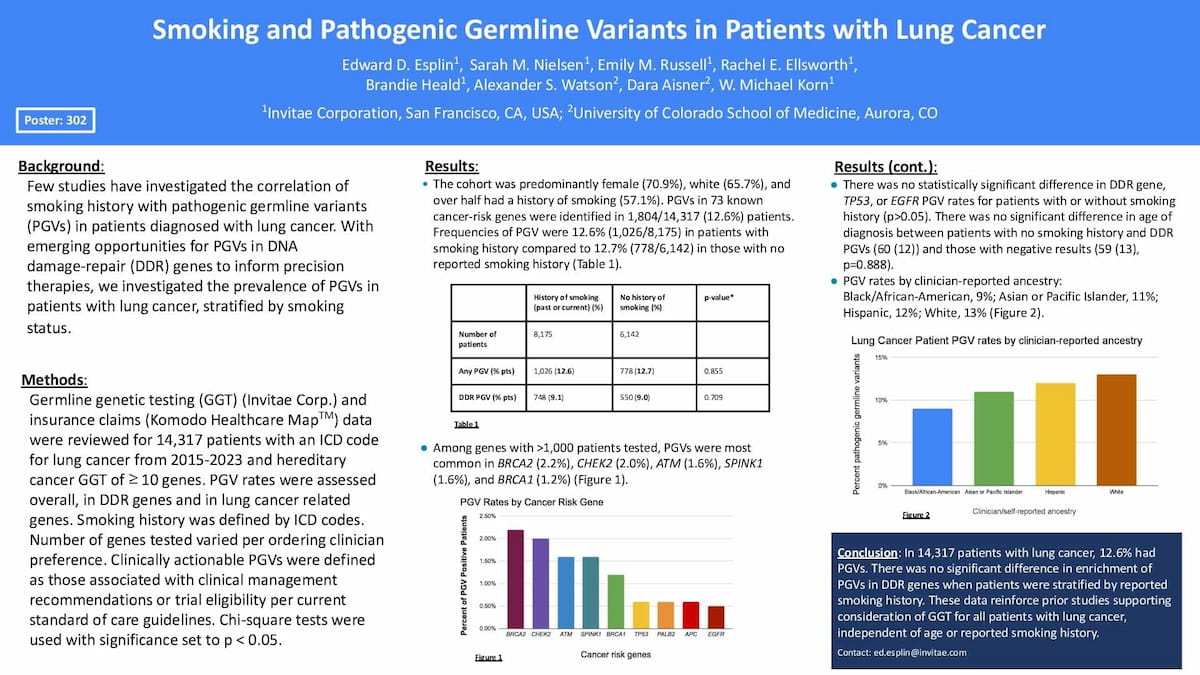
Current clinical guidelines do not recommend germline testing for patients with lung cancer. Dr. Esplin’s study, which analyzed a cohort of over 14,000 lung cancer patients, reaffirmed the high rate of pathogenic germline variants (PGVs), with over 12 percent of patients having these genetic changes. This finding mirrors results from two prior studies (Samadder et al., JAMA Onc 2020; Sorscher et al., JCO Precision Oncology 2023). The PGV rate in lung cancer patients is similar to that found in patients with breast, ovarian, pancreatic, and colorectal cancers, for which clinical practice guidelines already recommend germline genetic testing.
Pathogenic germline variants (PGVs) are inherited genetic mutations that can increase your risk of developing certain types of cancer. These variants are present in the DNA of every cell in the body from birth and can be passed down from one generation to the next. In lung cancer patients, PGVs were identified in several genes, including BRCA2, CHEK2, ATM, TP53, BRCA1, EGFR, APC, and PALB2. Some of these genes are also associated with increased risks for other cancers, such as breast, ovarian, pancreatic, prostate, and colorectal cancers.
RELATED: Genetic Testing: How Uncertain Results Impact Our Health
While smoking remains the primary risk factor, understanding genetic predispositions can help identify individuals at higher risk, even among non-smokers.
“These findings have significant implications for lung cancer screening and prevention strategies,” Dr. Esplin tells BlackDoctor.org. “Identifying PGVs in patients can not only inform their treatment options but also enable their unaffected family members to undergo genetic testing for early detection and prevention.”
Germline genetic testing can also inform your decisions about management and treatment options, including precision therapy clinical trials. The National Comprehensive Cancer Network (NCCN) guidelines for lung cancer state, “…the best management of any patient with cancer is in a clinical trial. Participation in clinical trials is especially encouraged.” This approach can identify patients who might benefit from targeted therapies based on specific genetic mutations and allow for appropriate screening and risk-reducing interventions for other potential cancers.
“Genetic testing can help inform lung cancer treatment, such as enabling patients to enroll in targeted therapy clinical trials based on specific genetic mutations,” Dr. Esplin notes. “This approach could lead to better outcomes and new treatment options for lung cancer patients.”
This study suggests that genetic testing could potentially be incorporated into population screening programs to identify individuals at risk before the development of cancer, aligning with broader cancer prevention goals.
“Identifying these genetic risks provides additional incentives for smokers to quit and for non-smokers to avoid starting,” Dr. Esplin says. “Moreover, it allows for tailored screening strategies, potentially catching the disease early when it’s more treatable.”
The study also highlights the importance of family history in determining lung cancer risk.
“Knowing your family history and sharing it with your physician is crucial,” Dr. Esplin adds. “Genetic testing can help you and your healthcare provider understand your full lung cancer risk and take appropriate preventive measures.”
The findings of this study coupled with the goals of President Joe Biden’s Cancer Moonshot 2.0, which aims to reduce cancer mortality rates by at least 50 percent, are a game-changer in the fight against lung cancer, emphasizing the importance of genetic testing for all lung cancer patients, regardless of smoking history. As we move towards more personalized approaches in cancer care, understanding the genetic factors at play will be crucial in improving prevention, screening, and treatment strategies.


By subscribing, you consent to receive emails from BlackDoctor.com. You may unsubscribe at any time. Privacy Policy & Terms of Service.