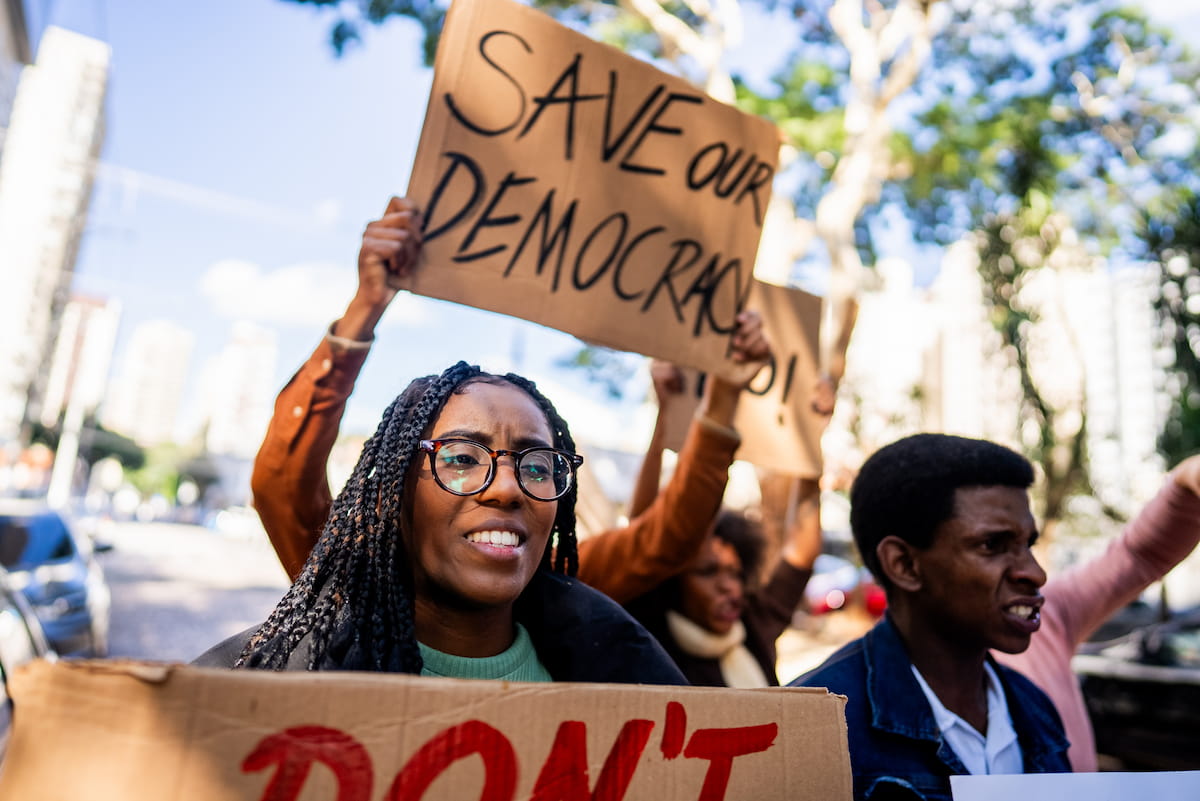
The U.S. Supreme Court has issued a decision that could reshape how political power shows up in communities across the country. For many Black Americans, this moment may feel both familiar and deeply personal. It is not just about legal language or district lines on a map. It is about whether communities have a real, lasting voice in the decisions that affect their lives, their health, and their future.
Voting has always been tied to access. Access to quality schools. Access to healthcare. Access to safe neighborhoods and economic opportunity. So when the rules around voting change, the impact reaches far beyond Election Day.
In Louisiana v. Callais, the Supreme Court ruled 6–3 that drawing congressional districts with race as a primary factor can violate the Constitution.
For decades, the Voting Rights Act of 1965 has allowed states to consider race when drawing district lines. This was not about giving one group an advantage. It was about correcting a long history of discrimination that kept Black voters from having equal political power.
In Louisiana, lawmakers created two majority-Black districts out of six. That decision reflected the state’s population, which is about one-third Black. The goal was to ensure that Black voters had a fair opportunity to elect candidates who represent their interests.
A group of white voters challenged that approach, arguing that using race in this way was discriminatory. The Supreme Court agreed with them, calling the maps unconstitutional.
On the surface, the case may seem narrow. But its implications reach much further.
The most important shift is how difficult it now becomes to challenge unfair voting maps.
Before this ruling, communities could bring a case if a map had the effect of weakening Black voting power. Courts could step in if district lines made it harder for minority voters to elect candidates of their choice, even if lawmakers did not openly admit discriminatory intent.
Now, that standard has changed.
Moving forward, challengers must prove that lawmakers intentionally discriminated based on race. That is a much higher bar. It requires clear evidence of intent, which is often hidden or explained away as political strategy.
In practice, this means states can argue that their maps are driven by party politics rather than race. Given that a large majority of Black voters tend to support Democratic candidates, separating race from political preference becomes extremely difficult.
This change weakens Section 2 of the Voting Rights Act, one of the law’s most powerful tools for protecting minority voters.
For Black communities, representation is not abstract. It is directly connected to lived experiences.
When communities have representation, they are more likely to see attention given to issues that matter to them. That includes funding for hospitals, maternal health outcomes, environmental safety, education, and criminal justice reform.
When representation shrinks, those priorities can fade into the background.
Without strong protections in place:
These strategies are not new. They have been used for generations in different forms. The difference now is that they may be harder to challenge in court.
Justice Elena Kagan, in her dissent, warned that this decision could lead to a sharp decline in minority representation. Her concern reflects a broader fear that progress made over decades could slowly erode.
At BlackDoctor, we often talk about health as more than doctor visits and prescriptions. Health is shaped by systems. It is shaped by policy. And policy is shaped by who gets elected.
When voting power is reduced, it can have real consequences for community health.
Think about:
Elected officials influence all of these decisions. And those officials are shaped by the voters who are able to elect them.
So when we talk about voting rights, we are also talking about health equity.
The timing of the ruling is important.
Because it came ahead of upcoming elections, states now have time to redraw their maps. Some states have already begun that process.
This kind of redistricting is usually done once every ten years after the census. Seeing changes happen in the middle of a decade is unusual and could shift the political landscape in ways that are hard to predict.
For voters, it may mean:
These shifts can influence not only local elections but also control of Congress.
This ruling is part of a larger pattern.
Over the past decade, the Supreme Court has issued several decisions that have narrowed the reach of the Voting Rights Act. One of the most notable was Shelby County v. Holder in 2013, which removed federal oversight requirements for states with a history of discrimination.
Taken together, these decisions have reduced the tools available to challenge voting restrictions.
The Voting Rights Act was originally passed in 1965 after years of activism, protest, and sacrifice. It was designed to enforce the promise of the 15th Amendment, which guaranteed Black men the right to vote after the Civil War.
Even with that amendment in place, barriers like literacy tests, poll taxes, and intimidation tactics were used to suppress Black voters for generations.
The Voting Rights Act helped dismantle many of those barriers. This new ruling raises questions about how much of that protection still remains.
Moments like this often bring a mix of frustration, concern, and determination.
Across the country, advocacy groups, legal organizations, and community leaders are already working to respond. Their efforts include:
There is also a growing focus on local elections. While national races get the most attention, local officials often have a direct impact on policies that affect daily life.
If this feels overwhelming, you are not alone. But there are still ways to stay engaged and protect your voice.
Start with awareness:
Stay connected:
Show up:
Advocate:
Change does not happen overnight, but it does happen when people stay engaged over time.
The Supreme Court’s decision in Louisiana v. Callais marks a significant shift in how voting rights are protected in the United States. By limiting how race can be considered in redistricting and raising the bar for proving discrimination, the ruling could have lasting effects on Black political representation.
At the same time, history shows that progress has never been a straight line. Every challenge has also created space for new advocacy, new leadership, and new ways of organizing.
Your voice still matters. Your vote still matters. And the future of representation will continue to be shaped by those who stay informed, stay engaged, and continue to show up.


By subscribing, you consent to receive emails from BlackDoctor.com. You may unsubscribe at any time. Privacy Policy & Terms of Service.