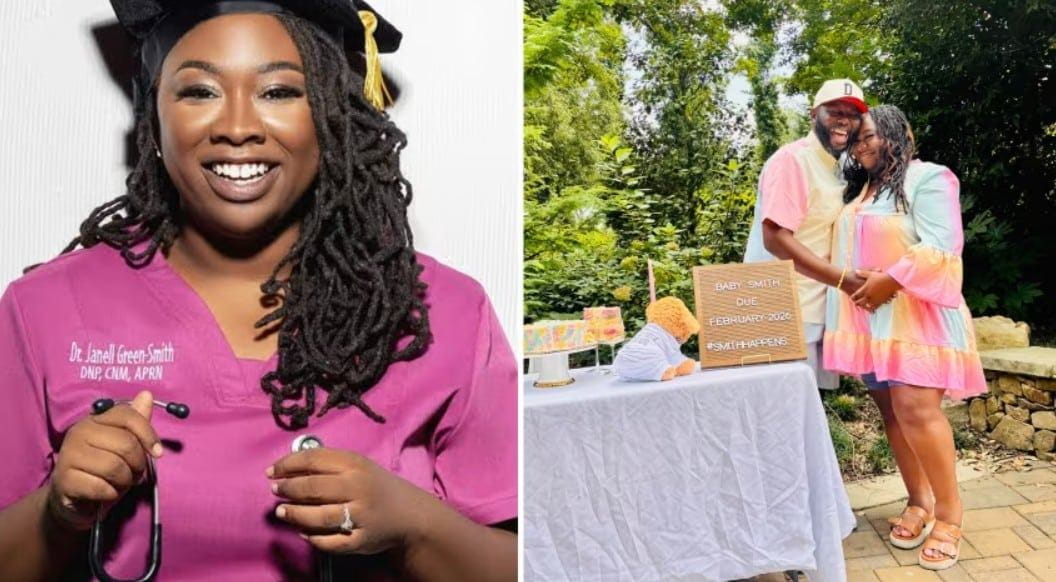
The death of Dr. Janell Green Smith is not just heartbreaking—it is devastatingly instructive.
Dr. Green Smith was a respected maternal health advocate, scholar, and community leader who spent years educating the public about the dangers Black women face during pregnancy and childbirth. She worked with the non-profit The Hive Impact Fund to support mothers and mothers-to-be with the resources required to expand and maintain their families. She spoke openly about medical racism, patient dismissal, and the life-or-death consequences of inequitable obstetric care. And yet, in a cruel and painful irony, she died from childbirth-related complications herself.
Her death forces a truth the United States has long resisted confronting: knowledge, credentials, and advocacy do not protect Black women from a system designed to fail them. If someone as informed and vigilant as Dr. Green Smith could not survive childbirth, what does that say about the conditions facing millions of Black mothers with fewer resources, less access, and less institutional power? The American College of Nurse-Midwives issued a statement expressing their grief, sadness, and outrage at the unexpected news. It appeared across their social channels.
This is not a tragedy of chance. It is a tragedy of systems.
Dr. Janell Green Smith devoted her career to improving maternal health outcomes, particularly for Black women and birthing people who are disproportionately harmed by the U.S. healthcare system. She worked at the intersection of research, policy, education, and community advocacy, translating data into lived realities and pushing institutions to confront uncomfortable truths.
Her advocacy emphasized that Black maternal mortality is not caused by individual behavior, genetics, or lack of education. Instead, she consistently pointed to:
Dr. Green Smith understood that childbirth outcomes are shaped long before labor begins and long after delivery ends. She amplified the voices of mothers who were ignored, rushed, or gaslit—and she urged providers and policymakers to listen.
RELATED: What Black Expecting Mothers MUST Know About Their Rights (According to a Doula)
Her work was rooted in care, but also in accountability. She did not soften the truth to make systems comfortable.
In 2024, the Centers for Disease Control (CDC) reported that “Black women are three times more likely to die from a pregnancy-related cause than white women.” The International Journal for Equity in Health describes Black maternal mortality in the United States as “one of the most alarming and persistent indicators of racial injustice.” Black mothers are more likely to experience:
“Most maternal deaths are preventable, as the health-care solutions to prevent or manage complications are well known,” according to the World Health Organization. These outcomes are not accidents. They are the predictable results of a healthcare system shaped by racial hierarchy, underinvestment in Black communities, and the normalization of Black suffering.
Dr. Green Smith knew these statistics intimately. She worked to ensure they were not treated as abstractions—but as evidence of lives lost unnecessarily.
RELATED: 7 Things Pregnant Black Women Can Do to Be Heard by Doctors
One of the most painful lessons of Dr. Green Smith’s death is this: individual vigilance cannot outwork systemic neglect.
Black women are often told to protect themselves by:
While these strategies can help, they quietly shift responsibility away from institutions and onto patients—many of whom are already navigating fear, exhaustion, and physical vulnerability.
Dr. Green Smith did everything “right.” She had the knowledge. She had the awareness. She had the advocacy. And still, the system failed her. Her death exposes the lie that a lack of information causes Black maternal deaths. The truth is far more damning: the system frequently does not respond, even when Black women do everything it asks of them.
According to the Journal of Obstetrics & Gynecology, “The shortage of ob-gyns in 10 years is projected to progressively worsen by today’s standard practice patterns.” By 2035, “Only six states (Hawaii, New York, Connecticut, Maryland, Rhode Island, Louisiana) were projected to continue to have an adequate supply.” The U.S. Department of Health and Human Services projects a shortage of obstetricians and gynecologists; its forecasts indicate that there will not be enough physicians in the specialty to meet the nation’s needs by 2037.
To understand how such a tragedy occurs, we must look beyond individual providers to the structure of obstetric care itself.
Decades of research show that Black patients are less likely to be believed when reporting pain or complications. This bias is often unconscious but deeply embedded in clinical decision-making.
Pregnancy care is often siloed—prenatal, delivery, and postpartum care are treated as separate events rather than a continuous process. This fragmentation is especially dangerous for conditions like hemorrhage, preeclampsia, and cardiomyopathy, which can escalate quickly.
More than half of maternal deaths occur after delivery, yet postpartum care in the U.S. is notoriously insufficient. Many women receive minimal follow-up during the most dangerous period.
Hospitals serving predominantly Black communities are more likely to be under-resourced, understaffed, and overburdened. This is not coincidental—it is the legacy of segregation and disinvestment.
Dr. Green Smith’s death sits at the intersection of these failures. It is not an anomaly; it is a warning.
In recent years, there has been a push for more culturally competent care, more Black providers, and more patient education. These efforts matter—but they are not sufficient.
Dr. Green Smith’s life and death make clear that representation without power does not guarantee safety. Black providers still operate within institutions governed by biased protocols, rigid hierarchies, and profit-driven priorities.
Similarly, education without accountability leaves patients responsible for navigating systems that were never built to protect them.
True change requires:
Without structural reform, advocacy becomes a form of emotional labor that too often costs Black women their lives.
RELATED: Why Are Black Women 25% More Likely to Have C-Sections?
Statistics can numb us. Numbers create distance. But Dr. Janell Green Smith was not a data point.
She was a mother. A scholar. A protector of other mothers. A woman who believed deeply that knowledge could save lives—and who worked tirelessly to share it.
Her death leaves behind grief, rage, and unanswered questions. It also leaves a responsibility.
To honor her life means refusing to allow her story to be absorbed into the background noise of “health disparities.” It means demanding more than sympathy statements. It means insisting on accountability—from hospitals, from policymakers, from a healthcare system that continues to sacrifice Black women at the altar of inertia.
The tragedy of Dr. Janell Green Smith is not that she didn’t know enough. It’s that she knew exactly how dangerous the system was—and still could not escape it.
That truth should unsettle us.
Black maternal mortality is not a mystery. It is not inevitable. And it is not acceptable. Until the U.S. healthcare system treats Black mothers’ lives as worth protecting—not just studying—these deaths will continue.
Dr. Green Smith spent her life warning us. Her death demands that we finally listen. “To address the disparities in Black maternal health, expanding access to midwives and doulas is essential. Midwifery care reduces preterm births and cesarean delivery rates and improves breastfeeding outcomes, particularly among Black mothers. Doulas provide invaluable emotional and physical support during pregnancy and childbirth, mitigating racial biases and fostering trust in the health care system,” according to The National Center for Chronic Disease Prevention and Health Promotion.


By subscribing, you consent to receive emails from BlackDoctor.com. You may unsubscribe at any time. Privacy Policy & Terms of Service.