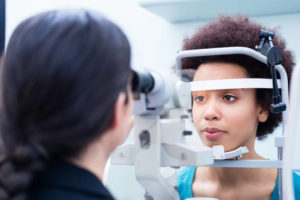
Blindness becomes more common after 65, but age 40 is already an important time for Black adults to get checked for glaucoma. Diabetes can put vision at risk earlier, and both glaucoma and diabetic eye disease can progress before a person notices changes in their sight.
The CDC estimated that 0.32% of non-Hispanic Black Americans of all ages met its visual-acuity definition of blindness in 2024. That’s about 1 in 310 people, compared with 0.22% of non-Hispanic White Americans and 0.21% of the U.S. population overall. The CDC defined blindness here as vision of 20/200 or worse in the better-seeing eye with the best possible glasses or contact lens prescription. A broader measure that included milder vision impairment as well as blindness was 2.18% among non-Hispanic Black Americans. These figures cover blindness and vision impairment from all causes.
The CDC’s 2024 estimates show the national age pattern across all racial and ethnic groups. Blindness affected 0.10% of adults ages 18–39, 0.21% at 40–64, 0.43% at 65–84, and 1.24% at 85 and older.
An older pooled study published in 2004 gives a more detailed look at how blindness increased with age among Black adults. These are historical prevalence estimates based on studies available at the time. They show how common blindness was in each age group, rather than the age at which people first lost their sight.
Believe it or not, research shows that of the 285 million people estimated to be visually impaired worldwide, 66 percent are women.
Furthermore, research from the University of Illinois at Chicago, suggests that, “older women are at risk for glaucoma,” which can cause blindness. While some experts suggest that the risk is linked to estrogen, other causes may stem from lifestyle habits like sleeping in contacts.
Per the Centers for Disease Control and Prevention (CDC), two-thirds of contact lens wearers are women. And while some causes involving vision loss aren’t preventable—as is the case with age-related eye diseases such as age-related macular degeneration, cataract, and diabetic retinopathy—other factors may be preventable.
Here’s what you should know to protect your eyes, especially if you are a woman.
RELATED: Your Eyes Need Love Too
If you’ve made a habit of sleeping in your contact lenses, pump the brakes.
Sleeping in contacts can lead to infections, corneal ulcers, and other health problems that can cause permanent vision loss, experts say.
This occurs because contact lenses reduce the much-needed supply of oxygen to the cornea, or the surface of your eye; creating a breeding ground for viral infections.
While for most women, menopause doesn’t become a concern until about age 51, for a select few, early onset menopause – better known as premature ovarian failure, can wreak havoc on your lifestyle, causing hot flashes, night sweats, sleep problems, pain during sex, urine or bowel leakage or worse, blindness.
In fact, according to experts, when a woman’s menstruation stops before her time, the risk of developing glaucoma spikes by over two and a half times.
In some drugs, that lengthy list of side effects may include blindness.
“There are some medications that cause deposits on the retina that can, over a long period of time, impair the vision,” Assumpta Madu, M.D., an ophthalmologist at NYU Langone, told Women’s Health Magazine.
It’s never too late to kick this nasty habit! The CDC, reports that “a leading cause of vision loss is now clearly linked to smoking.”
In fact, tobacco users are twice as likely to develop macular degeneration – which destroys the central vision that you need to read, drive, and see people’s faces — when compared with a nonsmoker.
Smokers are also two to three times more likely to develop cataracts – which causes blurry vision — when compared to nonsmokers.
Staring directly at the sun CAN lead to blindness. It’s called solar retinopathy.
While it would take several minutes of gazing at the heart of our solar system for it to cause permanent impairment, enough damage (solar radiation) to the retina can harm the macula, a tiny substructure of the retina responsible for much of your central detail vision, the University of Arkansas for Medical Sciences reports.
Tip: Protect your eyes from the harmful rays by never staring at the sun directly with the naked eye and always wear shades when you expect to spend long periods of time in the sunlight.


By subscribing, you consent to receive emails from BlackDoctor.com. You may unsubscribe at any time. Privacy Policy & Terms of Service.