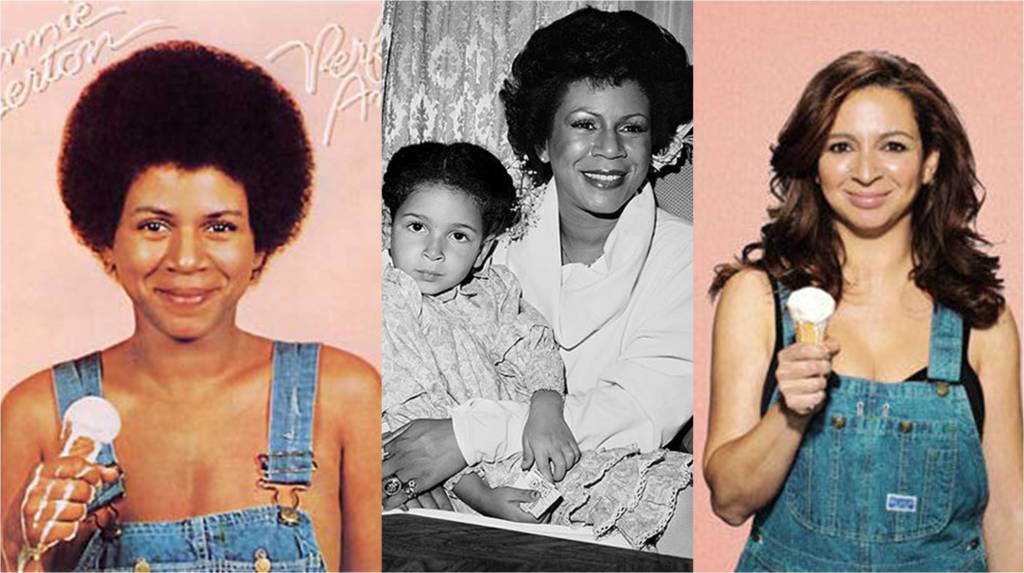
The 1975 hit song, “Loving You” was composed by legendary singer Minnie Ripperton and husband Richard Rudolph has long been thought of a song to a soulmate/incredible lover.
The lyrics go something like this:
No one else can make me feel
The colors that you bring
Stay with me while we grow old
And we will live each day in springtime
‘Cause lovin’ you has made my life so beautiful
And every day of my life is filled with lovin’ you
Lovin’ you I see your soul come shinin’ through
And every time that we oooooh
I’m more in love with you
La la la la la la la… do do do do do
But as the years have gone by, the real reason for the song has been made known: it was originally created to be a lullaby to their daughter, Maya Rudolph, now actress and comedian, when she was a baby. Showcasing Minnie’s five-octave vocal range, “Lovin’ You” was the singer’s most famous song.
READ: My Story: Bold And Breastless
According to Wikipedia, Minnie sang “Maya, Maya, Maya” toward the end of an unedited version of the chart-topping tune. When the soul singer was diagnosed with breast cancer and was told that she had about six months to live, she included her son, Marc (whose nickname is Ringo), when she sang “Lovin’ You” in her last concert performances: “Maya, Maya, Ringo, Maya.”
Minnie died at the young age of only 31 in 1979. The epitaph on Minnie’s headstone in an LA cemetery is the opening line from her popular song: “Lovin’ you is easy ’cause you’re beautiful.”
“It’s so nice, especially being on the receiving end as the child of that [song tribute],” Maya, now an actress, said in a recent interview.
As a regular on “Saturday Night Live” for 10 years, Maya parodied celebrities, including Whitney Houston, Oprah Winfrey, Beyonce and Donatella Versace.

Breast cancer is the most commonly diagnosed cancer among black women. Similar to the pattern among white women, breast cancer incidence rates among black women increased rapidly during much of the 1980s, largely due to increased detection by mammography screening. However, while rates thereafter generally stabilized in white women they continued to increase in black women.
In remembrance of the late great Ripperton, Maya and others put together a 10K race to raise money for breast cancer.
“Every year here in LA on or around my Mom’s birthday we have a run that raises money for breast cancer research and helps to raise awareness in the black community as well as in anyone else who shows up,” explains Rudolph. “It’s fun. And people can find other Minnie Riperton fans there as well as young and old people or people who just love to run.”
MUST READ: Brain Cancer Symptoms – It’s Not What You Think
Breast cancer is the second most common cause of cancer death among black women, surpassed only by lung cancer. An estimated 6,310 deaths from breast cancer are expected to occur among black women in 2016. Breast cancer death rates among black women increased from 1975 to 1991, but declined thereafter as a result of improvements in both early detection and treatment. Prior to the mid-1980s, breast cancer death rates for white and black women were similar. However, a larger increase in black women from the mid-1970s to the early 1990s, followed by a slower decline, has resulted in a widening disparity. Since 1990, breast cancer death rates dropped 23% in black women compared to a 37% drop in white women. As a result, breast cancer death rates in the most recent time period (2008-2012) are 42% higher in black women compared to white women, despite similar incidence rates.


By subscribing, you consent to receive emails from BlackDoctor.com. You may unsubscribe at any time. Privacy Policy & Terms of Service.