
AI. AI. AI.
It seems like everywhere we turn these days, it’s all we hear. We’re told it’s the future. That it’s going to revolutionize the way we do everything. And whether we’re using it to improve our lives, using it just for a hobby, or have never used it, the fact remains: it’s happening.
The massive data centers are going up everywhere.
From workplaces to schools and homes, through chatbots, large language models, and virtual assistants, in everyday tasks and complex, covert military operations, it seems like AI is leaving its footprint in literally every aspect of life.
But is this a good thing?
Research, including groundbreaking studies from MIT’s Media Lab, is now helping us to answer that question. Many specialists are now warning that AI could lead (and is already leading) to something called “cognitive atrophy.”
We’re talking about a gradual weakening of critical thinking, memory, creativity, and executive functions. While the power of AI may make our lives easier in many ways, it’s also having very real and noticeable effects on our brains.
Can we stop it? Can we slow it? Are there ways to integrate AI in an overall positive way without these negative impacts?
Let’s break it all down…
RELATED: Breakthrough Trials: How AI Immunotherapies Are Accelerating Personalized Cancer Care
The main reason people are concerned about AI is because of what they see in the areas of neuroscience and psychology. Take, for instance, MIT Media Lab’s “Your Brain on ChatGPT” study. This revealing study, conducted over four months with 54 participants, provides some of the most compelling data we have today.
It worked like this: participants were divided into different groups, each one using either only their brains, search engines, or large language models (LLMs) like ChatGPT for essay writing. As participants wrote their essays, they underwent electroencephalogram (EEG) monitoring to track their brain activity.

The results were fascinating. Participants who relied solely on LLMs showed the lowest levels of engagement across neural, linguistic, and behavioral metrics. Specifically, they showed weaker alpha and theta waves. What does this mean? Well, it indicates that they were using less of their deep memory and attention. Based on this, the researchers concluded that because of AI, these participants were not experiencing true comprehension and retention.
In time, this study found what was termed accumulating “cognitive debt,” meaning the AI users began to increasingly resort to ‘shortcuts.’ They used copy-and-paste, they underperformed in memory recall, and they struggled to quote their work – all indicators that they were not using their brains like the other participants.
But here’s the kicker. These effects persisted. Even when these AI users were switched to another group where they could only use their brains, the EEGs showed lower beta activity in their brains.
Unfortunately, other studies have shown the same type of thing. Broader research has also shown a negative correlation with critical thinking skills and AI use. According to Harvard researchers, overuse of large language models may actually shrink critical faculties, similar to how calculators impacted students’ basic arithmetic skills.
The journal Polytechnique Insights takes it even further. Alarmingly, continued AI use has been linked to reduced emotional sensitivity, shorter attention spans, and even the atrophy of neural networks. In other words, your brain weakens its ability to adapt and form new connections.
Frankly, it’s scary, but before we lose all faith in AI, it’s important that we understand how these impacts occur and what we can do to address them.
It doesn’t happen overnight.
One’s brain changes in relation to AI subtly and is often considered a good thing, especially in business. After all, who doesn’t want increased productivity and efficiency if your job requires you to complete task after task?
But here’s the thing. While instant output may feel like a ‘win,’ it skips your built-in ability to brainstorm. And there are numerous examples. Professionals might auto-complete reports or emails, bypassing personal phrasing that improves their communication skills. Or how about in decision-making?
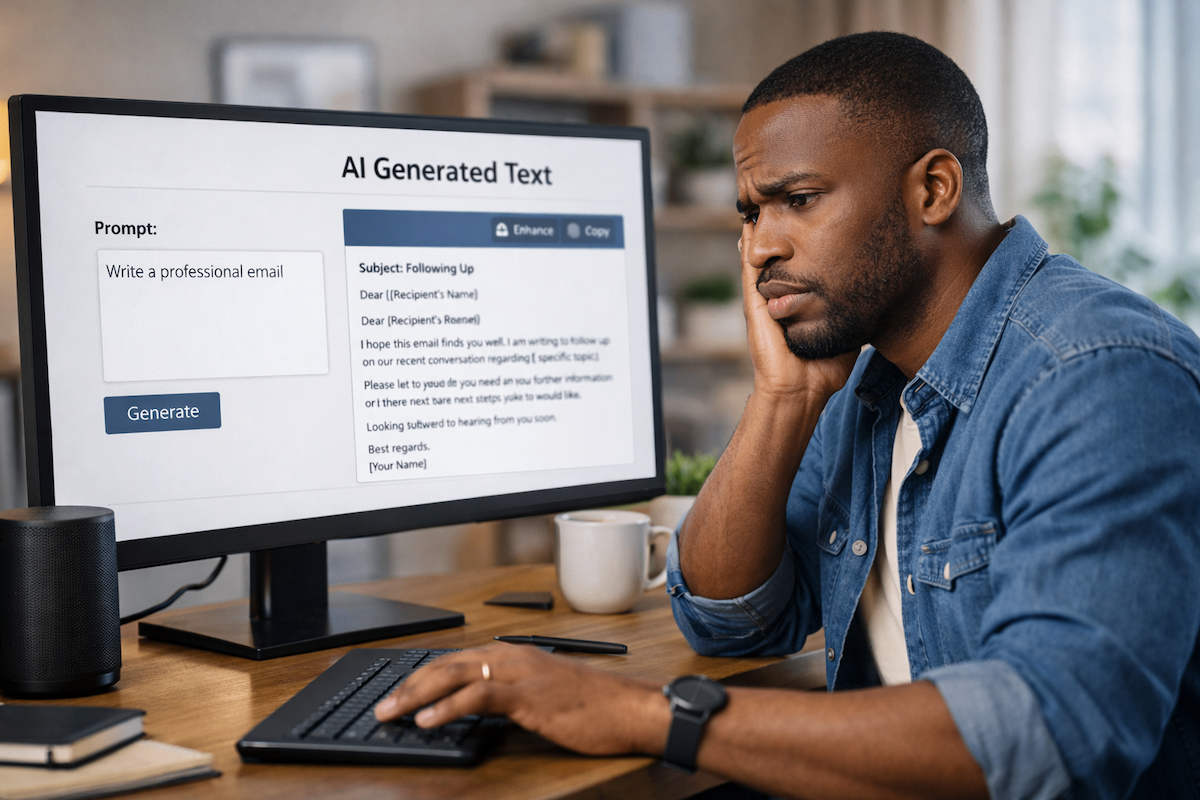
Why puzzle through a problem when AI can answer immediately? As a result, you don’t have to wrack your brain, you don’t have to trial-and-error. You just go to AI – and boom.
Over time, as each delegation accumulates, you’re basically slowly killing your own cognition. In adolescents and young adults, with still-developing brains, this is particularly problematic. Neuroscientists will tell you that prefrontal cortex maturation absolutely needs active problem-solving.
Surely, it’s easy to see the problem. As AI accelerates like never before, creativity vanishes, free association dies, and society as a whole becomes mentally lazy and cognitively lacking.
But here’s what we can do.
It all starts with so-called “brain-first” sessions. Before you go directly to AI, try to tackle tasks manually. Also, try to think in ways that are deliberately non-AI. In other words, do things like handwritten notes or solving puzzles and problems without hints. This will improve your memory and focus while also helping you to preserve your neural connections.
The bottom line is simple: use AI for refining, not for generating. Rather than just having AI create everything from scratch, use it as a complementary tool. Draft original ideas yourself, then you can go to AI for edits and improvements. And, when you do turn to AI, use it in a way that builds your mental abilities. This means crafting prompts that are well-reasoned, imaginative, and critically thought out. Be precise, clear, and crisp in your queries.
Last but not least, make sure you occasionally detox from AI. Hold yourself to days or just hours in your days where you are forbidden from AI. This may sound hard to do, but if you’re out and about in nature, in social settings, or just away from devices, it’s not as difficult as you think.
All of these simple measures are grounded in research, so if you use them regularly, you’ll be much more likely to sustain and use AI appropriately.
At the end of the day, it’s all about self-awareness. Some people are more vulnerable to the AI ‘brain drain’ than others. Younger users, such as students, face the highest risk due to academic pressures and the immaturity of their mental faculties. Meanwhile, certain professionals, such as those who analyze or write, are also more susceptible to the negative effects of AI, as it can easily take over their core skills if left unchecked.
As for educators? They have a heavy responsibility to nurture the next generation, so it can feel daunting knowing how badly AI affects them. To combat this, teachers can try hybrid assignments, even devoting some time to lessons on ‘AI ethics.’ Tips like these aren’t too difficult to implement and can go a long way in making positive change, while ensuring the benefits of AI are sustained.
Overall, we live in an AI-saturated world. The genie is out of the bottle, so now it’s just a matter of putting up the guardrails and being mindful of what we do. By staying self-aware, relying on old-school methods, and using AI as a supplement, not a replacement, we can protect the most important asset we have in this world: the human mind.


By subscribing, you consent to receive emails from BlackDoctor.com. You may unsubscribe at any time. Privacy Policy & Terms of Service.