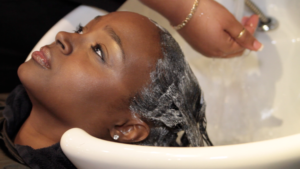
Do relaxers cause fibroids?
This is a question that a study conducted by the American Journal of Epidemiology attempted to answer.
The result?
There may be a link between hair relaxers to uterine fibroids, as well as early puberty in young girls.
Scientists followed more than 23,000 pre-menopausal Black American women from 1997 to 2009 and found that the two- to three-times higher rate of fibroids among black women may be linked to chemical exposure through scalp lesions and burns resulting from relaxers.
Women who got their first menstrual period before the age of 10 were also more likely to have uterine fibroids, and early menstruation may result from hair products black girls are using, according to a separate study published in the Annals of Epidemiology last summer.
CHECK THIS: When Is It Time To Seek Treatment For My Fibroids?
Three hundred African American, African Caribbean, Hispanic, and White women in New York City were studied. The women’s first menstrual period varied anywhere from age 8 to age 19, but African Americans, who were more likely to use straightening and relaxers hair oils, also reached menarche earlier than other racial/ethnic groups.
While so far, there is only an association rather than a cause and effect relationship between relaxers, fibroid tumors, and puberty, many experts have been quick to point out that the hair care industry isn’t regulated by the FDA, meaning that there’s no definite way to fully know just how harmful standard Black hair care products really are.
Fibroids are tumors that grow in the uterus. They are benign, which means they are not cancerous, and are made up of muscle fibers. Fibroids can be as small as a pea and can grow as large as a melon. It is estimated that 20-50% of women have, or will have, fibroids at some time in their lives. They are rare in women under the age of 20, most common in women in their 30s and 40s, and tend to shrink after the menopause.
According to US studies, fibroids occur up to nine times more often in black women than in white women, and tend to appear earlier. The reason for this is unclear. Also women who are overweight may be more likely to have fibroids. This is thought to be due to higher levels of estrogen in heavier women.
Although the exact cause of fibroids is unknown, they seem to be influenced by estrogen. This would explain why they appear during a woman’s middle years (when estrogen levels are high) and stop growing after the menopause (when estrogen levels drop).
READ: These Minor Changes to Your Diet May Be the Secret to Treating Fibroids
Most fibroids grow within the wall of the uterus. Health care providers put fibroids into three groups based on where they grow:
• Submucosal (pronounced sub-myou-co-sul) fibroids grow just underneath the uterine lining.
• Intramural (pronounced in-tra-myur-ul) fibroids grow in between the muscles of the uterus.
• Subserosal (pronounced sub-sir-oh-sul) fibroids grow on the outside of the uterus.
Some fibroids grow on stalks (also called peduncles, pronounced ped-uncles) that grow out from the surface of the uterus, or into the cavity of the uterus.


By subscribing, you consent to receive emails from BlackDoctor.com. You may unsubscribe at any time. Privacy Policy & Terms of Service.