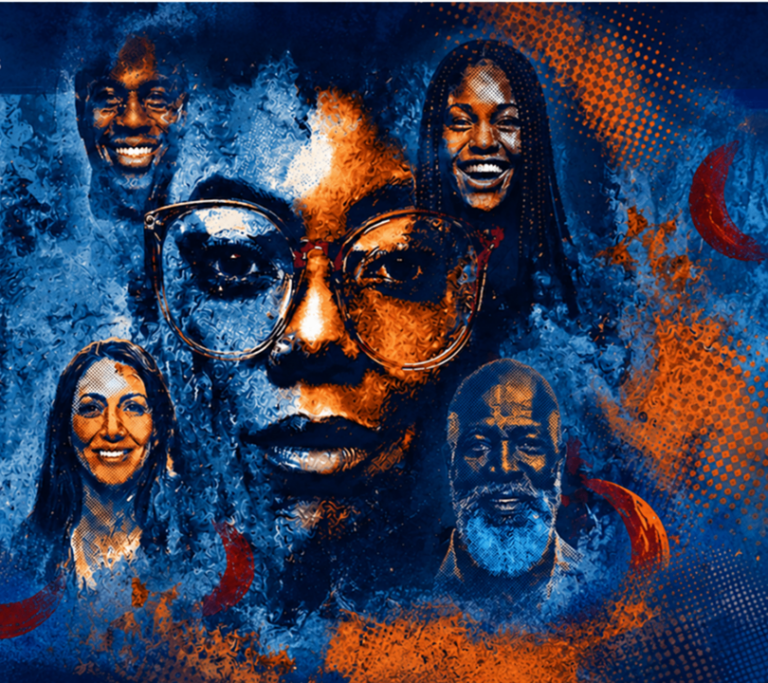
I had the pleasure of speaking with Adrienne Moore, who was diagnosed with endometrial cancer in 2016. This is such an important topic to discuss among Black women –young or older. As a founding member of the Endometrial Cancer Action Network for African Americans (ECANA), she now advocates for the health of all Black women, who are nearly twice as likely to die of EC compared to white women.
A: My name is Adrienne, and I currently reside in Georgia. I am a 52-year-old endometrial cancer survivor diagnosed with stage three in 2016. In 2018, I began as a patient partner to a research oncologist who was really concerned about endometrial cancer in Black women. And since that time, I’ve been a vocal advocate for bringing awareness and resources to Black women, specifically regarding endometrial cancer. Since we are more apt to be diagnosed at later, more aggressive stages, outside of that, I’m a daughter, a sister, an aunt, and a friend. All of these things correlate with the mission of the advocacy organizations that I am involved with, which is bringing an end, I should say, the silence around ending cancer and bringing tangible resources that will save lives.
A: When I was first diagnosed, I was very surprised because in the past, I had a previous gynecological cancer, ovarian cancer, and I had never heard of endometrial cancer before, so I was pretty much taken aback that I had gone so long with having symptoms that were a telltale sign of having endometrial cancer. And none of the care providers that I had sought out before my being diagnosed had ever expressed that that was a concern for them or that I was at risk for this particular cancer. So yes, I was surprised. I wouldn’t say I was mad or angered, but I really was kind of like I told you so kind of thing because I knew my body, and I knew that something was wrong with the irregularity of my periods. The heaviness of the flow, the pain, and the pelvic pressure that would come along with my periods when they came were really debilitating and, at one point, you know, caused me to have to leave a job.
A: Well, there is no screening tool for endometrial cancer. So, I guess the standard route would be to have a transvaginal ultrasound done, which I had more than once, and I was told that I had fibroids, so I was perimenopausal. But because this particular cancer is most positively diagnosed through a biopsy, I had never had that particular intervention done to, you know, let anyone or give anyone any kind of indication that there were cancer cells present in my uterus.
A: Yes. That’s what’s so important about this particular campaign is because what we’re doing is we’re bringing more awareness to what people have maybe in the past normalized and then also stigmatized because, you know, people don’t talk about their periods, but the Spot Her campaign is the opportunity for the public at large to learn about what endometrial cancer signs and symptoms are. And together with other advocacy organizations, the one that I belong to is, but there’s also the Foundation For Women’s Cancer. And all of us are working to bring more physical and tangible resources to learning more about endometrial cancer so that we can potentially save thousands of lives. The earlier we catch endometrial cancer, the more curable it is.
A: Well, the three most common symptoms of endometrial cancer, first in menopausal women, is any bleeding at all or brown discharge right after menopause. You should not see any blood. You should not see any brown discharge at all. For women who are not in menopause, I was not in menopause when I was diagnosed. It’s the heavy bleeding, right? And then there’s the pelvic pain and pressure. All of those things should be something that should be addressed when you’re speaking with your GYN or your practitioner. And then, of course, if you’re experiencing a lot of pelvic pain and pressure, bloating, a change in your weight, the growth around your waistline, all those things coupled with irregular bleeding might be indications that there could be something more going on.
A: Well, after I was diagnosed and treated, the first thing I did was I went to educate myself. It was important for me to learn what advocacy was all about and then how I could learn how to share that message with my sisters and my friends. That was important to me, and that helps with emotional well-being, physical well-being, and even spiritual well-being. So again, this is why we’re here with the Spot Her campaign is: for women to know that they’re not alone. We want to educate, empower, and inform them. So, there won’t be women like myself who have gone through months of having symptoms without being diagnosed. The earlier the symptoms are found, the better. This is particularly important for black women because they’re two times as likely to die from endometrial cancer because they’re often diagnosed at later, more aggressive stages.
RELATED: Endometrial Cancer: How To Spot The Early Warning Signs
A: Well, when someone comes to me, I talk to them about my personal experience. But when someone’s coming to the Spot Her campaign, there is a list of resources that your readers and your friends can find on Spot Her for easily downloadable EC resources that people are able to take with them to their physicians’ offices. And they can also learn what they can do to help communicate their information better, right? You want to be able to document what your periods are like, know your own personal history, and know your family history. Oftentimes, we normalize things that happen with our periods, but when you begin to think or believe that there might be something wrong. The sooner you start documenting, the sooner you can bring those to your practitioner, the sooner intervention can happen. And again, all of those resources can be located on Spot Her.
A: What would be too late? Could you clarify a little more?
A: That’s probably a clinical question because I’m not a doctor I probably wouldn’t answer that with any assurance. But again, if not on the Spot Her for EC website, you can look into advocacy organizations such as FORCE, SHARE, Black Health Matters, ECANA, and Foundation For Women’s Cancer (FWC), all of which have resources where you can also find a gynecological specialist in your area that might help you to make sure you get intervention in time in a timely fashion.
A: Speak with your gynecologist regularly, openly and freely. You want to start having conversations like this with the women in your community who you care about. Again, we talk about the normalization of heavy periods and, “Oh yeah, my mother has fibro, and my sister has fibro, so yes, it’s very possible I fibroid.” Just know that there are risk factors that you should also be aware of, heavy bleeding even before menopause and bloating; things of that nature when you’re younger are things that you should be talking about to your doctor. Then, you want to be sure that you are in tune with your body. I know that my periods come every 21 to 28 days. You should not be going two months without a period, and then one month you have a period, and then next month you don’t; there are so many things that we don’t have, and we don’t make space for to talk in our community because of the stigma that’s related to just having a reproductive cycle.
A: Like many of us, right? I just think the empowerment that comes from education is, that the more you grow, the more you know, the stronger you feel, the more confident you feel in saying there’s something wrong. You don’t want to have a tendency to be to feel bolder when you actually know the information in which you’re asking your provider to counsel you. Which is why Spot Her for EC is so important because it gives us all those tangible resources so that if you don’t have the language, we’ll give you the language. Spot Her has been in five cities, in five major metropolitan cities, as a mobile educational unit that provided resources for women, not just for themselves, but for their community at large. So that’s probably the most important takeaway I would say, is that if we can’t talk about it, we won’t be able to do anything about it. So, you have to be vocal. We have to start talking about what’s wrong and not just saying, “Oh, that’s normal,” or, “Oh, it’ll be okay”. No, it’s not okay. It’s great if it’s okay, but it’s not okay to not feel as if you can’t speak up and take action against something that is as devastating as a diagnosis of endometrial cancer.
A: Well, this is a collaborative effort. All the organizations I mentioned above probably have a place where you can go and request for speakers or presenters to come and talk to your community about endometrial cancer.
I do feel like there’s just not enough knowledge or importance placed around it, especially when it comes to high school, because a lot of the time, the students are goofing around, or as you said, there’s no pride in talking about things that go on with your body because of embarrassment or people telling you don’t worry about that. So then you become like, “Okay, well, this is fine. I don’t have to talk to my doctor.”
A: Exactly. We find comfort in something that feels like everybody. This is normal for everybody, but again, you’re not everybody. You’re only one person. What’s normal for someone else doesn’t mean it’s necessarily normal for you. Which is why it’s important for you to know your body to, you know, document what’s happening with your menstrual cycle, all of those things in which will help you to feel more confident and empowered when you’re talking about it with your healthcare provider. And the resources that we provide on Spot Her EC are resources that you can actually take and use. We give you the language, what you need to know regarding your research, your family or your person, gynecological history, all those things you can use when you’re in your provider’s office. So that you won’t be dismissed or feel like you’re being dismissed when you’re telling them there’s something wrong. You know, I’ve had this issue, and they’re like, “Oh no, it’s okay. You know, it’s normal for a person.” No, because these resources are telling me that I could be at risk for this cancer. So maybe we need to take the next best step toward making sure that I’m not having signs of this particular cancer.
A: No, well, first, I want to say thank you for the opportunity to talk with you. I look forward to your readers visiting the Spot Her for EC website so that they can learn more about endometrial cancer and then also be able to have any opportunity to share that with their own communities and feel as if they have learned something that they didn’t know about before. And that is endometrial cancer.


By subscribing, you consent to receive emails from BlackDoctor.com. You may unsubscribe at any time. Privacy Policy & Terms of Service.