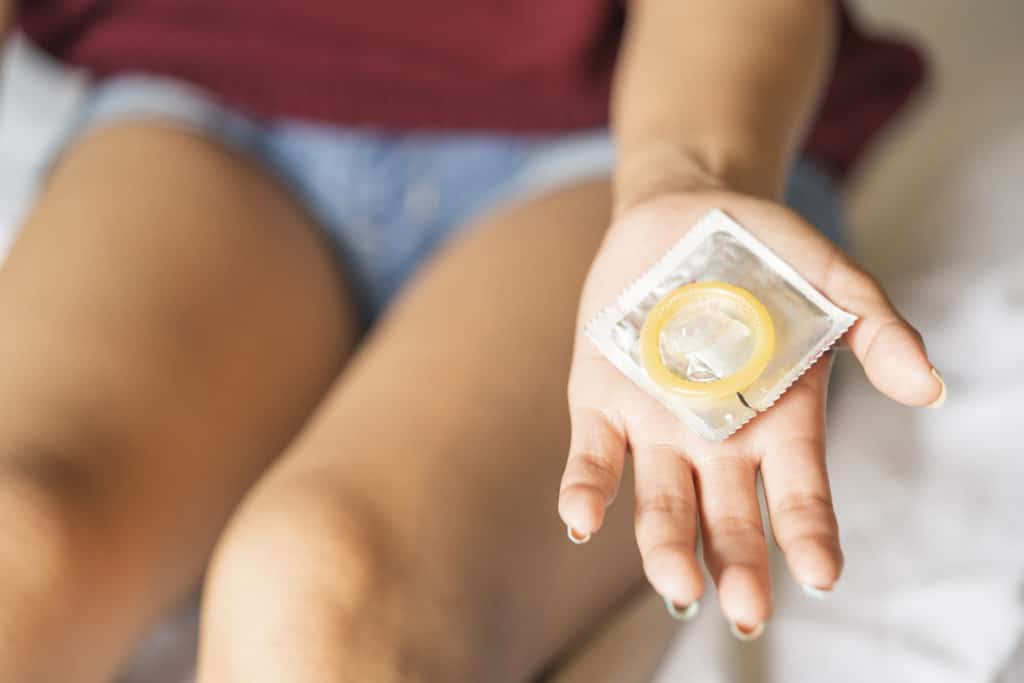
While condoms can dramatically reduce the risk of getting or transmitting STDs, they can’t guarantee 100% protection from sexually transmitted infections.
Here’s how it works:
First, a condom must be used correctly to provide protection. When it’s used incorrectly, slippage or breakage can occur.
STD transmission is a risk any time you engage in sexual activity—so to offer effective protection, a condom needs to be used every time you have sex (whether vaginal, oral, or anal).
In laboratory settings, the latex condom has been shown to provide a nearly “impermeable barrier” to particles that are the size of STD-causing pathogens. This means that it prevents the infectious agent from passing through the barrier, significantly reducing the risk of contracting or transmitting an STD.
RELATED: 3 Reasons To Try The Female Condom
To understand what condoms protect against, it’s first helpful to understand how STDs are spread. Infections like HIV, gonorrhea, chlamydia, and trichomoniasis are commonly spread when infected secretions of the urethra or vagina contact mucosal surfaces, which include the male urethra, the vagina, or the cervix.
Infections typically associated with genital ulcers are often passed on through contact of one’s skin with the mucosal surfaces or infected skin (such as sores) of a partner who has the infection.
Now that we know how STDs are transmitted, here are some that you need to be worried about even if you, or your partner, strap a condom on.
RELATED: The Most Common STD You’ve Never Heard Of
Genital herpes is a viral STD that typically results in sores or lesions on the genitals, anus, or upper thighs.
So even if the genitals are covered with a condom, there are more ways you can contract this disease.
A case of either HSV-1 or HSV-2 is called genital herpes when it affects the genitals or the genital area. Since lesions or sores can occur on parts of the genital region that is exposed during condom use, they can be spread from partner to partner.
RELATED: Is Syphilis Making a Comeback?
Yes, syphilis is still around. Syphilis is a highly contagious bacterial infection that spreads through sexual contact, including oral, vaginal, and anal sex.
Syphilis sores occur at the infection site and can be contracted by a partner via skin-to-skin contact regardless of condom use.
Pubic lice, also known as crabs, are Pthirus pubis that infects the genitals. These lice are most common among teens and are typically spread during sexual, skin-to-skin contact.
Pubic lice can live among public hair and can be spread whether or not a condom is used.
RELATED: Don’t Ignore This! Longterm Effects of Untreated STDs
Molluscum contagiosum causes small red or pink raised bumps to form on the body.
These firm bumps sometimes have a concave appearance and are painless.
When they occur on the genitals from skin-to-skin contact with an infected individual, it is considered an STI.
HPV is the most common STI; there are over 100 strains of the virus.
Some strains of HPV go unnoticed and seem to cause no symptoms at all, while others can cause genital warts or various cancers.
Because genital warts can be on parts of the genitals that are not covered by a condom, especially female condoms, HPV can be spread via skin-to-skin contact.
What’s worse– there is no male STD test for HPV and many cases show no symptoms, so it is often passed on unknowingly to partners.


By subscribing, you consent to receive emails from BlackDoctor.com. You may unsubscribe at any time. Privacy Policy & Terms of Service.