My journey to medical school, like many others, started with an idea. In its simplest form, that idea was to help people. As I was exposed to different subjects and career paths, that simple idea evolved into my dream to become a Cardiothoracic Surgeon, an opportunity to help the heartbeat of my community through the healthcare system.
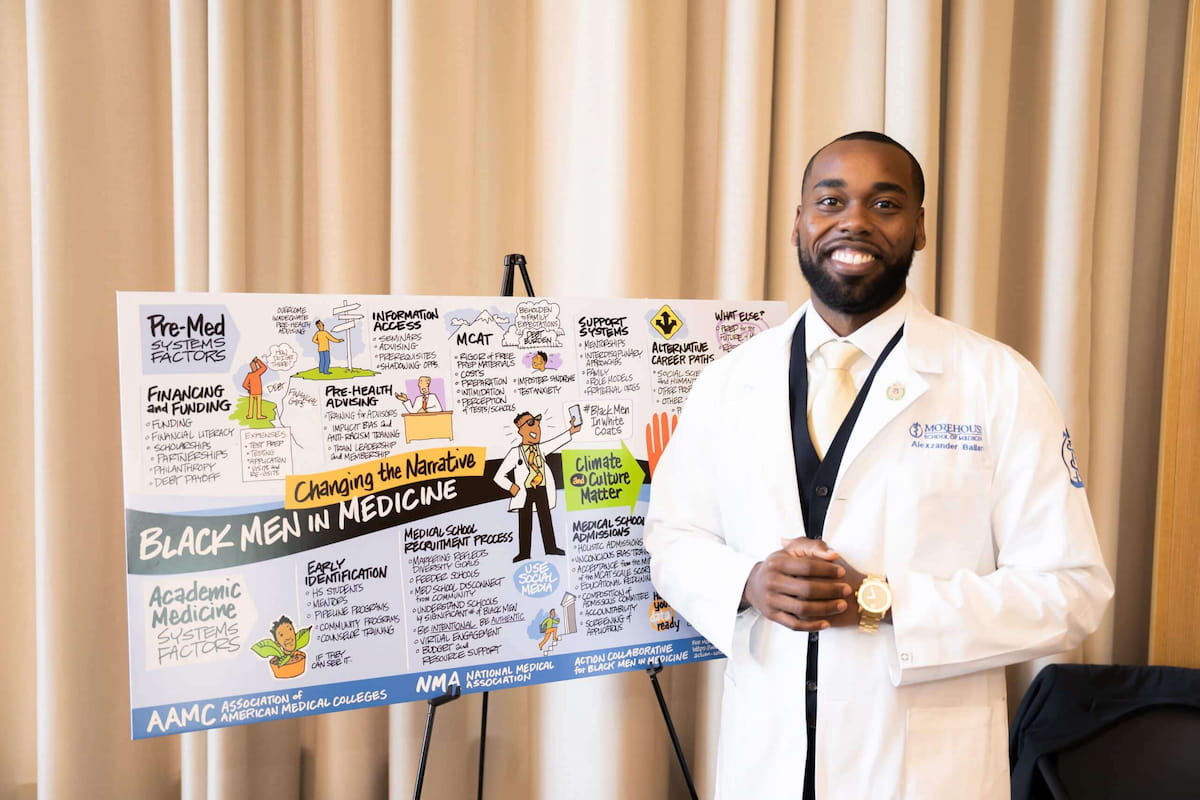
According to new data from AAMC, in 2025, there were just 552 men who identified as Black or African American alone who matriculated to medical school. A sobering number considering that in 1978 there were 542 Black men matriculating to medical schools. Not much has changed, but to achieve my dream, I’d have to create and implement a plan to turn it into reality.
Like many young people, I was told that to best prepare for medical school I should major in chemistry. After failing my first semester of chemistry at Hampton University, I had to reevaluate my plan because four years of this major likely would not give me the desired results to feel confident about applying to medical school. I researched the courses commonly required for admission and changed my major to Premed, Biology. I was able to meet the course requirements while also taking courses I was naturally interested in. I maintained a strong GPA while studying for the Medical School Admissions Test (MCAT) in my senior year of college. I enrolled in an in-person Kaplan prep course which was specifically tailored for students taking the MCAT within the next 6 months. While the course was very helpful and many of my classmates earned a competitive MCAT score following their participation in the prep course, I did not. I realized that without a competitive score as a senior, I would most likely need to take a gap year. Gap years are typically used to further develop skills, gain health or research related experiences, or take additional courses required for medical school admission prior to applying. Gap years provide a transitional period opposed to immediately transitioning from undergraduate education to medical school.
Redesigning my plan for applying to medical school included not one, but multiple gap years. During my first gap year, I maximized my time by completing an internship at the Association of American Medical Colleges (AAMC), earning a Master of Science in Clinical Research at Georgetown University, researching Pediatric Oncology at Inova Fairfax Hospital, and taking the MCAT again. I was determined to participate in as many relevant experiences as possible. Although I had increased determination and a tailored study strategy, my second MCAT attempt did not result in a more competitive score. Nonetheless, I submitted my application. No acceptance letters came. I’d invested a great deal, and it felt like I was staring down a dark tunnel, and there was no glimmer of light at the end. I was reminded of the quote by Dr. Martin Luther King Jr., “If you can’t fly then run, if you can’t run then walk, if you can’t walk then crawl, but whatever you do, you have to keep moving forward.” My dream would become a reality, and I couldn’t give up hope. I needed to recalibrate.
I learned more about the screening process medical schools use to distinguish competitive applicants. I also learned admissions committees strongly rely on a students’ personal statement to determine if the student possess the resilience to be successful in medical school amongst other defining characteristics called the Premedical Competencies for Entering Medical Students. This encouraged a deeper level of self-reflection, and to consider what would holistically make me a better medical school candidate, and best prepared to serve my community. Getting into medical school isn’t all about your grades and MCAT scores. As a result, I decided that I would take additional gap years. This go-around, I became a Medical Assistant to earn hands-on experience in patient care and build a network of professionals who practiced medicine as I aspired. In addition, with the strong support from my family, I’d volunteer, stay engaged with community, and continue to study for the MCAT.
I am now a second-year medical student at Morehouse School of Medicine. The second year of medical school is notorious for being the most difficult year. In a Cirque Du Soleil level balancing act; you must manage an enormous workload, rigorous courses, and any personal obstacles that may impact your ability to study. Throughout the struggle, I remind myself this is what I prayed for, and I continue to adapt to the obstacles, learn and persevere.
When I speak to high school and college students considering their pathways to medicine, I share my story, reminding them that no two stories are just alike, and that the most important thing is to keep trying and not give up hope. I’ve developed the mantra “Stay Humble & Stay Hungry”. This means be modest about your accomplishments while constantly pursuing your ambitions; no matter how many steps it may take to get there, you can turn your once simple ideas into dreams realized. Here are my six tips for young people and their families, mentors, and guidance counselors.
1. Trust your instinct and pursue a major that interests you.
2. Do not rush the process of preparing for and taking the MCAT. No one’s study plan is the same or yields the same results.
3. Tailor your premedical timeline to fit your unique journey.
4. Gap years are sometimes necessary. They provide opportunities to gain additional experience to increase your preparedness for applying.
5. Identify opportunities to learn from those in your desired career.
6. Sometimes stepping out of your comfort zone is necessary to achieve your goals and realize your dreams.
Written by Alexzander Ballard


By subscribing, you consent to receive emails from BlackDoctor.com. You may unsubscribe at any time. Privacy Policy & Terms of Service.